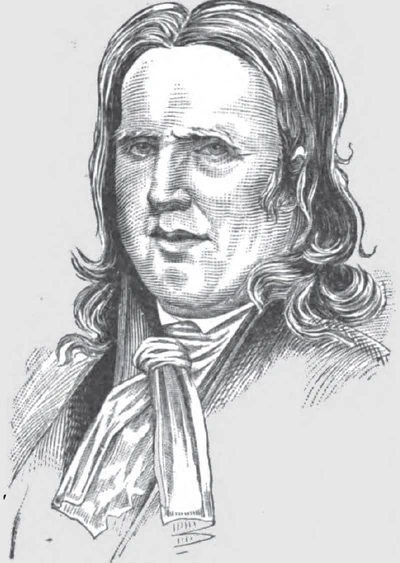
John Cleves Symmes
| Name | John Cleves Symmes |
| Title | American politician (1742-1814) |
| Gender | Male |
| Birthday | 1742-07-21 |
| nationality | United States of America |
| Source | https://www.wikidata.org/wiki/Q1699623 |
| pptrace | View Family Tree |
| LastUpdate | 2025-11-17T06:38:45.578Z |
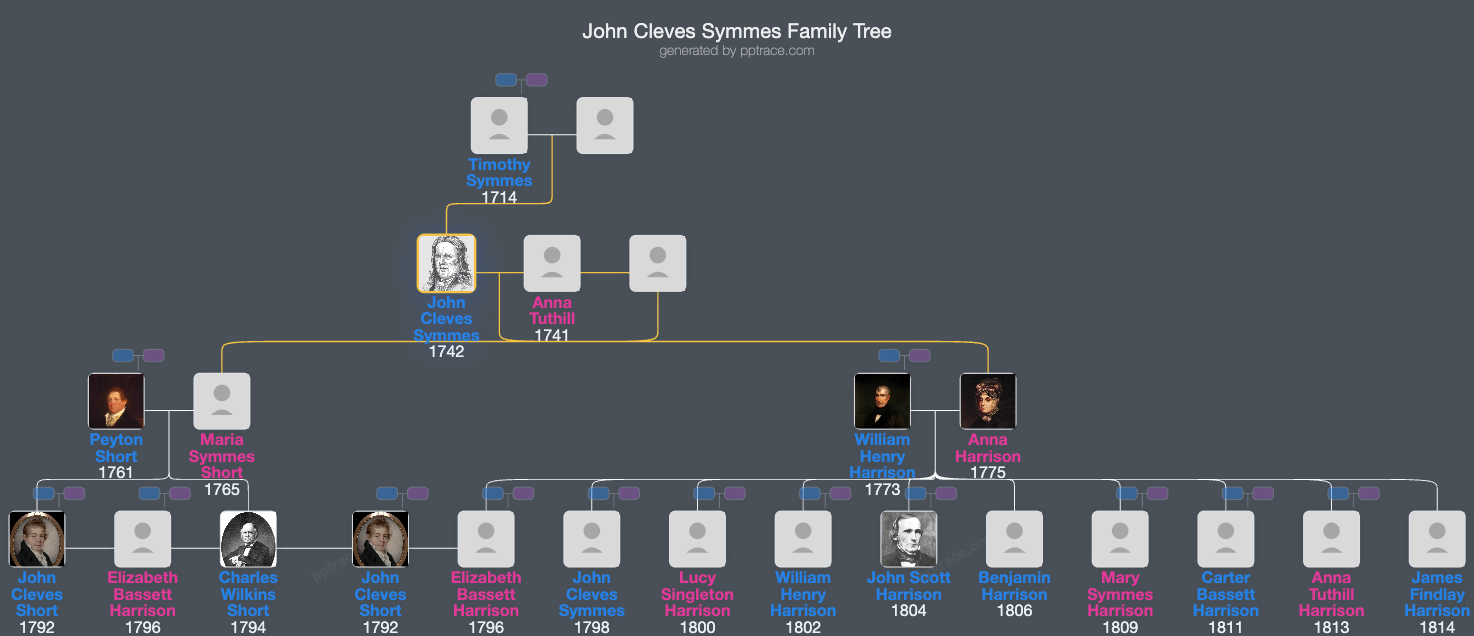
Family Tree
Tap  to expand more relatives
Introduction
John Cleves Symmes (July 21, 1742 – February 26, 1814) was an American political figure and land developer. He served as a delegate to the Continental Congress representing New Jersey and was a pioneer in the Northwest Territory. Symmes was born in Riverhead, Suffolk County, Long Island, in the Province of New York, to Reverend Timothy Symmes (1715–1756) and Mary Cleves (died circa 1746). He received education as a lawyer.
Symmes supported the American Revolution, becoming chairman of the Sussex County, New Jersey Committee of Safety in 1774. During the Revolutionary War, he held the rank of Colonel in the 3rd Regiment of Sussex County militia from 1777 to 1780; the regiment was called into service alongside the Continental Army on multiple occasions. In 1776, he was elected to the New Jersey Legislative Council (the predecessor of the New Jersey Senate), and he served again in 1780. Additionally, he served on the New Jersey Supreme Court in 1777 and 1778.
He maintained close ties with Governor William Livingston, often visiting him in Elizabethtown and Parsippany. Symmes represented New Jersey in the Continental Congress from 1785 to 1786. In 1788, he relocated to the Northwest Territory, settling in what would later beknown as North Bend, Ohio. From 1788 until Ohio achieved statehood in 1803, Symmes served as a judge of the Territorial Court. He was also involved extensively in land development and sales during this period.
In 1788, Symmes purchased 311,682 acres of land from the United States Congress. President George Washington signed the patent for this land on October 30, 1794, granting Symmes 248,250 acres plus an additional surveying township of 23,040 acres, held in trust for an educational institution. The land became known as the Symmes Purchase and sparked controversy over boundary disputes, land quality, and title validity. The purchase price was $225,000, paid with notes issued by Congress to fund the Revolutionary War, with parts likely originating from Symmes' own investments, as he had lent money to support the revolution. Other investors included General Dayton and Elias Boudinot. In later years, Symmes faced legal disputes related to the land, which contributed to his financial decline; he died impoverished.
Symmes married Anna Tuthill (1741–1776) on October 30, 1760, at Mattituck, New York. The couple had three children before relocating to Morristown around 1770, and another child was born at his father's estate, Solitude, outside Morristown. Their children included Maria Symmes (1765–1802), who married Kentucky State Senator Peyton Short; Mary Symmes (born August 30, 1767); and Anna Tuthill Symmes (1775–1864), who married William Henry Harrison, later the President of the United States. After Anna Tuthill Symmes’ death in 1776, Symmes married Susannah Livingston (1748–1840), daughter of Governor William Livingston and sister-in-law to John Jay.
John Cleves Symmes died on February 26, 1814, in Cincinnati, Ohio, and is buried at Congress Green Cemetery in North Bend, Ohio. His legacy includes the naming of the village of Cleves, Ohio, and Symmes Township in Hamilton County, Ohio. His nephew and namesake, John Cleves Symmes Jr., is known for his Hollow Earth Theory and fought in the War of 1812. Miami University named Symmes Hall in his honor in 1949; the hall is located on the university’s Oxford, Ohio campus and functions as a residence hall for first-year students.