William Augustine Washington
| Name | William Augustine Washington |
| Title | Virginia planter and politician |
| Gender | Male |
| Birthday | 1757-01-01 |
| nationality | United States of America |
| Source | https://www.wikidata.org/wiki/Q83424268 |
| pptrace | View Family Tree |
| LastUpdate | 2025-11-29T00:59:05.679Z |
Family Tree
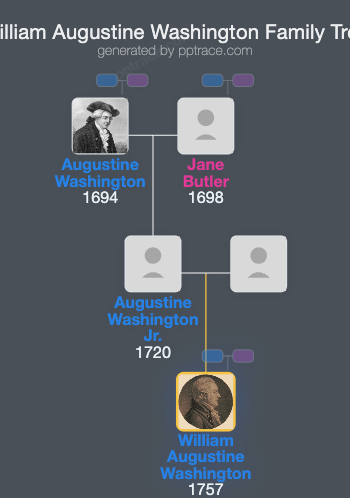
Tap  to expand more relatives
Introduction
William Augustine Washington was born on November 25, 1757, at Wakefield plantation in Westmoreland County, Virginia. He was a son of Anne Aylett and Augustine Washington Jr., making him a nephew of President George Washington. His familial relations include his mother’s siblings Elizabeth Washington Spotswood, Jane Washington Thornton, and Ann Washington Ashton. The Washington family previously resided at Wakefield before relocating to Ferry Farm in Stafford County, Virginia. William Augustine Washington is sometimes confused with his cousin, William Washington, a military figure noted for fighting at the Battle of Cowpens during the American Revolutionary War.
During the American Revolutionary War, William Augustine Washington served as a captain in the Westmoreland County militia, primarily tasked with defending the county from British forces in offshore engagements; however, he saw limited military action. A firearms accident in 1778 may have impacted his military service, and in 1787, he was promoted to the rank of colonel of the Westmoreland County militia. Additionally, he served as sheriff of Westmoreland County from 1784 to 1786.
Upon the death of his father in 1762, William Augustine Washington inherited Wakefield plantation, although his mother retained the right to reside there until her death in 1774. The Wakefield house burned down on December 25, 1779. Afterward, Washington moved approximately one mile inland to Blenheim, a residence on the inherited estate. In 1782, it is reported that he owned 69 slaves. By 1783, Washington constructed a new house and brick barn at the Haywood plantation, a 400-acre property overlooking the Potomac River, utilizing bricks recycled from the burned Wakefield house. Some bricks were also used to enlarge the Blenheim residence.
In 1788, Westmoreland County voters elected Washington to the Virginia House of Delegates, succeeding Bushrod Washington, who chose not to seek re-election. He served alongside Richard Lee and was succeeded by Henry Lee III. As a nephew of George Washington, William Augustine Washington was designated as one of the seven executors of the former president’s estate, the first listed in the will; the others included relatives and associates such as Bushrod Washington, Lawrence Lewis, Martha Washington, George Steptoe Washington, Samuel Washington, and George Washington Parke Custis.
In 1802, William Augustine Washington offered Wakefield for sale, describing it as comprising approximately 6,000 acres cultivated as four farms. Although it was not sold until after his death, in 1804 he moved to "Rock Hill" in the Dumbarton Heights neighborhood of Georgetown, District of Columbia.
Washington was married three times. His first wife was Jane Washington, his cousin, whom he married in 1777; their children included Hannah Bushrod Washington, Augustine Washington, Ann Aylett Washington Robinson, Bushrod Washington II, Corbin Aylett Washington, and George Corbin Washington. Following Jane's death in 1791, he married Mary Lee, daughter of Richard Henry Lee, with no surviving issue from this marriage. His third marriage took place on May 11, 1799, with Sarah Tayloe, daughter of John Tayloe II of Mount Airy. They had a daughter named Sarah Tayloe Washington, born in 1800; she married her fourth cousin Lawrence Washington in later years.
William Augustine Washington died at his Rock Hill residence on October 2, 1810. Francis Scott Key was present as a witness to his will. His remains were interred at Mount Vernon. His papers are archived at the Archives Center of the National Museum of American History. His eldest surviving son, George Corbin Washington, was a lawyer, politician, and planter who mainly resided in Maryland. The Wakefield property was sold in 1818 to John Gray, but the family burial ground and the area of the house were reserved; the property reverted to the Washington family in 1856 through marriage. The Blenheim residence, rebuilt after the fire, remains standing and is owned by Washington descendants. The Haywood house, rebuilt by William Washington, was restored in the 20th century and listed on the National Register of Historic Places in 1975.