Edmund Ruffin
| Name | Edmund Ruffin |
| Title | Virginia planter and slaveholder |
| Gender | Male |
| Birthday | 1794-01-05 |
| nationality | United States of America |
| Source | https://www.wikidata.org/wiki/Q3048129 |
| pptrace | View Family Tree |
| LastUpdate | 2025-11-17T06:39:08.778Z |
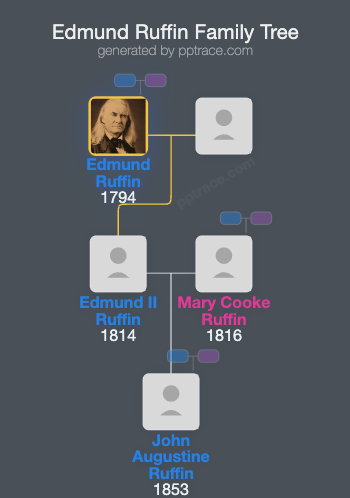
Family Tree
Tap  to expand more relatives
Introduction
Edmund Ruffin III was born on January 5, 1794, at Evergreen Plantation in Prince George County, Virginia. He was a member of Virginia’s planter class aristocracy and was a descendant of William Randolph. His father was George Ruffin (1765–1810), and his grandfather was Edmund Ruffin (1744–1807), who served in the Virginia House of Delegates during the American Revolutionary War. Ruffin received a private education suitable for his social class and attended the College of William and Mary in Williamsburg, Virginia.
During the War of 1812, Ruffin enlisted as a private in the Virginia Militia and served as secretary of the 4th Virginia Infantry, although he did not see combat. Later, he enlisted in the Palmetto Guards of South Carolina.
Ruffin was a plantation owner, farming with enslaved labor. By 1820, he owned 52 enslaved people in Prince George County. His holdings grew over the years, with 86 enslaved people recorded there in 1830, and 96 in 1840. The 1850 census recorded him owning 84 enslaved individuals in Prince George County and 41 in Hanover County, Virginia. In 1860, 31 enslaved persons owned by Ruffin were leased to an individual in Charles City County. His sons, Edmund Ruffin Jr. and J.C. Ruffin, owned additional enslaved persons in Prince George and Hanover counties.
In the 1820s and 1830s, Ruffin became interested in soil science. He experimented with marl to rejuvenate exhausted soils, notably on plantations where tobacco cultivation had depleted nutrients. He began studying bogs and swamp soils, publishing essays that contributed to early soil science, including his 1832 book, which detailed methods to improve soil fertility. His work emphasized crop rotation and soil amendments to restore land productivity. His research into soil acidity and improvements through calcareous materials earned him the title of "the father of soil science" in the United States.
Ruffin was also involved in intellectual circles that addressed Southern society, editing William Byrd’s Westover Manuscripts and associating with figures such as Nathaniel Beverley Tucker, George Frederick Holmes, James Henry Hammond, and William Gilmore Simms. Many of these contemporaries debated the morality and economics of slavery, often citing religious and stewardship reasons. Ruffin himself was a strong supporter of slavery and Southern secession.
In the 1840s, Ruffin was the editor of the Farmers Register and published influential works on soil amendment, including the 1852 book "An Essay on Calcareous Manures," which explained the benefits of marl in improving soil quality. He also conducted research into the origins of Virginia’s bogs and swamps.
Ruffin’s pro-slavery activism intensified in the 1850s as sectional tensions increased. He was associated with the so-called "Fire-Eaters," advocating for secession and armed resistance if necessary. In 1859, he traveled to Charles Town, Virginia, to witness the execution of abolitionist John Brown, joining the Virginia Military Institute cadets in witnessing the event and collecting local weapons, including pikes.
In 1860, Ruffin published "Anticipations of the Future," a series of letters from a fictional English observer predicting the civil war following Abraham Lincoln’s election. He forecasted a Southern victory but was mostly inaccurate in his predictions. He did correctly foresee that the conflict would begin with a Southern attack on Fort Sumter.
Following Lincoln’s election in 1860, Ruffin moved to South Carolina, which had declared secession. There, he played a role in the events at Fort Sumter, firing one of the first shots on April 12, 1861, which is widely regarded as initiating the Civil War. He was also the first to enter the fort after it fell to Confederate forces. During the conflict, Ruffin’s grandson, Julian Beckwith, was among the first Petersburg Confederate soldiers to die at the Battle of Seven Pines.
Ruffin enlisted as a Confederate soldier despite his advanced age, and his involvement in the opening military action at Fort Sumter remains a notable part of his legacy. He died by suicide on June 17, 1865, after the Confederate defeat, citing the imposition of what he called "Yankee rule."