Edward Hungerford
| Name | Edward Hungerford |
| Title | English politician (1632 – 1711) |
| Gender | Male |
| Birthday | 1632-10-20 |
| nationality | Kingdom of England |
| Source | https://www.wikidata.org/wiki/Q3184114 |
| pptrace | View Family Tree |
| LastUpdate | 2025-11-26T23:21:00.058Z |
Family Tree
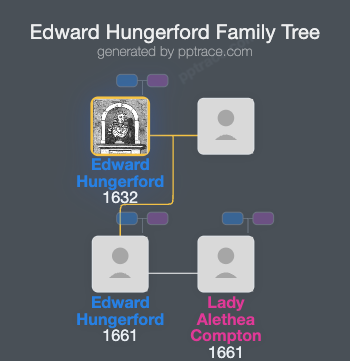
Tap  to expand more relatives
Introduction
Sir Edward Hungerford, KB (20 October 1632 – 1711), was an English politician who served in the House of Commons at various intervals between 1659 and 1702. He was born to Anthony Hungerford (1607/8–1657) and Rachel Jones, daughter of Rice Jones of Asthall, Oxfordshire. Hungerford was baptized in Black Bourton, Oxfordshire. His father supported the royalist cause during the English Civil War.
He attended Queen's College, Oxford, in 1649. Upon his father's death in 1657, Hungerford inherited the family estates.
In 1658, Hungerford was elected Member of Parliament for Chippenham in the Third Protectorate Parliament. He was re-elected as MP for Chippenham in 1660 for the Convention Parliament. In 1661, he was appointed a Knight of the Bath during King Charles II's coronation on 23 April. That same year, he was elected for Chippenham in the Cavalier Parliament; however, his election was declared void, but he was re-elected in subsequent by-elections later that year, and he was also returned in the elections of 1679.
In January 1680, Hungerford presented a petition for the summoning of a parliament, and his opposition to the court party of King Charles II led to his removal as Lord Lieutenant of Wiltshire in May 1681. That year, he moved to Spring Gardens, Whitehall. He was elected MP for Chippenham in the Oxford Parliament of 1681.
Hungerford was implicated in the Rye House Plot of 1683, prompting a search of his residence at Farleigh Castle for arms. He later served as MP for New Shoreham in 1685, 1688, and 1690, and for Steyning in 1695, 1698, 1700, and 1702.
He was involved in archery, serving as lieutenant-colonel of the Regiment of Archers in 1661 and as colonel in 1682. Nevertheless, he was primarily known for his financial recklessness. It is recorded that he sold approximately thirty manors, including the family seat at Farleigh Hungerford, to fund his expenditures.
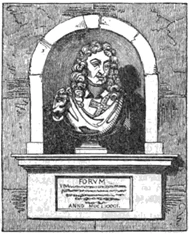
In 1679, Hungerford obtained permission to establish a market on the site of his demolished family house, Hungerford House, located where Charing Cross railway station now stands. A market-house, believed to be designed by Sir Christopher Wren, was erected there in 1682, with a bust of Hungerford placed on the building, which bore an inscription crediting him with the construction. In 1685, Sir Stephen Fox and Wren purchased the market and received the tolls. The market-house was rebuilt in 1833 and removed in 1860 during the construction of Charing Cross railway station.
In 1686, Hungerford sold Farleigh Castle and the associated manor to Henry Baynton of Spye Park for £56,000. The manor remained in the possession of Baynton’s descendants until 1891, when Lord Donington acquired it.
Hungerford was married three times. His first wife was Jane Hele, daughter of Sir John Hele of Dorset; they married before 1658 and had one son, Edward (died September 1689), and two daughters, Frances and Rachel. Rachel married Clotworthy Skeffington, third Viscount Massereene, in 1684. Jane Hele died in 1664.
His second marriage, to Jane Culme (1637–1674), occurred in 1666; his third marriage, in 1679, was to Jane Gerard, née Digby (died 1703). Both subsequent marriages were childless.
In his later years, Hungerford was reported to have become a Poor Knight of Windsor. He died in 1711 and was interred at St. Martin's-in-the-Fields. His death marked the end of the extensive Hungerford family ownership of Farleigh Manor.