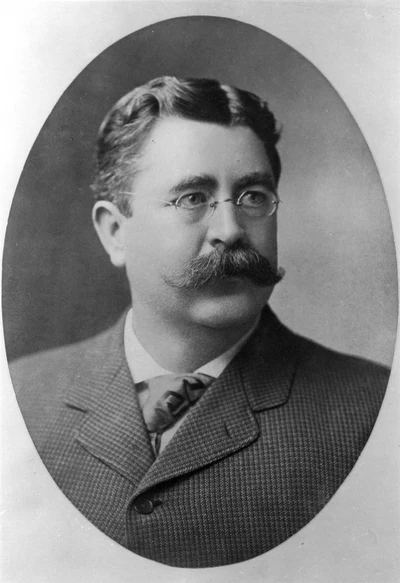
Patrick Joseph Kennedy
| Name | Patrick Joseph Kennedy |
| Title | American businessman and Massachusetts politician (1858–1929) |
| Gender | Male |
| Birthday | 1858-01-14 |
| nationality | United States of America |
| Source | https://www.wikidata.org/wiki/Q955405 |
| pptrace | View Family Tree |
| LastUpdate | 2025-11-17T06:44:52.862Z |
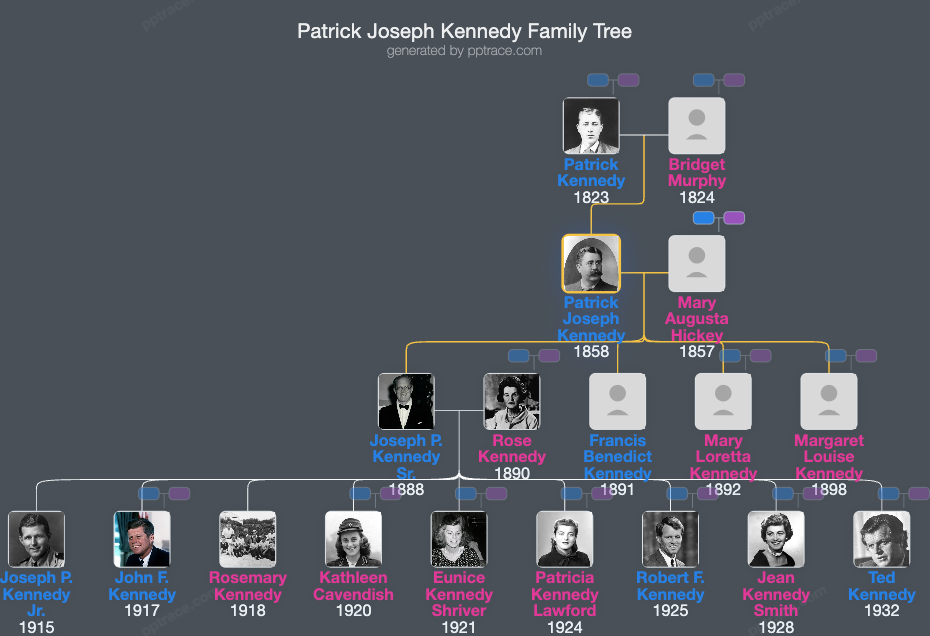
Family Tree
Tap  to expand more relatives
Introduction
Patrick Joseph Kennedy was born on January 14, 1858, in Boston, Massachusetts, to Patrick Kennedy and Bridget Murphy. His parents were Irish Catholic immigrants from New Ross, County Wexford, who emigrated to the United States fleeing the Great Famine in Ireland. Kennedy was the youngest of five children; his elder brother John died of cholera in infancy, and his father and another brother died of the same disease when Kennedy was ten months old, leaving him the sole surviving male in his family.
Following the deaths of his parents, Kennedy received his early education at Sacred Heart, a private Catholic school in Boston, making him the first in his family to attend school. His mother, Bridget, owned a stationery and notions store that expanded into a grocery and liquor business, which provided financial stability for the family. At age fourteen, Kennedy left school to work as a stevedore on Boston docks to support his mother and three sisters, Mary, Joanna, and Margaret.
In the 1880s, Kennedy began his entrepreneurial career by purchasing a saloon near Haymarket Square in Boston, supplementing his income with savings and help from his mother. He subsequently acquired a second saloon near the East Boston docks and a third in an upscale East Boston hotel, the Maverick House, targeting social drinkers among Boston's upper classes. His business ventures eventually expanded into a whiskey-importing house, which contributed significantly to his wealth.
Kennedy married Mary Augusta Hickey on November 23, 1887. The couple had four children and remained married until her death on May 20, 1923. Their residence was located on Jeffries Point in East Boston.
Kennedy entered politics in 1884, aligning with the Democratic Party during a period when Republicans dominated the Massachusetts General Court. He served five one-year terms in the Massachusetts House of Representatives, followed by three two-year terms in the Massachusetts Senate. He became an influential figure in Boston's Democratic circles and played a behind-the-scenes role as a party boss, notably serving on the Democratic party’s unofficial Board of Strategy and on local elections and fire commissions. Kennedy also delivered a seconding speech for Grover Cleveland at the 1888 Democratic National Convention in St. Louis.
He was known for assisting fellow Irishmen financially and offering political guidance. By the time of his death, Kennedy had investments in a coal company and held significant stock in the Columbia Trust Company bank.
Kennedy developed degenerative liver disease in his later years, leading to his hospitalization at Deaconess Hospital in April 1929. He died there on May 18, 1929, at the age of 71. His funeral was held at St. John the Evangelist Church in Winthrop, Massachusetts, with hundreds lining the streets of East Boston to observe the procession and local businesses closing in his honor. Kennedy was interred at Holy Cross Cemetery in Malden, Massachusetts.
His legacy includes his son Joseph P. Kennedy Sr., who married Rose Fitzgerald, daughter of Boston Mayor John F. Fitzgerald, and served as U.S. Securities and Exchange Commission Chair and U.S. Ambassador to the United Kingdom. Their children included notable figures such as President John F. Kennedy, U.S. Attorney General and Senator Robert F. Kennedy, and Senator Ted Kennedy.