Fielding Lewis
| Name | Fielding Lewis |
| Title | Brother in law of George Washington |
| Gender | Male |
| Birthday | 1725-07-07 |
| nationality | — |
| Source | https://www.wikidata.org/wiki/Q5447176 |
| pptrace | View Family Tree |
| LastUpdate | 2025-11-17T06:36:30.999Z |
Family Tree
Tap  to expand more relatives
Introduction
Fielding Lewis was born on July 7, 1725, at Warner Hall, a plantation located in Gloucester County, Virginia. He was the third of seven children born to John Lewis IV, a merchant and planter, and Frances Fielding, who was the sole heir of Henry Fielding of King and Queen County. His mother died in childbirth when Lewis was six years old, and his father subsequently remarried Priscilla Churchill Carter, the widow of Robert Carter II.
Lewis's paternal lineage included his uncle Robert Lewis, who may have served as a burgess for Louisa County in the early 1740s, and his family was connected to Meriwether Lewis, the explorer of the Louisiana Purchase, through his grandfather Robert Lewis.
Initially assisting his merchant father in his trade operations, Lewis took over the business in the 1750s. His father’s trade activities included grain trading with the West Indies, and Lewis expanded the family enterprise into real estate investments. He was president of the Dismal Swamp Land Company and invested in bank stocks. In 1749, his father constructed a retail building in Fredericksburg, notable for its sandstone quoins, which displayed the family's merchant aspirations. Lewis had established himself as a successful merchant prior to the American Revolutionary War.
Lewis owned a plantation in Spotsylvania County south of Fredericksburg, which he operated using enslaved labor. On this property, he and his second wife, Betty Washington, began constructing a Georgian mansion in 1769, completed in 1775. This mansion, later known as Kenmore Plantation, features well-preserved colonial interior finishes and has been designated a National Historic Landmark and placed on the National Register of Historic Places.
In terms of political involvement, Lewis was elected to the Virginia House of Burgesses representing Spotsylvania County in 1760, succeeding William Waller. He served alongside Zachariah Lewis, William Grymes, William Johnson, and Benjamin Grymes. Prior to this, he had sought a position on the Governor's Council, but the appointment was awarded to his stepbrother, Robert Carter of Nomini Hall.
During the period leading up to the American Revolution, Lewis commanded the local militia and was appointed as Commissary General of Munitions, with the rank of colonel, reflecting his role during the conflict.
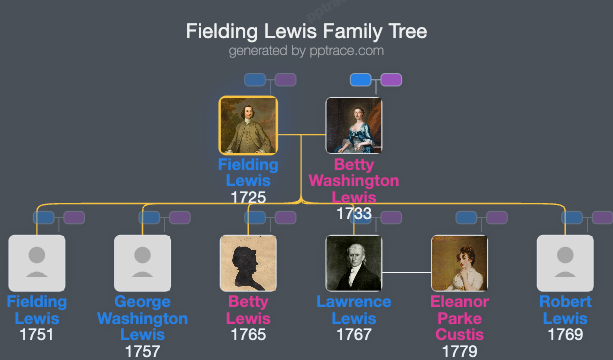
In his personal life, Lewis married his second cousin, Catharine Washington, on October 18, 1746. She was the daughter of John Washington, an uncle of George Washington, and Catharine Whiting. The couple had three children prior to Catharine's death on February 19, 1750: John Lewis (1747–1825), Francis Lewis (died in childhood), and Warner Lewis (died in infancy).
Subsequently, on May 7, 1750, Lewis married Elizabeth Washington, who was sixteen years old at the time, and the sister of George Washington. They had eleven children, including Fielding Lewis Jr., George Washington Lewis, Lawrence Lewis, and others. Several of his descendants married into notable families, including the Bonaparte-Murat family of France.
Lewis died in Fredericksburg on December 7, 1781, shortly after the conclusion of the American Revolutionary War. His widow, Elizabeth Washington Lewis, outlived him until 1797. His mother, Mary Ball Washington, was buried at Kenmore after her death in 1789, with her grave site marked by a memorial established in the late 19th century.
The Kenmore Plantation remains as a historic house museum, and Lewis's legacy includes street names in Fredericksburg and the surrounding area, as well as the establishment of the Colonel Fielding Lewis Chapter of the Sons of the American Revolution in 1999.