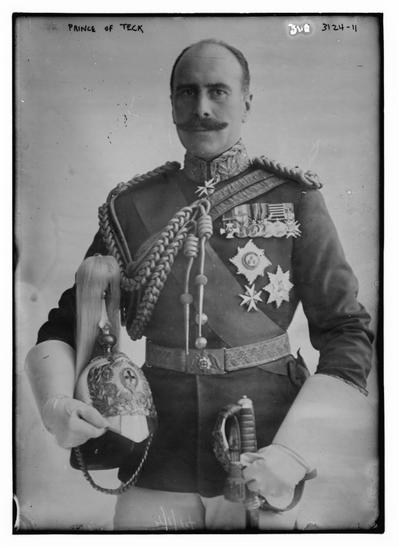
Alexander Cambridge, 1st Earl Of Athlone
| Name | Alexander Cambridge, 1st Earl Of Athlone |
| Title | British Army general (1874-1957) |
| Gender | Male |
| Birthday | 1874-04-14 |
| nationality | United Kingdom |
| Source | https://www.wikidata.org/wiki/Q335091 |
| pptrace | View Family Tree |
| LastUpdate | 2025-11-12T01:18:56.044Z |
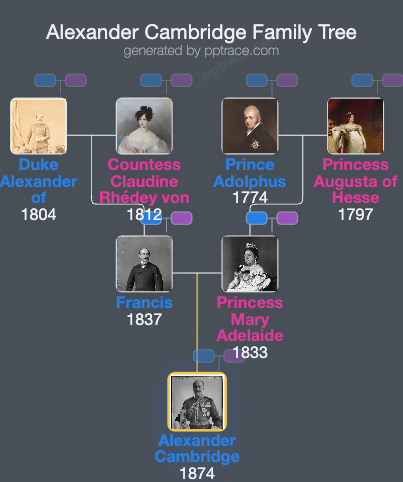
Family Tree
Tap  to expand more relatives
Introduction
Alexander Cambridge, 1st Earl of Athlone (born Alexander Augustus Frederick William Alfred George; 14 April 1874 – 16 January 1957), was a member of the British royal family and served in various official capacities, including as Governor-General of South Africa and Canada.
Early Life and Education
Born in Kensington, London, he was the youngest son of Prince Francis of Teck and Princess Mary Adelaide of Cambridge. Following his parents' departure from the United Kingdom amid financial difficulties, he remained at Eton College and later attended the Royal Military College, Sandhurst.
Military Career
Commissioned as a second lieutenant in the 7th Queen's Own Hussars in October 1894, he participated in the Second Matabele War and was mentioned in despatches. He was promoted through the ranks, achieving the rank of captain in April 1900, and received several military honours, including the Distinguished Service Order in 1901 for his service in the Second Boer War.
Marriage and Family
In 1904, he married Princess Alice of Albany, a granddaughter of Queen Victoria, at St. George's Chapel, Windsor Castle. The marriage produced three children: Princess May, Prince Rupert, and Prince Maurice, the latter of whom died in infancy.
Titles and Name Changes
Originally styled as His Serene Highness Prince Alexander of Teck, he gave up his German titles in 1917 amid widespread anti-German sentiment during World War I, adopting the surname Cambridge after his maternal grandfather, Prince Adolphus, Duke of Cambridge. That year, he was created Earl of Athlone.
World War I and Honors
During World War I, he served actively with his regiment in France and Flanders, attaining the rank of lieutenant colonel and temporarily holding the rank of brigadier-general. In recognition of his military service, he was appointed a Companion of the Order of St. Michael and St. George in 1917.
Post-War and Civil Roles
Retiring from active military duty in 1919, Athlone engaged in medical and educational administration, notably chairing the Athlone Committee, which contributed to postgraduate medical education in London.
Governor-General of South Africa
In 1923, he was appointed Governor-General of the Union of South Africa, a position he held from 1924 to 1930. His tenure involved navigating increasing Afrikaner nationalism and proposing a compromise on the national flag. For his service, he was appointed a Knight of the Garter in 1928 and was made Governor and Constable of Windsor Castle in 1931.
Governor-General of Canada
In 1940, he was appointed Governor-General of Canada, succeeding Lord Tweedsmuir. His term lasted until 1946, during which he was actively engaged in supporting the war effort and hosting significant wartime conferences, including the Quebec Conferences with Winston Churchill, Franklin D. Roosevelt, and William Lyon Mackenzie King. During his tenure, he hosted numerous royal and foreign dignitaries and supported war and social efforts across Canada.
Later Life
After returning to the United Kingdom in 1946, Athlone resided at Kensington Palace and participated in events related to the coronation of Queen Elizabeth II in 1953. He continued his association with the University of London as Chancellor until 1955.
Death and Burial
He died at Kensington Palace in 1957 at the age of 82 and was initially interred in the Royal Vault at St George's Chapel, Windsor Castle, before being transferred to Frogmore Royal Cemetery.
Honours and Recognitions
Athlone received numerous honours, including the Order of the Garter, Order of the Bath, and various foreign decorations. His legacy includes places and institutions named after him in South Africa, Canada, and elsewhere.
Ancestry
He was a great-grandson of King George III and related to various European royal families through his maternal lineage.