Peter Lawford
| Name | Peter Lawford |
| Title | British actor (1923–1984) |
| Gender | Male |
| Birthday | 1923-09-07 |
| nationality | United Kingdom |
| Source | https://www.wikidata.org/wiki/Q345517 |
| pptrace | View Family Tree |
| LastUpdate | 2025-11-17T06:44:59.103Z |
Family Tree
Tap  to expand more relatives
Introduction
Peter Sydney Ernest Lawford (born Aylen; September 7, 1923 – December 24, 1984) was an actor of British-American nationality. He was born in London, England, and was the only child of Lieutenant General Sir Sydney Turing Barlow Lawford, KBE (1865–1953), and May Sommerville Bunny (1883–1972). His parents' marriage was complex; at the time of his birth, his mother was married to Lieutenant Colonel Dr. Ernest Vaughn Aylen, DSO, a fellow officer of Sir Sydney Lawford, but they were living separately, and May confided that the child was not Aylen's. May and Sydney Lawford married in September 1924, after their divorces were finalized, when Peter was approximately one year old.
Lawford's family had connections to British aristocracy; his uncle Ernest Lawford's wife was a daughter of the Scottish 14th Earl of Eglinton. His aunt Ethel Turner Lawford married a son of the 1st Baron Avebury, and another aunt, Jessie Bruce Lawford, was married to the Hon Hartley Williams, a senior puisne judge in the Supreme Court of the colony of Victoria, Australia. A relative through his mother was Australian artist Rupert Bunny.
During his early childhood, Lawford spent time in France due to his family's travels and was educated informally by governesses and tutors, receiving lessons in tennis, ballet, languages, and the arts. His education included reading English fairy stories, English and French classics, and, later, dramatics, while Latin, algebra, and higher mathematics were replaced with arts subjects. His diverse tutors exposed him to various religious and cultural services, including Christian, Jewish, and Christian Science meetings.
At around age seven, in approximately 1930, Lawford made his film debut in the British movie "Poor Old Bill," and he had an uncredited role in "A Gentleman of Paris" (1931). A significant injury occurred when Lawford was 14 years old; he severely damaged his right arm after it went through a glass door, resulting in irreversible nerve damage to his forearm and hand, which he learned to conceal. The injury prevented him from pursuing a military career, which his parents had envisioned, influencing his subsequent choice of acting as a profession. This injury also led to a change in his family's plans regarding his inheritance, as one aunt declined to leave him her fortune, believing he would pursue a different path.
In 1938, Lawford was traveling in Hollywood when he was discovered by a talent scout. He made his Hollywood debut in a minor part in the film "Lord Jeff," starring Freddie Bartholomew. During World War II, his family was residing in Florida, and their assets in Britain were frozen. Lawford, working odd jobs such as parking cars and as a theatre usher, saved enough money to return to Hollywood to pursue acting.
His early film work during the war included uncredited roles in movies such as "Mrs. Miniver" (1942) and "Eagle Squadron" (1942), both portraying pilots. His first featured role was in "A Yank at Eton" (1942), in which he played a snobbish bully. Throughout 1942 and 1943, Lawford appeared in various war-related films in minor parts, often portraying military personnel or civilians. His contractual relationship with Metro-Goldwyn-Mayer (MGM) began in June 1943, which led to roles in films such as "The White Cliffs of Dover" (1944) and "The Picture of Dorian Gray" (1945).
Lawford's first leading role was in "Son of Lassie" (1945), which was commercially successful. He appeared in musicals including "Two Sisters from Boston" (1946) and "Cluny Brown" (1946). He gained popularity after being named the most popular actor in Hollywood by Modern Screen magazine readers in 1946. He starred in films like "My Brother Talks to Horses" (1947), "It Happened in Brooklyn" (1947), and "Easter Parade" (1948).
His acting career included notable performances in "Little Women" (1949), "Please Believe Me" (1950), and "Royal Wedding" (1951). He was also involved in international productions such as "Kangaroo" (1952). Lawford transitioned from film to television, guest-starring on various shows.
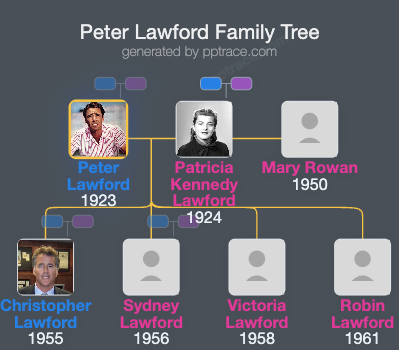
In 1954, Lawford married Patricia Kennedy, sister of U.S. Senator John F. Kennedy. Through this marriage, he became part of the Kennedy family's social circle and a supporter of Kennedy's political career. He remained active in entertainment and public life until his death in 1984.