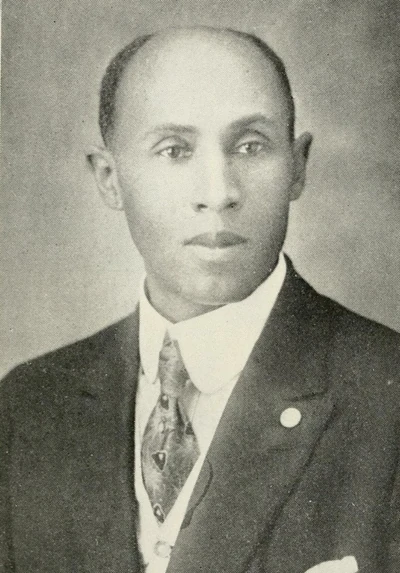
Frederick Madison Roberts
| Name | Frederick Madison Roberts |
| Title | African-American politician, great grandson of Thomas Jefferson (1879-1952) |
| Gender | Male |
| Birthday | 1879-09-14 |
| nationality | United States of America |
| Source | https://www.wikidata.org/wiki/Q5498340 |
| pptrace | View Family Tree |
| LastUpdate | 2025-11-29T01:00:06.347Z |
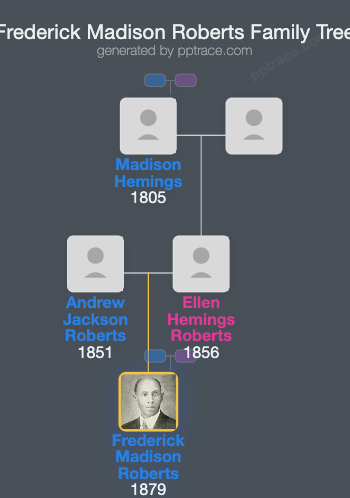
Family Tree
Tap  to expand more relatives
Introduction
Frederick Madison Roberts was born on September 14, 1879, in Chillicothe, Ohio. His parents were Ellen Wayles Hemings and Andrew Jackson Roberts. Ellen Wayles Hemings was the daughter of Madison Hemings, who was the son of Thomas Jefferson and Sally Hemings. Andrew Jackson Roberts was a graduate of Oberlin College and originated from Chillicothe. In 1865, the family relocated to Los Angeles, where Andrew established A.J. Roberts and Son, the first Black-owned mortuary in the city. Frederick had one sibling, William Giles Roberts.
Roberts attended Los Angeles High School and was the first individual of African-American descent to graduate from this institution. He pursued higher education at the University of Southern California (USC), majoring in pre-law, and later graduated from Colorado College. During his time in Colorado, he served as deputy assessor for El Paso County. Roberts also completed training at the Barnes-Worsham School of Embalming and Mortuary Science.
In 1908, Roberts began editing the Colorado Springs Light newspaper. While in Colorado, he served as deputy assessor for El Paso County. He subsequently moved to Mound Bayou, Mississippi, where he served as principal of the Mound Bayou Normal and Industrial Institute, an educational institution for African Americans during segregation. In 1912, Roberts returned to Los Angeles and founded The New Age Dispatch, a newspaper later called New Age, which he edited until 1948. He partnered with his father in the mortuary business, named A.J. Roberts & Son, and eventually took over ownership of the enterprise.
Roberts was active within the African American community in Los Angeles and participated in civic and religious organizations, including the Methodist Church, the National Association for the Advancement of Colored People (NAACP), and the Urban League. He was part of the broader Great Migration movement, which saw significant numbers of African Americans relocating from the South to Northern, Midwestern, and Western states in the 20th century.
Politically, Roberts was elected to the California State Assembly representing the 62nd District in 1918 as a Republican. He was re-elected multiple times, serving a total of 16 years, and earned the nickname "dean of the assembly." During his tenure, he sponsored legislation to establish the University of California at Los Angeles, improve public education, and promote civil rights measures, including anti-lynching laws. In June 1922, he hosted African American nationalist Marcus Garvey during Garvey’s visit to Los Angeles.
Roberts was a contemporary and friend of Earl Warren, the governor of California who later became Chief Justice of the United States. In the 1934 mid-term elections, Roberts was defeated by Democrat Augustus F. Hawkins in the California State Assembly. He subsequently ran unsuccessfully for the U.S. House of Representatives on two occasions. Notably, in 1946, he campaigned against Helen Gahagan Douglas for the 14th Congressional District but was unsuccessful. Douglas later lost a Senate race to Richard M. Nixon.
In his personal life, Roberts married Pearl Hinds Roberts in 1921. Pearl, educated at the Boston Conservatory of Music and Oberlin Conservatory of Music, was a pipe organist and the founder of a choral group. They had two daughters: Gloria Roberts, a concert pianist, and Patricia Roberts, a businesswoman.
On July 18, 1952, Roberts was involved in a car accident in front of his Los Angeles home, resulting in serious injuries. He died the following day, July 19, 1952. He was interred at Evergreen Cemetery. In 1957, Los Angeles dedicated Frederick M. Roberts Park in his memory. His biography has been recognized in subsequent years, including honors during Black History Month in California.