Princess Margarita Of Greece And Denmark
| Name | Princess Margarita Of Greece And Denmark |
| Title | Greco-Danish Royal and German Noble |
| Gender | Female |
| Birthday | 1905-04-18 |
| nationality | Greece |
| Source | https://www.wikidata.org/wiki/Q240317 |
| pptrace | View Family Tree |
| LastUpdate | 2025-11-12T01:19:22.070Z |
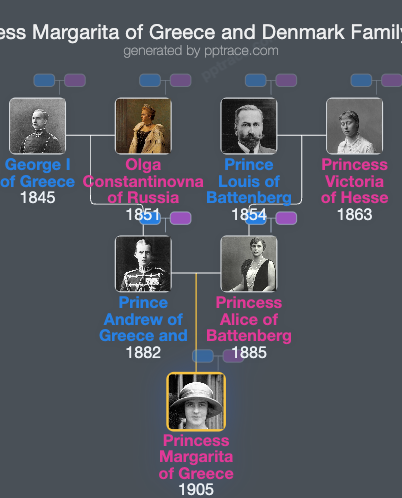
Family Tree
Tap  to expand more relatives
Introduction
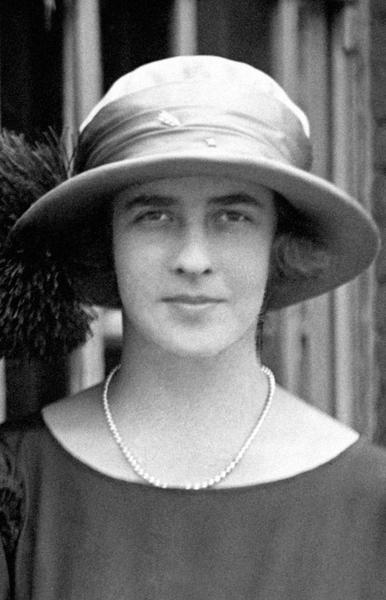
Princess Margarita of Greece and Denmark (Greek: Μαργαρίτα; 18 April 1905 – 24 April 1981) was born at the Royal Palace in Athens. She was the eldest daughter of Prince Andrew of Greece and Denmark and Princess Alice of Battenberg. Her birth was attended by her father, in accordance with her grandmother Queen Olga’s belief that men should witness the birth to understand the suffering they cause their wives. She was baptized on 11 May 1905, with her maternal grandparents in attendance.
Margarita grew up between Athens and Corfu, along with her younger sisters Theodora, Cecilie, and Sophie. Her upbringing was multilingual; she and her sisters communicated in English and Greek, while also using French and German in family settings. Her early childhood coincided with political instability in Greece, including the Goudi coup of 1909, which led her family to seek refuge abroad multiple times, including stays in the United Kingdom, Germany, Malta, Russia, France, and Switzerland.
During her youth, Margarita experienced the Balkan Wars of 1912–1913, with her family remaining in Athens during the conflict, and the aftermath of the assassination of King George I in 1913. Her family’s residence, Mon Repos, was bequeathed to her father by King George I. After the conflicts, the family returned to Greece briefly, then went into exile following the 1917 deposition of King Constantine I.
Margarita's education and childhood amid European aristocratic culture included stays with relatives such as Queen Alexandra and her maternal grandparents, the Mountbattens. She experienced the death of her paternal grandfather King George I in 1913 and her maternal grandmother, Grand Duchess Victoria Feodorovna, in 1920. Her father was involved in the Greco-Turkish War of 1919–1922, during which her family faced political upheaval and exile.
In 1920, the death of King Alexander of Greece led to a political crisis, and Margarita's family returned from exile, reuniting with her father briefly before he participated in the Asia Minor campaign. The subsequent military defeat in 1922 resulted in her family fleeing Greece aboard HMS Calypso. During her teenage years in exile, the family lived in Saint-Cloud, France, and depended on aid from relatives, including Princess Marie Bonaparte.
In 1931, Margarita married Prince Gottfried of Hohenlohe-Langenburg, with whom she established a family at Weikersheim Castle. They had four sons: Kraft, Georg Andreas, Rupprecht, and Albrecht, and a daughter, Princess Beatrix. The marriage was religiously dual (Lutheran and Orthodox) and took place amid family gatherings that included relatives from various European noble houses.
Throughout the 1930s, Margarita and Gottfried maintained connections with Germany, becoming members of the Nazi Party in 1937 and promoting closer ties with the regime, although attempts to influence the United Kingdom in this direction were unsuccessful. In 1934, she traveled to New York to testify in a custody case involving Gloria Vanderbilt, due to Gottfried’s prior affair with Vanderbilt.
Margarita’s family’s life was disrupted by the Second World War. Her husband and brothers-in-law fought for Germany, while her brother Philip served in the British Royal Navy. Her mother, Princess Alice, helped refugees and Jews in Greece during the occupation; Margarita’s exile remained in Langenburg, where she gave birth to twins Rupprecht and Albrecht in 1944.
Post-war, her family faced social and political repercussions, including estrangement from the British royal family and difficulties related to Nazi associations. Despite this, she and her family gradually reintegrated into European aristocratic and royal circles, attending the coronation of Elizabeth II in 1953 and participating in various royal events in Greece and abroad.
In her later years, following her husband's death in 1960, Margarita assumed a more active social role within her circle. Her estates, including Langenburg and Weikersheim castles, underwent restorations following fires and renovations. She participated in royal visits, including the 1965 state visit by Queen Elizabeth II.
Princess Margarita died on 24 April 1981 in Bad Wiessee, Bavaria. Her remains were interred in the Hohenlohe-Langenburg family mausoleum. Her personal papers, which include correspondence and photographs, are preserved in the Hohenlohe Central Archive located in Neuenstein Castle, Baden-Württemberg, Germany.