Xu Da
| Name | Xu Da |
| Title | Ming Dynasty founding general, father of Empress Xu of Yongle Emperor (1332-1385) |
| Gender | Male |
| Birthday | 1332-01-01 |
| nationality | Ming dynasty |
| Source | https://www.wikidata.org/wiki/Q1355886 |
| pptrace | View Family Tree |
| LastUpdate | 2025-10-31T07:17:16.074Z |
Family Tree
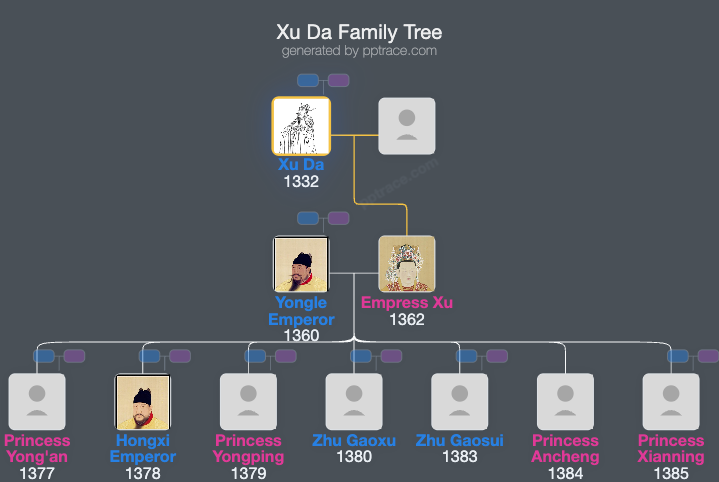
Tap  to expand more relatives
Introduction
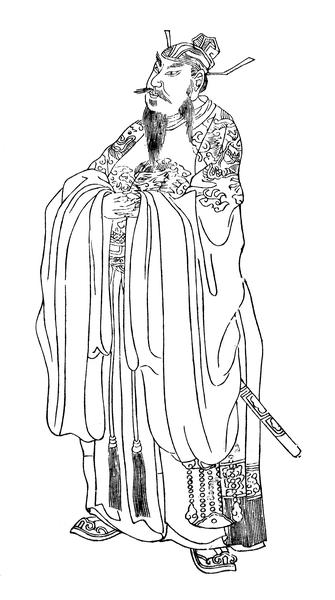
Xu Da (1332–1385), courtesy name Tiande, was a Chinese military officer and statesman during the late Yuan dynasty and early Ming dynasty. He held the title Duke of Wei (魏國公) and was posthumously honored as Prince of Zhongshan (中山王). His familial relationships included being the father of Empress Xu, father-in-law to the Yongle Emperor, and maternal grandfather of the Hongxi Emperor. His descendants include all but two of the subsequent Ming and Southern Ming emperors.
Born in 1332, Xu Da was described as a sturdy man with a slim face and high cheekbones. In 1353, he joined the Red Turban rebels to challenge the ruling Mongol-led Yuan dynasty. He served as a military general under Zhu Yuanzhang, a prominent rebel leader who later founded the Ming dynasty. Xu contributed to the efforts against rival warlords and opposing forces. In 1368, Xu Da and other Ming generals launched an attack on Khanbaliq (modern-day Beijing), the Yuan capital, compelling the last Yuan ruler, Toghon Temür, to flee northward.
Following this victory, Xu Da led a pursuit of the retreating Yuan forces. His campaigns extended into Mongol territories, where his forces defeated Mongol reinforcements, sacked the Mongol capital of Karakorum, and captured numerous Mongol nobles in 1370. His military expeditions reached into Transbaikalia and ventured further north than any previous Chinese army.
Xu Da died in 1385 under circumstances that are a matter of speculation. Although some legends suggest he was poisoned due to a suspicion related to a goose dish, there is no conclusive evidence that this was related to his death. Officially, he died of natural causes. His reputation was highly esteemed; Zhu Yuanzhang (the Hongwu Emperor) praised him as "the Great Wall" of the Ming Dynasty, and upon his death, he was posthumously titled King of Zhongshan. He was honored in the Imperial Ancestral Temples and Portrait Temples of Meritorious Officials, ranking first among them in 1385.
In familial terms, Xu Da was associated with several notable figures. His wife was from the Zhang clan, and another wife, Madame Wang of Zhongshan from the Xie clan, was the mother of his first daughter, Empress Xu (Xu Yihua), born on March 5, 1362, who later married Zhu Di, the fifth son of the Hongwu Emperor, in 1736. They had four daughters and three sons, including Xu Huizu, titled Duke Zhongzhen of Wei, and Xu Yingxu, who served as a general-in-chief. His other children included sons Xu Tianfu and Xu Zengshou, and daughters who married into the imperial family, becoming princess consorts.
Xu Da's ancestry and early life are not extensively documented. His legacy extended into Chinese fiction; he appears as a minor character in Louis Cha’s wuxia novel "The Heaven Sword and Dragon Saber," depicted as participating in the rebellion to overthrow the Yuan dynasty under Zhang Wuji's leadership. In this narrative, he receives the Book of Wumu, a military treatise attributed to Yue Fei, which enhances his military prowess. He is also featured in Shelley Parker-Chan’s novels "She Who Became the Sun" and "He Who Drowned the World," although these portrayals incorporate fictional elements not based on historical records.