Thomas Pakenham, 2nd Earl Of Longford
| Name | Thomas Pakenham, 2nd Earl Of Longford |
| Title | Anglo-Irish peer |
| Gender | Male |
| Birthday | 1774-05-14 |
| nationality | Republic of Ireland |
| Source | https://www.wikidata.org/wiki/Q7792977 |
| pptrace | View Family Tree |
| LastUpdate | 2025-11-26T12:36:45.899Z |
Family Tree
Tap  to expand more relatives
Introduction
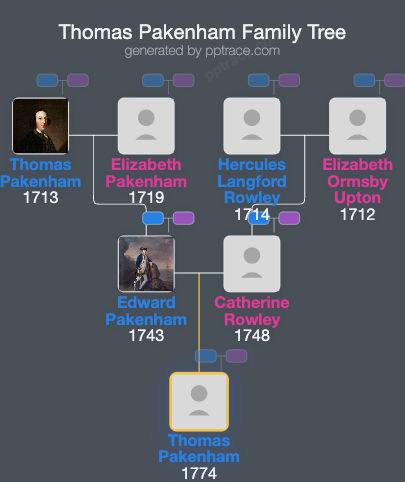
Thomas Pakenham, 2nd Earl of Longford (14 May 1774 – 28 May 1835), was a hereditary peer in the Peerage of Ireland and the Peerage of the United Kingdom. He was born in 1774 as the eldest son of Edward Pakenham, 2nd Baron Longford, and Catherine Rowley, daughter of Hercules Rowley.
He inherited the Pakenham family estate, Pakenham Hall (also known as Tullynally Castle), in 1792 upon the death of his father, thereby becoming the 2nd Baron Longford. Subsequently, in 1794, he succeeded his paternal grandmother, Elizabeth Pakenham, 1st Countess of Longford, as the 2nd Earl of Longford.
His family included notable siblings and relations. His sister, the Honourable Catherine Pakenham, married Arthur Wellesley, 1st Duke of Wellington. Longford initially opposed their marriage due to Wellington's financial circumstances at that time. He also had brothers who served in the British Army, including the Honourable Sir Edward Pakenham, who served under Wellington during the Peninsular War, and Sir Hercules Robert Pakenham, a lieutenant-general and aide-de-camp to King William IV.
In terms of public service, Longford was among the initial 28 Irish representative peers elected to the UK Parliament after the Act of Union 1800, taking office on 2 August 1800. He supported the Act of Union and, like many Irish aristocrats, received financial remuneration for his support. He retained a seat in the House of Lords until his death. On 17 December 1813, he was appointed a Knight of the Order of St Patrick. In 1821, he was created Baron Silchester of Silchester in the County of Southampton, a title in the Peerage of the United Kingdom, granting him an automatic seat in the House of Lords.
Longford was known for his opposition to Catholic Emancipation, a stance that led to disagreements with his brother-in-law, Arthur Wellesley, who, as Prime Minister, facilitated the passage of the Emancipation Act.
He married Lady Georgiana Emma Charlotte Lygon on 23 January 1817. She was the daughter of William Lygon, 1st Earl Beauchamp. They had eight children:
- Edward Michael Pakenham, 3rd Earl of Longford (1817–1860), who died unmarried.
- William Lygon Pakenham, 4th Earl of Longford (1819–1887).
- Rear Admiral Hon Thomas Alexander Pakenham (1820–1889), father of Admiral Sir William Pakenham.
- Hon Charles Reginald Pakenham (1821–1857).
- Rev. Hon Henry Robert Pakenham (1822–1856).
- Major Hon Frederick Beauchamp Pakenham (1823–1901).
- Lady Georgina Sophia Pakenham (c. 1828–1909), who married William Cecil, 3rd Marquess of Exeter.
- Hon Sir Francis John Pakenham (1832–1905), ambassador to Sweden.
In the early 19th century, Longford remodeled Pakenham Hall in the Gothic Revival style, adding towers and a moat, making it one of the largest castellated houses in Ireland at that time.
He died in May 1835 at the age of 61. His eldest son, Edward, succeeded as the 3rd Earl of Longford. His second son, William, later inherited the earldom as the 4th Earl. The Dowager Countess of Longford survived her husband by over 40 years, passing away in February 1880.