Francis Maitland Balfour
| Name | Francis Maitland Balfour |
| Title | British biologist |
| Gender | Male |
| Birthday | 1851-11-10 |
| nationality | United Kingdom of Great Britain and Ireland |
| Source | https://www.wikidata.org/wiki/Q1348857 |
| pptrace | View Family Tree |
| LastUpdate | 2025-11-26T23:30:38.650Z |
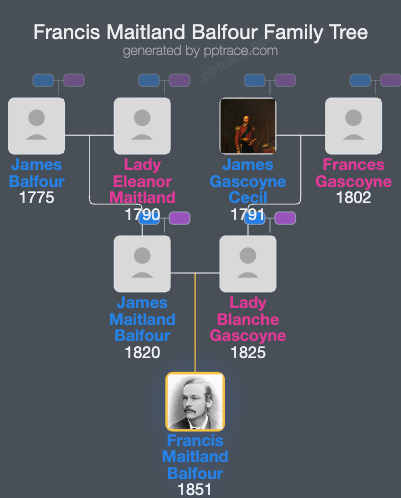
Family Tree
Tap  to expand more relatives
Introduction
Francis Maitland Balfour, often referred to as F. M. Balfour, was a British biologist born on 10 November 1851 in Edinburgh, Scotland. He died on 19 July 1882 during an attempt to ascend Mont Blanc. He was a Fellow of the Royal Society (FRS) and was recognized by his contemporaries as a prominent figure in the field of biology, regarded as one of the leading biologists of his era and considered a successor to Charles Darwin.
Balfour was the son of James Maitland Balfour, a Scottish Member of Parliament, and Lady Blanche Gascoyne-Cecil. His maternal lineage included members of the Cecil family, related to the Marquess of Salisbury, a future Prime Minister of the United Kingdom. His family was politically prominent; his brother was Arthur Balfour, who served as Prime Minister from 1902 to 1905.
He attended Harrow School, where he excelled in natural history, sharing the Natural History Prize with Arthur Evans, a future archaeologist known for excavations at Knossos. George Griffith, a teacher at Harrow, influenced him in his interest in natural sciences, particularly geology, which he developed through his mother’s influence. In 1870, Balfour matriculated at Trinity College, Cambridge, and was awarded a scholarship in natural sciences in 1871. He completed the Natural Science Tripos in December 1873, ranking second.
In 1873 and 1874, Balfour traveled with Arthur Evans across Lapland, Finland, and Sweden. He was also a member of the Alpine Club and traveled in the Alps with his brother Gerald.
His scientific interest was sparked by a series of lectures on embryology delivered by Sir Michael Foster in 1871. After completing his Tripos, Balfour was appointed to a position at the Naples zoological station, where he conducted research that contributed to his election as a Fellow of Trinity College in 1874. His research on Elasmobranch fishes resulted in publications and a monograph in 1878, providing insights into vertebrate organ development, particularly of the urogenital and nervous systems.
Balfour authored a significant two-volume treatise, "Comparative Embryology," published in 1880 and 1881, covering invertebrates and vertebrates respectively. The work was recognized for its comprehensive synthesis of animal developmental observations and for its original scientific contributions.
He was offered academic positions at Oxford and Edinburgh but declined, preferring to remain at Cambridge, where the university established a special Chair of Animal Morphology for him in 1882. His scientific views aligned with Darwinian principles, although he disagreed with Darwin regarding the origin of larvae, believing most larvae to be secondary and introduced into ontogeny, contrary to Darwin’s hypothesis of larvae as direct descendants of ancestral forms.
In 1878, Balfour was elected a Fellow of the Royal Society, and in 1881, he received their Royal Medal for his research in animal morphology and embryonic development.
Balfour died while climbing Mont Blanc with the guide Johann Petrus, likely on 19 July 1882. His death was a significant loss to the scientific community, with Charles Darwin referring to him as the "English Cuvier" and Huxley considering him the only person capable of advancing his work.
He was buried at Whittingehame, East Lothian. His notable publications include "The Elements of Embryology" (1874), co-authored with Michael Foster, and "A Treatise on Comparative Embryology," published in two volumes in 1880 and 1881.