William Petty
| Name | William Petty |
| Title | English scientist, philosopher, statistician and economist (1623-1687) |
| Gender | Male |
| Birthday | 1623-05-26 |
| nationality | Kingdom of England |
| Source | https://www.wikidata.org/wiki/Q278699 |
| pptrace | View Family Tree |
| LastUpdate | 2025-11-26T23:25:25.843Z |
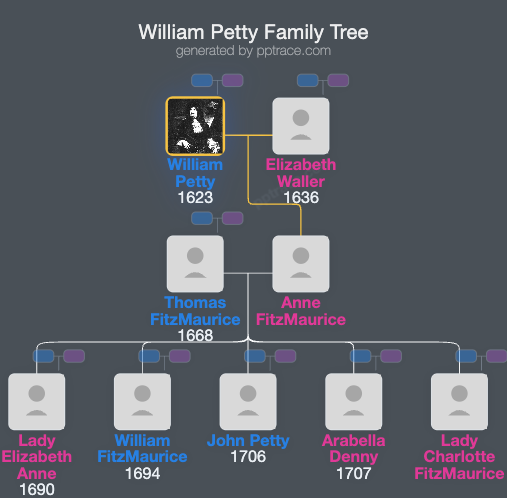
Family Tree
Tap  to expand more relatives
Introduction
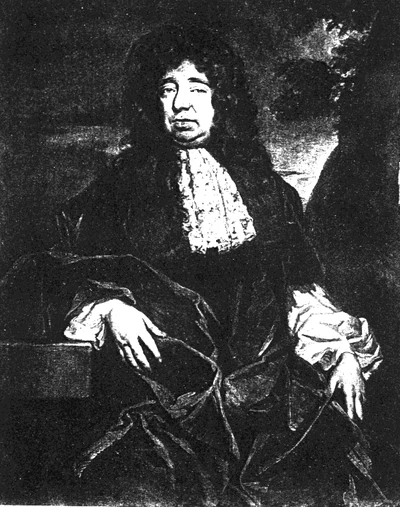
Sir William Petty (26 May 1623 – 16 December 1687) was an English economist, physician, scientist, and philosopher. He was born in London to a family involved in the cloth trade; his father and grandfather were clothiers. Petty demonstrated early intellectual promise and, in 1637, became a cabin boy on a ship, a role that ended following a leg injury and an incident involving the captain's discipline. Subsequently, he studied in Caen, Normandy, supporting himself by teaching English while acquiring proficiency in Latin, Greek, French, mathematics, and astronomy. After returning to England, he entered the University of Oxford, where he studied medicine at Brasenose College and became involved in the Oxford Philosophical Club. During this period, he befriended notable figures such as Samuel Hartlib and Robert Boyle.
Petty initially pursued a career in medicine and academia, teaching anatomy at Oxford and participating in medical cases including that of Anne Greene, a woman who survived her own hanging. In 1650, he was appointed Gresham Professor of Music by the City of London, a position he held until 1660. His scientific interests extended into naval architecture, and he developed theories advocating for double-hulled ships.
In 1652, Petty traveled with Oliver Cromwell’s army as physician-general in Ireland, responding to Cromwell’s campaigns there. He was responsible for conducting the Down Survey (completed in 1656), a detailed land assessment aimed at facilitating the redistribution of land confiscated from Irish landowners to Cromwell's supporters. In addition to this work, Petty acquired approximately 30,000 acres in Kenmare, County Kerry, and received £9,000 in compensation. These gains led to ongoing legal disputes over allegations of bribery and breach of trust, which persisted until his death.
Petty also engaged in land development and economic projects in Ireland. He possessed three baronies: Iveragh, Glanarought, and Dunkerron, and attempted to establish ironworks and fisheries on his estates. He applied his scientific and statistical methods—what he termed "political arithmetic"—to analyze the land and its resources, emphasizing quantitative measurement.
Following the English Restoration in 1660, Petty was treated favorably. He was knighted by King Charles II in 1661 and served as a Member of Parliament for Inistioge in Ireland from 1661 to 1666. That year, he also became a charter member of the Royal Society. His scientific interests included naval architecture, and he favored double-hulled ships, though his designs experienced mixed success.
Petty’s career in Ireland continued until 1685, after which he returned to London. He was a close associate of Samuel Pepys and contributed significantly to economic thought. His works on economics include "Treatise of Taxes and Contributions" (1662), "Verbum Sapienti" (1665), and "Quantulumcunque Concerning Money" (1682). His theories covered fiscal policies, national wealth, the velocity of money circulation, value, interest rates, and international trade. He also helped found the Dublin Society in 1682.
Petty’s personal life included marriage to Elizabeth Waller in 1667. She was the daughter of Sir Hardress Waller and Elizabeth Dowdall; her previous marriage was to Sir Maurice Fenton. Elizabeth Waller was granted the title Baroness Shelburne for life. They had three children who survived to adulthood: Charles Petty, Henry Petty, and Anne. The title of Earl of Shelburne was inherited by Anne’s son, John Petty, who adopted the surname Petty.
William Petty died in 1687 and was buried in Romsey Abbey.