Sei Wada
| Name | Sei Wada |
| Title | Pioneer in early Japanese electronic sound and stage technology. |
| Gender | Male |
| Birthday | 1893-01-01 |
| nationality | Japan |
| Source | https://www.wikidata.org/wiki/Q11418097 |
| pptrace | View Family Tree |
| LastUpdate | 2025-11-19T08:04:31.063Z |
Family Tree
Tap  to expand more relatives
Introduction
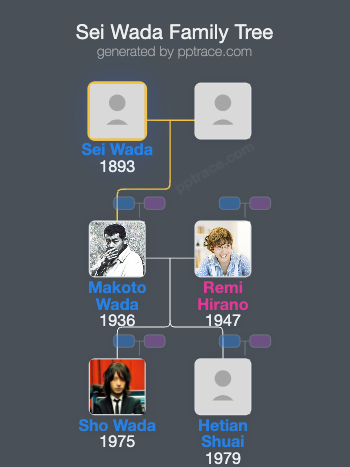
Sei Wada (January 15, 1893 – April 11, 1970) was a Japanese sound director specializing in sound production. Known as one of the pioneers of sound effects in Japan, he was a founding member of the Tsukiji Little Theatre, where he was involved in managing sound and lighting. His son is the illustrator Makoto Wada, his wife is the culinary enthusiast Remi Hirano, his grandson is the rock band TRICERATOPS’s Sho Wada, and his granddaughter-in-law is actress Juri Ueno.
Born in Sakura, Chiba Prefecture, and raised in Tokyo, Wada attended the Tokyo Higher Normal School (now the University of Tsukuba Junior and Senior High School). Among his classmates were Yoshimasa Kiyama and Hideo Shibusawa. In 1915, he graduated from the ceramics department of the Tokyo Higher Industrial School (now Tokyo Institute of Technology), and he was employed at the Japan Hard Ceramic Company in Kanazawa, Ishikawa Prefecture. Four years later, in 1919, he returned to Tokyo and transferred to Tokyo Electric (later Toshiba), where he worked as a lighting engineer. In his private life, he participated as a hobbyist in the Stage Model Research Institute hosted by Yoshi Hijikata, collecting electrical materials useful for model making.
During the same period, he collaborated with Hijikata in managing the "Theatre Society" and was involved with theater research groups including those led by Koreya Chida. In 1920, during the production of Wagner’s opera "Tannhäuser" at the Imperial Theatre, a typo in the pamphlet listed "Lighting: Sei Wada," which marked the beginning of his serious involvement in the theater industry. In the 1921 performance of "Shunkan" at Meiji-za, he partnered with Kinsho Ito, Yoshi Hijikata, and Koizaku Yamada to devise and construct a large-scale electrical sound system. This is regarded as Japan’s first attempt at creating sound effects.
In 1924, he participated as a member in founding the Tsukiji Little Theatre and took charge of sound and lighting in over 80 performances thereafter. He also appeared on stage as a commentator during the performance of Čapek’s "The Life of the Beetle." During this period, he pioneered Japan’s full-fledged radio drama with "Inside the Coal Mine" (1925) and managed the sound effects for Japan’s first "talkie" film, "Dawn" (1927). His work on "Inside the Coal Mine" was especially acclaimed, leading to his joining the NHK (Japan Broadcasting Corporation) Kansai branch’s production department as a studio director in 1930 after the dissolution of the Tsukiji Little Theatre.
In 1935, he was in charge of music for the serial drama "Shadow on Fuji," composing Japan’s first theme music using shakuhachi (bamboo flute) and orchestra. At that time, the importance of theme music was not yet widely recognized. There is also a record of him being scolded by his superior for "playing the same music every day."
Towards the end of World War II, in 1944, he was dismissed from Jobk (The Japan Broadcasting Corporation’s Kansai branch). The reasons are unclear, but it has been suggested that he was viewed as a politically dangerous figure. In March 1945, he returned to Tokyo and was unemployed, staying at his father’s house in Setagaya Daita. In March 1946, he co-directed a student theater production of "Alt Heidelberg" along with Tatsuji Iwabuchi and Seiichiro Ujiie.
In 1951, at the request of Shoichi Koyama, Wada was invited to work at New Japan Broadcasting (now MBS) in Osaka, where he served as a director and general manager of production. He directed radio and television dramas, and from 1939 to 1941, he was in charge of broadcasting serial radio dramas. He received the Ministry of Education Arts Festival Minister of Education Award for three consecutive years for his work in this field. Due to his achievements, he was hailed as the "God of Radio."
After surpassing age 70, Wada retired from active work. In 1961, he received the Yellow Ribbon Medal, and in 1967, he was awarded the Order of the Rising Sun, 4th Class, Gold Rays with Rosette. He died on April 11, 1970, from encephalomalacia at the Rissho Kosei-kai Kosei Hospital in Nakano, Tokyo.