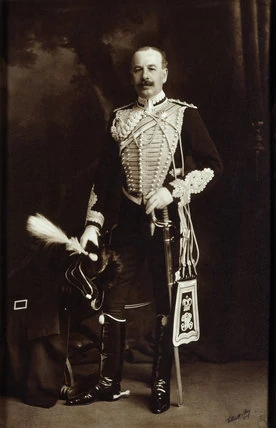
Coningsby Disraeli
| Name | Coningsby Disraeli |
| Title | British politician (1867-1936) |
| Gender | Male |
| Birthday | 1867-02-25 |
| nationality | United Kingdom |
| Source | https://www.wikidata.org/wiki/Q5161086 |
| pptrace | View Family Tree |
| LastUpdate | 2025-11-26T23:30:07.043Z |
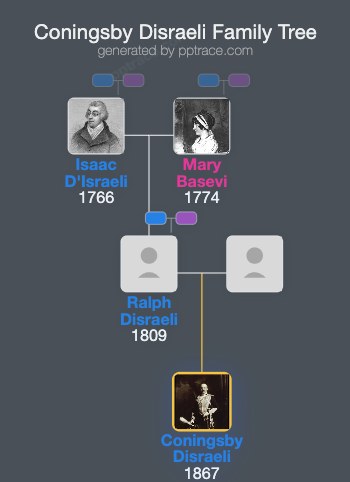
Family Tree
Tap  to expand more relatives
Introduction
Coningsby Ralph Disraeli was born on 25 February 1867 in Kensington, London. His parents were Ralph Disraeli (1809–1898) and Katherine (née Trevor) (1837–1930). He was the grandson of the writer Isaac D'Israeli and the nephew of Benjamin Disraeli, who served as Prime Minister of the United Kingdom. Disraeli was named after Benjamin Disraeli's 1844 novel, "Coningsby," and was reportedly close to his uncle, who considered him an heir to his estate, including Hughenden Manor.
Benjamin Disraeli supervised and directed Coningsby Disraeli's education, which began at Charterhouse School and continued at New College, Oxford. Due to a dispute with examiners, he later moved to Charsley's Hall. After Benjamin Disraeli's death in April 1881, Coningsby, then 14 years old, received extensive press coverage, notably attending the funeral and reportedly weeping at the head of the coffin. In May 1881, he was presented to Queen Victoria at Windsor Castle by Lord Rowton. Because he was a minor at the time, his inheritance was managed by trustees until he attained the age of 21 in 1888.
Following his coming of age, Disraeli became more involved in politics. He regularly attended Conservative events, was a member of the Beaconsfield Club and The Primrose League, and maintained connections with notable political figures, including Sir George Elliot, who introduced him to the Prince of Wales in 1884. Disraeli also engaged in amateur dramatics; during his youth, he performed at a charity event in Whitby and was active in Oxford's Dramatic Society, including performances at the opening of the second New Theatre in 1886.
Disraeli first publicly appeared as a politician in April 1888, delivering a speech at a Conservative event. In 1890, he supported Henry Robert Graham in a by-election for St Pancras North, though Graham was defeated. Subsequently, Disraeli considered running for office in Sheffield and Buckinghamshire before accepting an invitation to stand for Altrincham in the 1892 general election, replacing William Cunliffe Brooks. Over the following two years, he made several public appearances in Altrincham to campaign and was elected as Member of Parliament for the constituency in July 1892.
During his parliamentary career, which lasted for thirteen years, Disraeli was notably active in agricultural issues and debates concerning the Licensing Bill in 1902 and 1905. He was re-elected in 1895 and 1900 but was defeated in the 1906 general election by William Crossley, a Liberal candidate. He later contested elections in Rushcliffe in January and December 1910 but was unsuccessful on both occasions; during the December contest, he experienced an incident where his motor vehicle was attacked by youths.
Disraeli served as an officer in the Buckinghamshire Yeomanry, starting as a second lieutenant on 18 April 1900, and was promoted to lieutenant on 11 June 1902. During World War I, he worked with the Royal Air Force and reached the rank of major before retiring in 1921.
In his personal life, Disraeli was engaged to Marion Grace Silva, OBE, in 1896. They married at St. Margaret's, Westminster, on 2 March 1897. He held the position of High Sheriff of Buckinghamshire in 1931. Disraeli underwent a serious operation in July 1936, but he died of pneumonia in a nursing home in Hove, East Sussex, on 30 September 1936, at the age of 69. He died without issue. Following his death, Hughenden Manor was sold; it was later acquired by the National Trust in 1949. Marion Disraeli died in 1963 at the age of 87.