Mitsusada Inoue
| Name | Mitsusada Inoue |
| Title | Japanese historian (1917-1983) |
| Gender | Male |
| Birthday | 1917-09-19 |
| nationality | Japan |
| Source | https://www.wikidata.org/wiki/Q11372857 |
| pptrace | View Family Tree |
| LastUpdate | 2025-11-17T09:47:19.404Z |
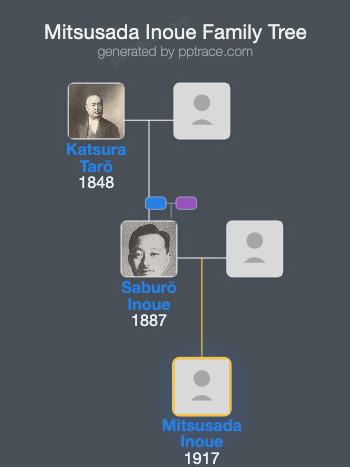
Family Tree
Tap  to expand more relatives
Introduction
Mitsusada Inoue (Inoue Mitsusada, born September 19, 1917 – died February 27, 1983) was a Japanese historian. He served as an emeritus professor at the University of Tokyo and was the first director of the National Museum of Japanese History. He was awarded the Order of the Purple Ribbon and held a Doctor of Letters degree. His specialization was ancient Japanese history (the history of Japan's early periods).
Regarding his birth and family background, Mitsusada Inoue belonged to a family where his father was Saburō Inoue, a marquis and the third son of Taro Katsura, and his mother was Chiyoko, the eldest daughter of Kaoru Inoue. He was born in the Azabu district of Minato, Tokyo.
His educational history is as follows: He entered Gakushuin Elementary School in 1924, then progressed to Seikei High School's ordinary course in 1930. In 1934, he entered the Science B Course at Seikei High School, but then developed nephritis in 1935. In 1937, he transferred to the Humanities B Course at the senior high school and was diagnosed again with nephritis. He graduated from Seikei High School in 1940 and enrolled in the Department of Japanese History at the Faculty of Literature, Tokyo Imperial University (now the University of Tokyo).
During his university years, he was a classmate of scholars of ancient Japanese history such as Koji Seki and Yamada. As his research progressed, he engaged in the study of social structures of ancient Japan, the history of Buddhist thought, and the Ritsuryō system. He particularly focused on the origins of the state and the emperor before the Ritsuryō system, as well as the history of Buddhist thought centered on Pure Land Buddhism, leaving many scholarly works on classical texts and annotations.
Inoue’s academic orientation was inherited from his mentor, Taro Sakamoto, who built a scientific, positivist approach to scholarship. His research emphasized critical analysis of Japanese historical sources. Influenced by Max Weber’s social theory and Sadayoshi Tsuda’s criticism of the Kojiki and Nihon Shoki, he developed studies on the political and social organization prior to the Ritsuryō system.
His academic growth was significantly shaped by encounters with various mentors. Notably, he received instruction on the philosophy of history from art historian Kikuo Kojima, which helped him develop a philosophical and global perspective on Japanese history, as he later mentioned in his autobiography.
In graduate school, he researched “Society and Buddhism before the transfer of the capital to Nara,” under the guidance of the ethicist Tetsurō Watsuji. During his studies, he also reflected on his background, which was influenced by Western-style family upbringing, and his sense of distance from the Japanese-centered focus of the national history department.
His experiences visiting India and America are said to have influenced his worldview. Grounded in his scholarly training, he pursued historical research emphasizing rigorous proof and reasoning.
He was also prolific in writing, contributing to textbooks and general histories of Japan. Notably, in 1949, he co-authored “New Systematic Japanese History” with Toshiya Okubo and Kōta Kodama, and in 1951, he participated in editing the high school textbook “Japanese History” with Kazuo Kasahara and others. Moreover, his collaboration with Rizo Takeuchi and Kōta Kodama on editing “The History of Japan” became a bestseller with approximately 400,000 copies sold, and it has been reprinted over the years.
From the 1960s onward, he continued to be active at the forefront of historical research and education, mentoring many students at the University of Tokyo.