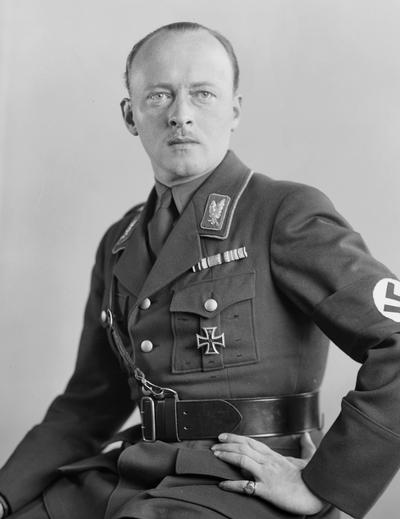
Philipp, Landgrave Of Hesse
| Name | Philipp, Landgrave Of Hesse |
| Title | German prince, head of the Electoral House of Hesse and member of the Nazi Party (1896-1980) |
| Gender | Male |
| Birthday | 1896-11-06 |
| nationality | Germany |
| Source | https://www.wikidata.org/wiki/Q60741 |
| pptrace | View Family Tree |
| LastUpdate | 2025-11-12T01:18:20.484Z |
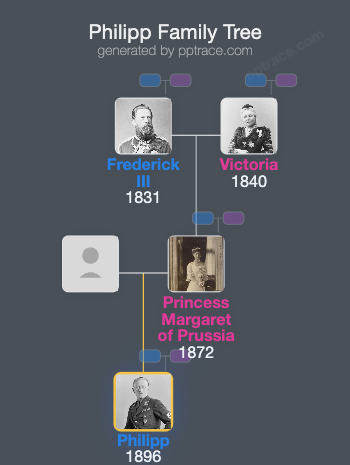
Family Tree
Tap  to expand more relatives
Introduction
Philipp, Prince and Landgrave of Hesse, was born on 6 November 1896 at Schloss Rumpenheim in Offenbach, Germany. He was the third son of Prince Frederick Charles of Hesse and Princess Margaret of Prussia, sister of Kaiser Wilhelm II. Philipp had a younger twin brother named Wolfgang, and two older brothers as well as two additional younger twin brothers. His early education included time with an English governess, and in 1910 he attended a school in Bexhill-on-Sea, Britain. Upon returning to Germany, he studied at the Musterschule in Frankfurt and the Realgymnasium in Potsdam. Unlike his siblings, he did not attend a military academy.
During the First World War, Philipp served in the Hessian Dragoon-Regiment Nr. 24 alongside his older brother Maximilian, who was killed in Belgium in October 1914. Philipp served primarily on the Eastern Front in Ukraine and the Hindenburg Line, holding the rank of lieutenant. He was wounded in Ukraine and was responsible for munitions procurement. His father was elected king of Finland in October 1918, and Philipp was positioned as second in line to succeed his uncle as head of the House of Hesse, a plan that was disrupted by Finland's transition to a republic in 1919 following Germany's defeat.
Following the war, Philipp was part of the Übergangsheer, the transitional military force, which opposed communist and socialist movements. He studied art history and architecture at the Technical University in Darmstadt from 1920 to 1922. He also made visits to Greece, where his aunt Princess Sophie was married to King Constantine I. In 1922, Philipp left university without a degree and worked at the Kaiser-Friedrich-Museum in Berlin, before moving to Rome in 1923 to work as an interior designer utilizing his aristocratic connections.
In 1925, Philipp married Princess Mafalda of Savoy, daughter of King Victor Emmanuel III of Italy. They had four children: Prince Moritz (1926–2013), Prince Heinrich Wilhelm (1927–1999), Prince Otto Adolf (1937–1998), and Princess Elisabeth Margarethe (born 1940). The family resided mainly at Villa Polissena on the outskirts of Rome, with frequent travels to Germany.
Philipp became involved with the Nazi Party in 1930 while in Italy, joining the party with membership number 418,991. He was enthusiastic about Fascism and considered the Bolsheviks a greater threat, which influenced his political orientation. In 1932, he joined the SA, and his brother Christoph joined the SS, with other brothers also participating in Nazi paramilitary units. Philipp developed a close association with Hermann Göring and was granted a reserve rank of Luftwaffe Hauptmann by him in 1936.
Following Adolf Hitler's rise to Chancellor in 1933, Philipp was appointed Oberpräsident of Hesse-Nassau on 7 June 1933 by Göring, who was Minister-President of Prussia. He served on the Prussian State Council and played a role in consolidating Nazi rule. He acted as an art agent for Hitler in Italy, facilitating the purchase of art treasures, and acted as an intermediary between Hitler and Mussolini, especially leading up to Austria's annexation. Philipp was linked to the Aktion T4 euthanasia program, signing a contract in 1941 for the Hadamar Clinic.
In late April 1943, Philipp was ordered to report to Hitler’s headquarters, where he stayed for most of the following months. In July 1943, Mussolini was arrested by Philipp’s father-in-law, King Victor Emmanuel III, significantly affecting Philipp's position. Hitler suspected Philipp's family of complicity in Mussolini's downfall, leading to his arrest on 8 September 1943 and his dismissal from his offices in early 1944.
He was imprisoned at Flossenbürg concentration camp, and later in Buchenwald, but was transferred to Tyrol in April 1945, where he was liberated by Wehrmacht forces on 30 April. He was then arrested by U.S. forces on 4 May 1945 in Italy. After internment in various detention centers until 1947, Philipp underwent denazification; he was initially classified as an offender, sentenced to two years in a labor camp with property forfeiture, but this was reduced to a follower classification upon appeal.
He succeeded his father as Head of the Electoral House of Hesse on 28 May 1940. In 1968, after the death of Louis, Prince of Hesse and by Rhine, Philipp became head of the entire House of Hesse, including the grand ducal branch. He died in Rome, Italy, on 25 October 1980.