Thomas Jefferson Randolph
| Name | Thomas Jefferson Randolph |
| Title | American planter and politician, grandson of Thomas Jefferson |
| Gender | Male |
| Birthday | 1792-09-12 |
| nationality | United States of America |
| Source | https://www.wikidata.org/wiki/Q2425078 |
| pptrace | View Family Tree |
| LastUpdate | 2025-11-17T06:37:23.819Z |
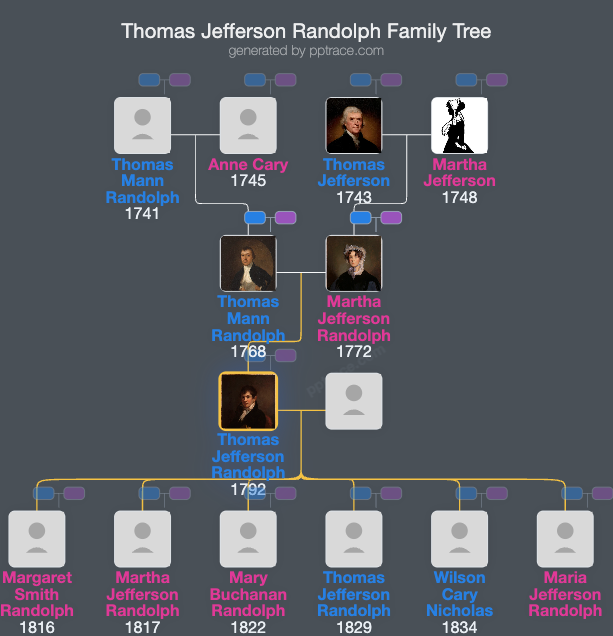
Family Tree
Tap  to expand more relatives
Introduction
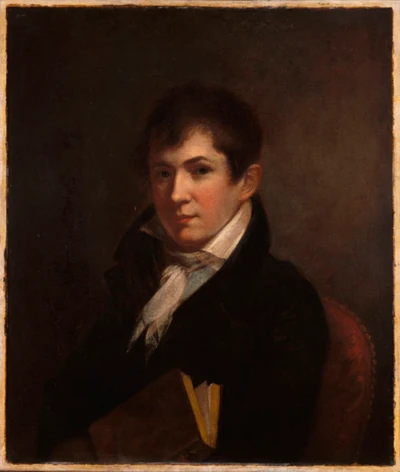
Thomas Jefferson Randolph (September 12, 1792 – October 7, 1875) was a Virginia planter, soldier, and politician. He served multiple terms in the Virginia House of Delegates, was rector of the University of Virginia, and held the rank of colonel in the Confederate Army during the American Civil War.
Born in Charlottesville, Virginia, Randolph was the eldest son of Thomas Mann Randolph Jr., who later became Virginia's governor, and Martha Jefferson Randolph, also known as "Patsy." He was the eldest grandson of U.S. President Thomas Jefferson and was descended from Pocahontas. Randolph received a private education suited to his social standing and spent part of his childhood at Monticello and Poplar Forest plantations. In 1809, his parents moved into Monticello; however, they later separated due to his father's alcoholism, with Randolph, his mother, and siblings remaining at Monticello.
At age 15, Randolph was sent to Philadelphia in 1807 for further studies, where he developed interests in botany, natural sciences, and anatomy. He assumed roles of family leadership early on. In 1815, Randolph married Jane Hollins Nicholas (1798–1871), daughter of Wilson Cary Nicholas, a former Congressman, Senator, and Virginia Governor. Jane Randolph established and taught a school at Edgehill estate from 1829 until 1850. Thomas and Jane Randolph had thirteen children, including Margaret Smith Randolph, Martha Jefferson Randolph, Mary Buchanan Randolph, Careyanne Nicholas Randolph, Ellen Wayles Randolph, Maria Jefferson Carr Randolph, Carolina Ramsey Randolph, Thomas Jefferson Randolph Jr., Jane Nicholas Randolph, Wilson Cary Nicholas Randolph, Meriwether Lewis Randolph, and Sarah Nicholas Randolph.
Randolph is also associated with controversy regarding Sally Hemings, an enslaved woman at Monticello. Historians generally agree that Jefferson had a long relationship with Hemings and fathered her children.
As a planter, Randolph managed plantations that utilized enslaved labor, including Monticello. Upon Thomas Jefferson's death in 1826, Randolph was appointed executor of Jefferson's estate and was responsible for managing the sale of enslaved people to settle Jefferson's debts. About six months after Jefferson's death in 1827, Randolph oversaw an auction of Jefferson's enslaved individuals, which generated funds to partially pay off Jefferson's debts. His mother, Martha Randolph, was allowed to retain her enslaved woman Sally Hemings temporarily and lived freely in Charlottesville.
Randolph purchased his father's plantation at Edgehill following a foreclosure auction in 1827. Throughout the 1850s, he used enslaved labor to construct sections of the Virginia Central Railroad. Census records from 1850 and 1860 indicate that he owned dozens of enslaved individuals.
Politically, Randolph was elected multiple times to the Virginia House of Delegates, often serving alongside Alexander Rives. After the Nat Turner slave rebellion of 1831, Randolph introduced a bill proposing gradual emancipation of slaves born after July 3, 1840, which was defeated. By 1850, his stance shifted toward supporting slavery, and he participated in the Virginia Constitutional Convention of 1850.
Randolph published a collection of Jefferson's writings titled "Memoir, Correspondence and Miscellanies" in 1829, which was the first compilation of Jefferson's papers. He served as a member of the Board of Visitors at the University of Virginia and was its rector from 1857 to 1864. He and others from Albemarle County participated in the Virginia Secession Convention of 1861, which voted in favor of secession.
During the Civil War, Randolph supported the Confederacy, and his brother, George Wythe Randolph, served as a delegate to the convention and was a Confederate officer. Randolph's political and military involvement continued through the years of conflict and into the Reconstruction era.