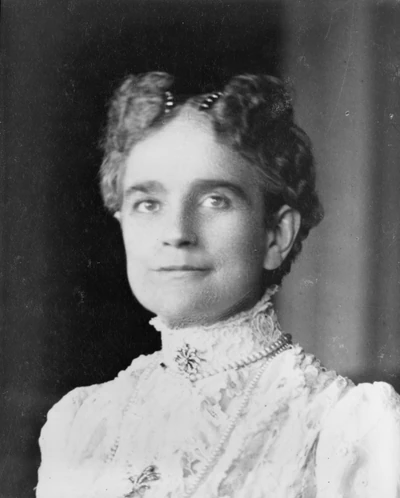
Ida Saxton McKinley
| Name | Ida Saxton McKinley |
| Title | First Lady of the United States from 1897 to 1901 |
| Gender | Female |
| Birthday | 1847-06-08 |
| nationality | United States of America |
| Source | https://www.wikidata.org/wiki/Q238397 |
| pptrace | View Family Tree |
| LastUpdate | 2025-11-17T06:41:53.959Z |
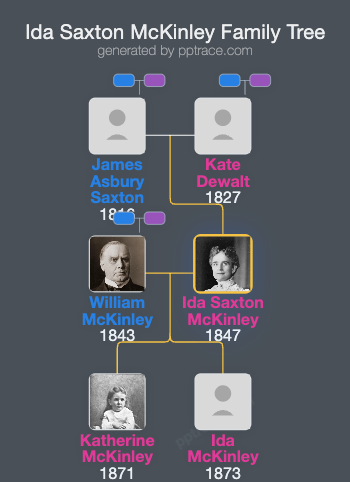
Family Tree
Tap  to expand more relatives
Introduction
Ida McKinley (née Saxton) was born on June 8, 1847, in Canton, Ohio. She was the eldest child of James Saxton, a prominent banker in Canton, and Katherine “Kate” DeWalt. The Saxton family was among Canton's first pioneer families and accumulated considerable wealth through James Saxton’s banking activities, making him the second-richest man in Canton. Ida was raised in the Saxton House, a grand residence, alongside her younger siblings, Mary and George. Her early childhood was marked by close relationships with her mother and grandmother, Christiana DeWalt. During the American Civil War, her mother led volunteer efforts to supply the Union Army, and Ida assisted when school was not in session.
Educationally, Saxton’s family valued abolitionism and equal education for women. Her father served on the board of trustees for Canton’s public schools and brought Betsy Mix Cowles, an abolitionist and suffragette, as principal of Canton Union School, where Saxton studied. Between 1862 and 1863, she attended Delphi Academy in Clinton County, New York, learning accounting and finance, though she left due to the school's Confederate sympathies. She continued her studies at Sanford School in Cleveland from 1863 to 1865, excelling academically. From 1865 to 1868, she attended Brooke Hall Female Seminary, where she learned music, languages, and needlework, preparing her for social hosting duties. She formed lasting friendships during this period, including with teacher Harriet Gault.
Following her graduation, Saxton’s father encouraged her to pursue acting to help fund the construction of a local Presbyterian church. In March 1868, she performed at Schaefer’s Opera House, earning acclaim as the “best actress.” She also worked at Stark County Bank, owned by her father, serving as a cashier and manager in his absence, a role that was somewhat controversial at the time. Alongside her career, Saxton taught Sunday school and traveled to Europe after June 1869, with her sister Mary, on a Grand Tour funded by a chaperone, Janette Alexander. Their travels spanned Ireland, Scotland, England, Switzerland, The Netherlands, Belgium, France, Germany, and Italy. During this trip, Saxton encountered notable figures such as sculptor Vinnie Ream in Paris and a limbless painter, Charles Felir, in Amsterdam. In Italy, she met Pope Pius IX, an experience that left a lasting impression despite her disapproval of Roman Catholicism’s rituals.
Saxton’s European experiences broadened her social perspectives. She observed working-class women engaged in labor and supported lace workers in Belgium by purchasing their craftsmanship. Her travels also influenced her physical regimen; she hiked in the Swiss Alps daily to maintain health.
In 1868, Saxton met William McKinley at a picnic in Ohio and was initially engaged to Confederate veteran John Wright, who died unexpectedly in 1870. Afterward, Saxton considered suitors but was eventually influenced by McKinley’s moral character. They began courting in 1870, and on January 25, 1871, they married at the First Presbyterian Church in Canton before approximately one thousand attendees. Their honeymoon followed a secret trip to New York.
Their first child, Katherine “Katie,” was born on December 25, 1871. Ida became active in social and religious life, including joining William’s Methodist church and baptizing Katie. During her pregnancy with their second child, Ida’s mother succumbed to cancer, and Ida sustained a head injury that likely contributed to her later health issues, including epilepsy and phlebitis. Their second child, also named Ida, was born in April 1873 but died after four months due to cholera.
William and Ida McKinley experienced significant personal losses, including the death of their children, her brother, and the assassination of President William McKinley in 1901. After her husband's assassination, Ida McKinley continued to visit his resting place daily until her death on May 26, 1907.