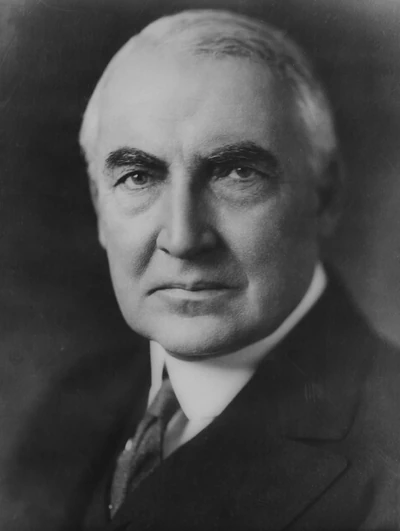
Warren G. Harding
| Name | Warren G. Harding |
| Title | president of the United States from 1921 to 1923 |
| Gender | Male |
| Birthday | 1865-11-02 |
| nationality | United States of America |
| Source | https://www.wikidata.org/wiki/Q35286 |
| pptrace | View Family Tree |
| LastUpdate | 2025-11-17T06:43:29.825Z |
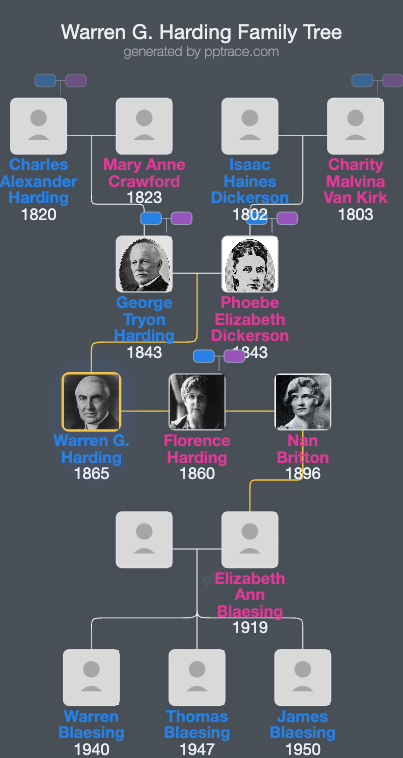
Family Tree
Tap  to expand more relatives
Introduction
Warren Gamaliel Harding was born on November 2, 1865, in Blooming Grove, Ohio. He was the eldest of eight children born to George Tryon Harding and Phoebe Elizabeth (née Dickerson) Harding. Phoebe Harding was a state-licensed midwife, and her husband Tryon Harding was a farmer, schoolteacher, and later a doctor after studying medicine. Harding’s ancestors included Richard Harding, who arrived from England to Massachusetts Bay around 1624, as well as Welsh, Scottish, and Dutch ancestry, with some speculation about African American ancestry that has been statistically refuted through genetic testing.
In 1870, Harding's family moved to Caledonia, Ohio, where Tryon Harding acquired a local weekly newspaper, The Argus. Harding learned the newspaper business from a young age at this publication. At age 14, Harding enrolled at Ohio Central College in Iberia and demonstrated early aptitude as a student. During his final year, he and a friend published a small college and town newspaper, the Iberia Spectator. After graduating in 1882, Harding's family moved to Marion, Ohio, approximately six miles from Caledonia.
Harding joined the Free Baptist Church in Marion on May 6, 1883, and remained a member until his death, serving later as a trustee for 25 years. As a young man, Harding worked as a teacher, insurance agent, and briefly studied law. He financed his career in journalism by purchasing The Marion Star, a failing daily newspaper, with $300 in 1884. He attended the 1884 Republican National Convention, supporting James G. Blaine, although Harding’s initial involvement was limited until he gained full ownership of The Marion Star with his father's financial aid.
Harding developed the newspaper into a successful local enterprise by adopting a nonpartisan stance and circulating a weekly edition to attract advertisers. His journalism emphasized community development and civic improvement, and he became well-known locally for his editorial influence. Harding also invested in local businesses, which contributed to the growth of Marion, whose population doubled from 4,000 in 1880 to 8,000 by 1890 and reached 12,000 by 1900. By 1923, Harding’s estate was valued at approximately $850,000 (equivalent to about $15.69 million in 2024).
He was a supporter of Republican politics and a supporter of Governor Joseph B. Foraker. Harding’s relationship with Florence Kling, the daughter of a local banker, developed during his early years in Marion. The relationship was complicated by local rumors, including allegations of African American ancestry stemming from rumors spread by Florence’s father, Amos Kling, which Harding confronted. Harding and Florence married, and their relationship was intertwined with local political and social dynamics.
Elected to the Ohio State Senate in 1900, Harding served until 1904, and was lieutenant governor of Ohio from 1904 to 1906. He was defeated in the Ohio gubernatorial race in 1910, but successfully ran for the U.S. Senate in 1914 during Ohio's first election by direct vote. As a senator, Harding gained national prominence and ran as the Republican candidate in the 1920 presidential election.
In 1921, Harding was inaugurated as the 29th President of the United States and served until his death in 1923. His administration was marked by efforts such as the Washington Naval Conference of 1921–1922, which resulted in naval disarmament agreements. Harding appointed respected officials such as Andrew Mellon, Herbert Hoover, and Charles Evans Hughes to his cabinet. He also moved to release political prisoners from World War I opposition.
Harding died of a heart attack on August 2, 1923, in San Francisco while on a tour of the western United States. His death led to Vice President Calvin Coolidge succeeding him. Posthumous revelations of scandals, including the Teapot Dome affair, and knowledge of Harding's extramarital affair with Nan Britton, along with criminal convictions of some associates, damaged his reputation. Although early assessments ranked him among the worst U.S. presidents, subsequent historical evaluations have revisited Harding’s record with a more nuanced perspective.