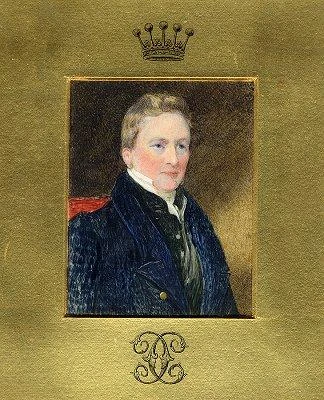
George Cadogan, 3rd Earl Cadogan
| Name | George Cadogan, 3rd Earl Cadogan |
| Title | British Royal Navy officer (1783-1864) |
| Gender | Male |
| Birthday | 1783-05-05 |
| nationality | United Kingdom of Great Britain and Ireland |
| Source | https://www.wikidata.org/wiki/Q5537609 |
| pptrace | View Family Tree |
| LastUpdate | 2025-11-26T23:20:36.682Z |
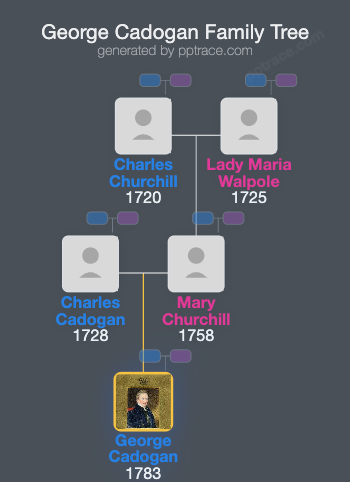
Family Tree
Tap  to expand more relatives
Introduction
George Cadogan, 3rd Earl Cadogan, CB (5 May 1783 – 15 September 1864), was a British Royal Navy officer and politician active during the first half of the nineteenth century. He was born at St James's Square in London and was the eighth son of Charles Cadogan, 3rd Baron Cadogan, and his second wife, Mary Churchill. His family background includes notable lineage, with his mother being a member of the Churchill family.
Cadogan entered the Royal Navy at age 13 in 1796, participating in the French Revolutionary Wars. By 1804, he held the rank of Commander and commanded the 18-gun ship-sloop HMS Cyane. During an incident off Marie-Galante in November 1804, the Cyane captured the French privateer brig Bonaparte. However, in May 1805, the Cyane was captured by French forces while cruising between Barbados and Martinique after engagement with French fleet under Admiral Villeneuve. Cadogan was compelled to surrender the vessel amidst superior French firepower.
By 1807, Cadogan had achieved the rank of Post Captain. In 1811, he was appointed to command HMS Havannah, a 36-gun fifth-rate frigate. During the War of the Sixth Coalition, around 1812–1813, he operated along the northern Italian coastline and engaged in multiple actions against French and Italian ships. His notable military achievements include the destruction or capture of several vessels off Vasto and other ports, the surrender of Trieste in October 1813, and the capture of Zara from the French garrison later that year.
Cadogan returned to Britain in 1815 and was made a Companion of the Order of the Bath. In January 1816, he was received by the Pope in Rome along with other British officers. He inherited the title of Earl Cadogan in 1832 upon the death of his eldest brother, Charles Cadogan, 2nd Earl Cadogan, after the deaths of six of his seven brothers. Prior to inheriting the earldom, he was created 1st Baron Oakley of Caversham on 10 September 1831.
Cadogan served as aide-de-camp to King William IV from 1830 to 1837 and to Queen Victoria from 1837 to 1841. He continued his naval career, attaining the rank of full admiral by 1864. He was involved in a notable duel in 1809 with Lord Paget, related to the seduction of Cadogan's sister, Lady Charlotte.
In terms of honors, Cadogan was promoted to vice-admiral by 1851 and was elected a Fellow of the Society of Antiquaries of London in 1852. He died in 1864 at his residence in Piccadilly, London.
Regarding his family, Cadogan was married to Honoria Louisa Blake. They had five children. His eldest surviving son, Henry, succeeded him as the 4th Earl Cadogan. His younger sons included Sir George Cadogan, a general in the British Army, and Frederick William Cadogan, who served as Member of Parliament for Cricklade.
References for Cadogan's naval career include David J. Hepper's "British Warship Losses in the Age of Sail, 1650-1859" (1994) and William Richard O'Byrne's "A Naval Biographical Dictionary" (1849). External contributions include entries from the Hansard archives documenting his parliamentary activities.