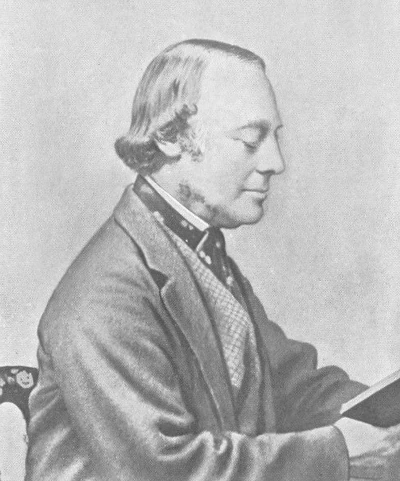
Sir Stephen Glynne, 9th Baronet
| Name | Sir Stephen Glynne, 9th Baronet |
| Title | Welsh landowner, Conservative Party politician, and ecclesiastical antiquarian (1807-1874) |
| Gender | Male |
| Birthday | 1807-09-22 |
| nationality | United Kingdom of Great Britain and Ireland |
| Source | https://www.wikidata.org/wiki/Q7528986 |
| pptrace | View Family Tree |
| LastUpdate | 2025-11-26T23:23:31.560Z |
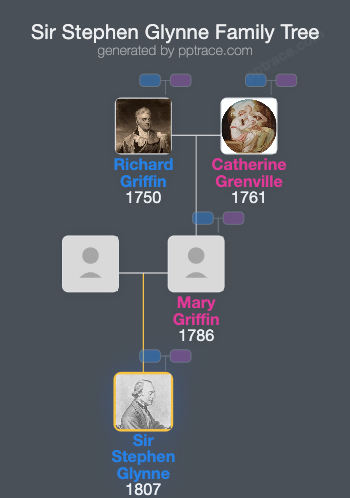
Family Tree
Tap  to expand more relatives
Introduction
Sir Stephen Richard Glynne, 9th Baronet, was born on 22 September 1807 and died on 17 June 1874. He was a Welsh landowner and a politician associated with the Conservative Party. Glynne is notably recognized for his work as an antiquary and as a scholar of British church architecture.
Glynne was the son of Sir Stephen Glynne, 8th Baronet, and Hon. Mary Griffin, daughter of the 2nd Baron Braybrooke. His father died in 1815 when Glynne was seven years old, upon which he inherited the Glynne baronetcy and the family estates, including Hawarden Castle in Flintshire. Glynne was educated at Eton College, where he was described as having a pronounced reluctance to associate socially with peers, despite being noted for his intelligence and excellent memory. He proceeded to Christ Church, Oxford, but graduated with a third class degree in Classics, as he was considered indolent.
In 1839, Glynne’s sister Catherine married William Ewart Gladstone, a future Liberal Prime Minister. William Gladstone's father, Sir John Gladstone, assisted Glynne in recovering from near financial ruin following the failure of the Oak Farm brick and iron works near Stourbridge, in which Glynne was involved as a part-owner. To restore his residence at Hawarden, Glynne sold part of his estate and agreed to share Hawarden Castle with William and Catherine Gladstone.
Glynne’s political career included serving as Member of Parliament for Flint Boroughs from 1832 to 1837 and for Flintshire from 1837 to 1841 and again from 1842 to 1847. He held the position of High Sheriff of Flintshire in 1831 and was Lord Lieutenant of Flintshire from 1845 until 1871. Initially elected as a Whig, Glynne later pursued a Conservative political alignment. Despite maintaining a friendly relationship with William Gladstone, Glynne did not share many Liberal ideals. He was known for his extreme shyness and found public speaking distressing; he never spoke in Parliament himself. During the 1841 election campaign, Glynne initiated libel proceedings against the Chester Chronicle due to allegations of homosexuality, which the newspaper later retracted.
Glynne frequently consulted Gladstone on ecclesiastical appointments, including the appointment of Bishop Joshua Hughes to the Diocese of St Asaph in 1870. Gladstone described Glynne’s memory as "decidedly the most remarkable known to me of the generation and country."
Beyond politics, Glynne was deeply interested in church architecture and antiquarian studies. He was actively involved in the Ecclesiological Society, serving as an honorary secretary and vice-president, and contributed to its publications. He served as the first President of the Cambrian Archaeological Association from 1847 to 1849 and was chairman of the Architectural Section of the Archaeological Institute from 1852 to 1874. His extensive knowledge of church architecture was reflected in his detailed notes and observations spanning over 5,500 churches across England, Wales, and the Channel Islands—covering more than half of the surviving medieval churches in these regions. His notes typically included architectural details, fittings, and changes over time, and he visited churches repeatedly at different intervals. His observations largely adhered to the Gothic style, reflecting his support for the Oxford Movement and ecclesiastical principles of the Ecclesiological Society.
Glynne also traveled extensively in Europe and Turkey, recording his impressions in diaries, though these are considered less significant than his British church notes. His remarkable memory and detailed documentation have made his work valuable to architectural historians.
He died after collapsing outside Bishopsgate railway station in London, where he had been visiting churches in Essex and Suffolk. Glynne was buried at St Deiniol's Church in Hawarden, where a recumbent effigy by Matthew Noble and a tomb designed by John Douglas commemorate him. He remained unmarried, and with his death, the Glynne baronetcy became extinct. His family estate was inherited by his nephew, William Henry Gladstone, son of William and Catherine Gladstone.
Glynne’s church notes are preserved in 106 volumes at Gladstone’s Library in Hawarden, accessible through the Flintshire Record Office. A subset from his 1824 tour is held by the National Library of Wales. Posthumously, his notes have been published mainly according to county and are often produced by regional archaeological societies, recording centuries of ecclesiastical architecture based on his extensive and meticulous observations.