Violet Jacob
| Name | Violet Jacob |
| Title | Scottish writer |
| Gender | Female |
| Birthday | 1863-09-01 |
| nationality | United Kingdom |
| Source | https://www.wikidata.org/wiki/Q543788 |
| pptrace | View Family Tree |
| LastUpdate | 2025-11-12T01:17:38.446Z |
Family Tree
Tap  to expand more relatives
Introduction
Violet Jacob (1 September 1863 – 9 September 1946) was a Scottish writer and poet associated primarily with Scots language literature and historical fiction.
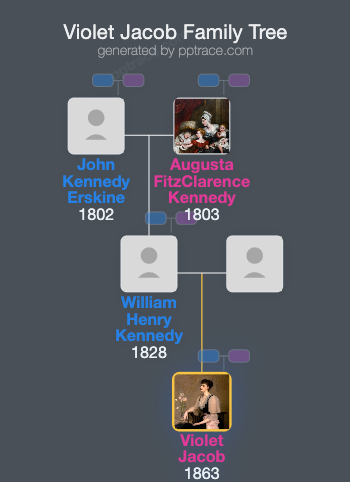
Born as Violet Augusta Mary Frederica Kennedy-Erskine at the House of Dun in Montrose, Forfarshire, she was the daughter of William Henry Kennedy-Erskine (1828–1870), a captain in the 17th Lancers, and Catherine Jones (died 1914). Her paternal lineage includes John Kennedy-Erskine of Dun and Augusta FitzClarence, the illegitimate daughter of King William IV and Dorothy Jordan. She was a great-granddaughter of Archibald Kennedy, 1st Marquess of Ailsa.
In 1894, she married Arthur Otway Jacob, an Irish Major in the British Army, at St John's Episcopal Church in Edinburgh. The couple relocated to India due to her husband's military service. During their time in India, she documented their experiences in the book "Diaries and letters from India 1895–1900," which recounts their stay in Mhow, Central India. They had one son, Harry, born in 1895, who died in 1916 at the Battle of the Somme. Arthur Jacob died in 1936, after which Violet returned to live in Kirriemuir, Angus. She died of heart disease in 1946 and was buried alongside her husband at Dun.
Violet Jacob's literary work includes poetry, short stories, novels, family histories, and personal correspondence. Her poetry is recognized for its use of the Scots language, especially the Angus dialect. Her work is linked to the Scottish vernacular revival of the early 20th century, drawing inspiration from early Scots poets such as Robert Henryson and William Dunbar, rather than from Robert Burns. Hugh MacDiarmid, a prominent Scottish poet, described her as "the most considerable of contemporary vernacular poets," a judgment he upheld for over fifty years.
She is commemorated in Makars' Court, located outside the Writers' Museum in Edinburgh. In 1936, she received an honorary Doctor of Laws (LLD) degree from Edinburgh University.
Her notable poems include "The Wild Geese," a melancholic piece that explores homesickness and was set to music as "Norlan' Wind." This poem was interpreted and popularized by musicians including Jim Reid, Cilla Fisher, and Artie Trezise, with various versions appearing on recordings through the years.
In addition to her poetry, Jacob published several novels, among which "Flemington" (1911) is the most well-known. Set after the Jacobite uprising of 1745, the novel has been praised as one of the finest Scottish romances since "The Master of Ballantrae," according to John Buchan. Her literary output also includes collections of fairy stories, fairy tales, short stories, and family histories, such as "The Lairds of Dun" (1931).
Her published works encompass multiple genres, including novels such as "The Sheep-stealers" (1902) and "The Interloper" (1904), poetry collections like "Verses" (1905) and "Songs of Angus" (1915), as well as family histories and biographical writings. Her posthumous publications include "The Lum hat and other stories: Last tales of Violet Jacob" (1982) and "Diaries and letters from India 1895–1900" (1990).