Theresa May
| Name | Theresa May |
| Title | Prime Minister of the United Kingdom from 2016 to 2019 |
| Gender | Female |
| Birthday | 1956-10-01 |
| nationality | United Kingdom |
| Source | https://www.wikidata.org/wiki/Q264766 |
| pptrace | View Family Tree |
| LastUpdate | 2025-11-26T23:34:04.046Z |
Family Tree
Tap  to expand more relatives
Introduction
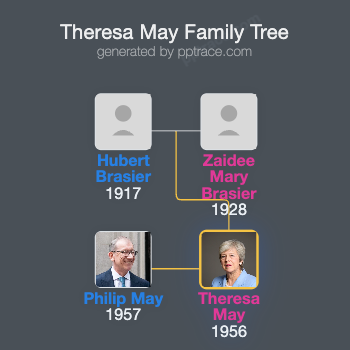
Theresa Mary May, Baroness May of Maidenhead, née Brasier, was born on October 1, 1956, in Eastbourne, Sussex, United Kingdom. She is the daughter of Zaidee Mary (née Barnes, 1928–1982) and Hubert Brasier (1917–1981). Her father was a Church of England clergyman, who served as chaplain of an Eastbourne hospital and later as vicar of Enstone with Heythrop and St Mary's at Wheatley, near Oxford. Her mother was a supporter of the Conservative Party. May was an only child.
May's early education included attending Heythrop Primary School, followed by St. Juliana's Convent School for Girls, a Roman Catholic independent school in Begbroke, which closed in 1984. At the age of 13, she gained admission to Holton Park Girls' Grammar School in Wheatley. During her school years, the local education system was reorganized, and the school became Wheatley Park Comprehensive School.
She pursued higher education at the University of Oxford, where she studied geography at St Hugh's College. She graduated in 1977 with a second-class Bachelor of Arts degree. Her undergraduate studies included instruction from John Patten, who later served as Conservative Secretary of State for Education.
Following her graduation, May worked at the Bank of England from 1977 to 1983, and subsequently as a financial consultant at the Association for Payment Clearing Services (APACS) from 1985 to 1997, where she served as Head of the European Affairs Unit (1989–1996) and Senior Adviser on International Affairs (1996–1997).
May's political career began with local government service, as she served as a councillor for Durnsford ward on the Borough Council of the London Borough of Merton from 1986 to 1994. During this period, she was Chairman of Education (1988–1990) and Deputy Group Leader and Housing Spokesman (1992–1994).
In national politics, May first stood for Parliament in the 1992 general election in North West Durham as the Conservative candidate, where she finished second to Labour incumbent Hilary Armstrong. She also contested the 1994 Barking by-election, held in a seat continuously represented by Labour since its creation in 1945, where she finished third.
In preparation for the 1997 general election, May was selected as the Conservative candidate for the newly created constituency of Maidenhead. She was elected as Member of Parliament (MP) for Maidenhead with 25,344 votes, representing 49.8% of the vote, defeating Liberal Democrat candidate Andrew Terence Ketteringham.
In Parliament, May was a member of William Hague's opposition front bench, serving as Shadow Spokesman for Schools, Disabled People, and Women from 1998 to 1999. She was appointed Shadow Education and Employment Secretary in 1999 and was later moved to the Transport portfolio following the 2001 election.
May was designated the first female Chairman of the Conservative Party in July 2002. In this role, she advocated for party reforms and addressed challenges of image and diversity within the Conservative Party.
Her early parliamentary career continued with her involvement in party leadership and policy development, leading up to her appointment as Home Secretary in 2010, a position she held until 2016. As Home Secretary, May implemented various policies, including police reforms, asylum and immigration restrictions, and counter-terrorism measures.
May was elected Leader of the Conservative Party and Prime Minister in 2016, succeeding David Cameron. Her tenure as Prime Minister was marked by the initiation of the Brexit process, domestic policies on health and security, as well as response to national emergencies and international incidents.
In August 2024, May was appointed to the House of Lords as Baroness May of Maidenhead and ceased to serve as MP for Maidenhead. Her parliamentary tenure extended from 1997 to 2024, consolidating her role as a significant figure in contemporary British politics.
Her ranking among prime ministers has been subject to scholarly and media assessments, generally placing her in the lower quartiles of historical evaluations.