Phipps Hornby
| Name | Phipps Hornby |
| Title | British Royal Navy officer (1785-1867) |
| Gender | Male |
| Birthday | 1785-04-27 |
| nationality | United Kingdom of Great Britain and Ireland |
| Source | https://www.wikidata.org/wiki/Q5087502 |
| pptrace | View Family Tree |
| LastUpdate | 2025-11-26T12:41:52.499Z |
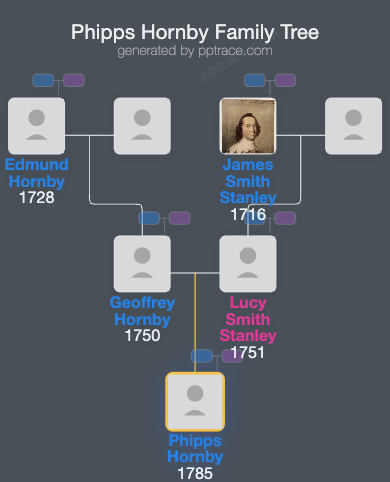
Family Tree
Tap  to expand more relatives
Introduction
Admiral Sir Phipps Hornby (27 April 1785 – 19 March 1867) was an officer in the Royal Navy. He served during the French Revolutionary Wars and the Napoleonic Wars. Hornby's early service included assignments on various frigates, and he experienced the Nore Mutiny firsthand at age 12 in 1797. His maritime career progressed through a series of commands and engagements, culminating in significant participation at the Battle of Lissa in 1811. During this battle, Hornby's ship, HMS Volage, engaged a larger French vessel, and Hornby sustained wounds while fighting a force more than twice their own strength. The action contributed to a British victory under William Hoste.
Hornby was born in 1785 as the fifth son of Reverend Geoffrey Hornby (1750–1812) of Scale Hall near Lancaster, Lancashire. His father served as Rector of Winwick, High Sheriff of Lancashire in 1774, and Deputy Lieutenant of Lancashire. His mother was Lucy Smith-Stanley (d. 1833), daughter of James Smith-Stanley, Lord Strange, and sister to Edward Smith-Stanley, 12th Earl of Derby. His family had notable connections to the Earldom of Derby, with his sister Charlotte Margaret Hornby marrying their first cousin, Edward Smith-Stanley, 13th Earl of Derby, who served as Prime Minister three times. Hornby's elder brother Edmund Hornby was Member of Parliament for Preston from 1812 to 1826.
Hornby joined the Royal Navy as a midshipman in 1797 at age 12. His first ship was HMS Latona, which became involved in the Nore Mutiny shortly after he joined. He then served on HMS Romney, HMS Agincourt, and HMS Theseus, mainly in the American waters. Following the Peace of Amiens in 1802, Hornby served briefly on HMS Victory under Admiral Horatio Nelson in the Mediterranean. He was attached to HMS Excellent and participated in operations along the Italian coast, including the capture of Capri.
Hornby received his first independent command in 1806 aboard HMS Duchess of Bedfordshire, successfully fighting off Spanish privateers. Promoted to commander in 1807, he commanded the sloop HMS Minorca, engaging Spanish gunboats off Cádiz. In 1809, he operated with the Adriatic Squadron, and the following year, he was promoted to post captain. He commanded HMS Fame temporarily before taking command of HMS Volage, serving under William Hoste. At Lissa in 1811, Hornby was wounded but continued combat against a larger French vessel, demonstrating notable resolve.
Later, Hornby commanded HMS Stag off the Cape of Good Hope and HMS Spartan in the Mediterranean, participating in the capture of Elba from the French. His service earned him the Austrian Order of St Joseph of Würzburg. On 4 June 1815, Hornby was appointed a Companion of the Order of the Bath. Afterward, he entered semi-retirement and became involved in politics, supporting the Earls of Derby.
In 1832, Hornby resumed naval duties to support his son's career, assuming roles such as superintendent of Plymouth Naval Hospital and later superintendent of Woolwich Dockyard. He was appointed extra naval aide-de-camp to the King in 1836. Between 1841 and 1846, Hornby served as comptroller-general of the Coast Guard, and in 1847, he became commander-in-chief of the Pacific Fleet, flying his flag in HMS Asia. His ranks advanced, and he was promoted through various grades, becoming a rear admiral of the red in 1851 and a Knight Commander of the Order of the Bath (KCB) in 1852.
Hornby served as Second Naval Lord under the Duke of Northumberland until his retirement in 1853. Post-retirement, he received further promotions, becoming vice-admiral of the blue (1854), vice-admiral of the white (1855), vice-admiral of the red (1857), full admiral (1858), and a Knight Grand Cross of the Order of the Bath (1861). He attained the rank of admiral of the white in 1862, admiral of the red in 1863, and was appointed Rear Admiral of the United Kingdom in 1866.
Hornby married Sophia Maria Burgoyne in 1814, daughter of General John Burgoyne. They had five daughters and three sons, including Sir Geoffrey Hornby, a Royal Navy officer, and James Hornby, an academic and headmaster of Eton College. He died at his estate in Little Green near Petersfield, Hampshire, on 19 March 1867.