Ida Chamberlain
| Name | Ida Chamberlain |
| Title | English political organizer and activist (1870-1943) |
| Gender | Female |
| Birthday | 1870-05-22 |
| nationality | United Kingdom |
| Source | https://www.wikidata.org/wiki/Q18529131 |
| pptrace | View Family Tree |
| LastUpdate | 2025-11-26T23:32:18.229Z |
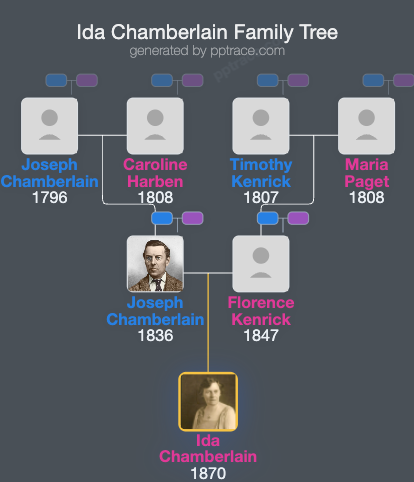
Family Tree
Tap  to expand more relatives
Introduction
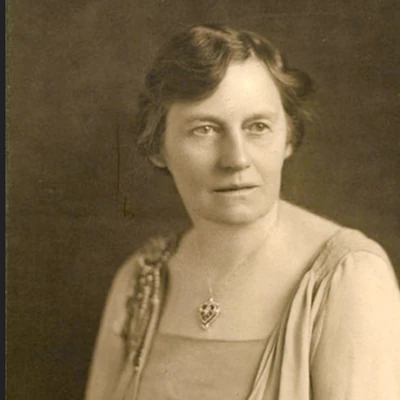
Florence "Ida" Chamberlain was born on 22 May 1870 in Edgbaston, Birmingham, England. She was the daughter of Florence (née Kenrick) and Joseph Chamberlain, a prominent British politician. Her mother died in childbirth in 1875, leading her elder half-sister Beatrice to assume a caregiving role.
Ida Chamberlain received her education at Allenswood Boarding Academy, an institution run by Marie Souvestre, where she studied alongside her younger sisters, Hilda and Ethel. Her early involvement in public service included assisting her brother Neville Chamberlain, who later became Prime Minister of the United Kingdom. In 1911, she helped establish a social service program at Birmingham General Hospital by developing an almoner service, supporting her brother Neville’s role as the hospital's house committee chair.
Following her father’s death in 1914, which resulted from a stroke he had suffered for nearly eight years, Ida and her sister Hilda contributed their resources to purchase Bury House in Odiham, Hampshire, a Grade II listed property from the 1600s, with good transportation links to London. The inheritance from their father amounted to £20,000 each. During Christmas 1914, they began planning new community projects at Bury House.
Ida's initial post-war activities focused on helping wounded soldiers, working alongside her sister Beatrice. In February 1918, she was elected to Hartley Wintney Rural District Council, marking her entry into public office. Her prior experience included employment with the Odiham branch of the Growers Co-operative Union, participation in the French Wounded Emergency Fund in London, and work at the Belgravia War Hospital Supply Depot. As a councillor in Hartley Wintney, she served as chair of the housing committee.
In 1925, Chamberlain was elected to Hampshire County Council, where she focused on health and housing issues. Her work there was aligned with her brother Neville Chamberlain’s role as Minister of Health, and she provided consultation and support to him and her sister Hilda. In 1931, she achieved the distinction of becoming Hampshire’s first woman alderman.
During the rise of Adolf Hitler and the increasing threat of war, Ida and her sister Hilda expressed concern about German militarization and sought to influence Neville Chamberlain, who served as Prime Minister. With the outbreak of World War II in 1939, Neville resigned, and Ida directed her efforts toward supporting Britain’s food supply, which was impacted by German attacks on maritime trade.
Ida Chamberlain died on 1 April 1943 at her residence, "The Bury," in Odiham. Her sister Hilda survived her, passing away in her nineties at the same address.
Further reading on Ida Chamberlain includes "The Austen Chamberlain Diary Letters: The Correspondence of Sir Austen Chamberlain with his Sisters Hilda and Ida, 1916–1937," edited by Robert C. Self and published by Cambridge University Press in 1995.