William F. Haddad
| Name | William F. Haddad |
| Title | American political operative, lobbyist, and journalist |
| Gender | Male |
| Birthday | 1928-01-01 |
| nationality | — |
| Source | https://www.wikidata.org/wiki/Q64021420 |
| pptrace | View Family Tree |
| LastUpdate | 2025-11-16T10:25:36.367Z |
Family Tree
Tap  to expand more relatives
Introduction
William Haddad was born on July 25, 1928, in Charlotte, North Carolina. His mother was Esther (Nowack) Haddad, a Jewish immigrant from Russia, and his father was Charles Haddad, a Syrian Jew. Haddad completed his education at St. Petersburg Junior College in Florida and earned a bachelor's degree from Columbia College in 1954. He also undertook studies at the Columbia Graduate School of Journalism.
Following his university education, Haddad engaged in careers spanning business, journalism, and politics. From 1954 to 1956, he served as an aide to U.S. Senator Estes Kefauver. During this period, he contributed to Kefauver's bid for the vice-presidency as the Democratic candidate alongside Adlai Stevenson. At the 1956 Democratic National Convention, Haddad played a role in helping Kefauver secure the nomination, competing against John F. Kennedy.
Haddad worked for the New York Post and gained recognition for investigative reporting that led to the exposure of corruption associated with Robert Moses. His reporting during this period earned him a Polk Award in 1958, with a shared award in 1959.
In the late 1950s, Haddad paused his journalism career to work as a special assistant for Senator John F. Kennedy during Kennedy’s presidential campaign. Subsequently, he served as an aide to Sargent Shriver and was instrumental in founding the Peace Corps. Haddad held the positions of first associate director and inspector general of the Peace Corps from 1961 to 1963.
After his work with the Peace Corps, Haddad returned to journalism as part of the New York Herald Tribune, which was owned by John Hay Whitney, his father-in-law. He resigned after several months and subsequently challenged Democratic Congressman Leonard Farbstein in the 1964 primary for New York's 19th congressional district, but was defeated.
Haddad served as inspector general for the Office of Economic Opportunity from 1964 to 1966. He also advised Robert F. Kennedy during Kennedy’s 1968 presidential campaign. During this period, he served on the New York Board of Education and was involved in publishing the newspaper The Manhattan Tribune, which aimed to provide a biracial perspective. The publication ceased in 1972.
In 1972, Haddad drew attention by informing journalist Jack Anderson about a surveillance plan by the Nixon administration to wiretap the Democratic National Committee staff. Although Anderson did not pursue the tip, the incident was related to the broader Watergate scandal that ultimately led to President Nixon’s resignation.
In the business sector, Haddad participated in the DeLorean Motor Company venture in 1979, serving as marketing director. He later authored a book titled *Hard Driving: My Years With John DeLorean*, documenting the company's rise and fall.
Haddad managed the campaign of Mario Cuomo in the 1982 New York gubernatorial election. Subsequently, he became actively involved in pharmaceutical lobbying, advocating for lower drug prices. He was chairman of the Generic Pharmaceutical Industry Association, which eventually merged into the Association for Accessible Medicines. His efforts contributed to the passage of the Drug Price Competition and Patent Term Restoration Act (Hatch-Waxman Act) in 1984, promoting the growth of the generic drug industry in the United States. He collaborated with Indian scientist Yusuf Hamied of Cipla to promote affordable medicines for HIV/AIDS treatment in Africa and India.
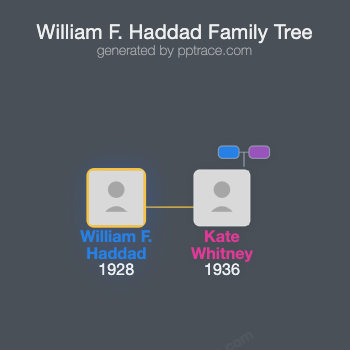
William Haddad married Kate Roosevelt in 1959. She was the daughter of Congressman James Roosevelt and Betsey Cushing Roosevelt Whitney, granddaughter of President Franklin D. Roosevelt, and adoptive daughter of John Hay Whitney. The marriage ended in divorce. Haddad's second marriage to Noreen Walsh also ended in divorce. He passed away on April 30, 2020, due to congestive heart failure. He was survived by children from both marriages, a stepson, thirteen grandchildren, and two great-grandsons.