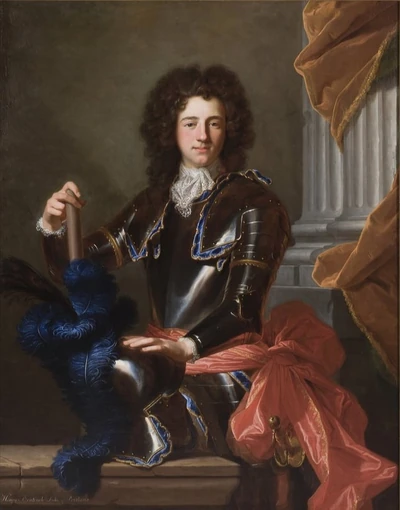
Henry Bentinck, 1st Duke Of Portland
| Name | Henry Bentinck, 1st Duke Of Portland |
| Title | English peer and Governor of Jamaica (1682-1726) |
| Gender | Male |
| Birthday | 1682-03-17 |
| nationality | — |
| Source | https://www.wikidata.org/wiki/Q126107 |
| pptrace | View Family Tree |
| LastUpdate | 2025-11-26T23:25:31.888Z |
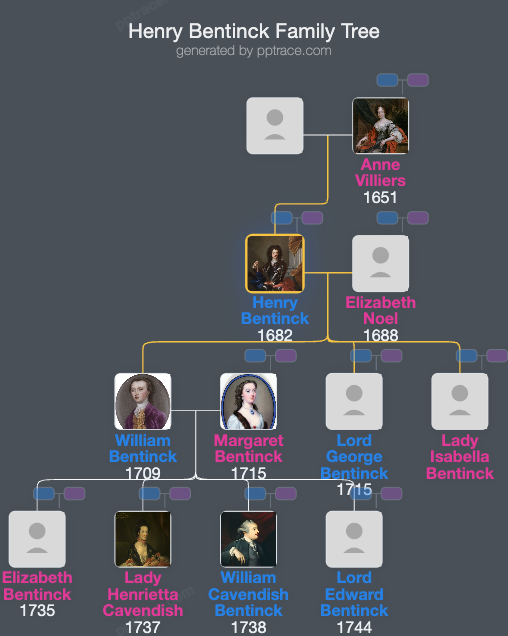
Family Tree
Tap  to expand more relatives
Introduction
Henry Bentinck, 1st Duke of Portland (17 March 1682 – 4 July 1726), was a British Army officer, politician associated with the Whig party, and colonial administrator. He served as the governor of Jamaica from 1721 until his death in 1726.
Born in 1682, Bentinck was the second son of William Bentinck, 1st Earl of Portland, and Anne Villiers. His maternal grandfather was Sir Edward Villiers, and she was the sister of Edward Villiers, 1st Earl of Jersey. During the years 1702 to 1703, Bentinck completed the Grand Tour—an educational journey through Europe—accompanied by his tutor, Paul de Rapin, a historian. His travels took him through Italy and Germany.
On 9 June 1704, Bentinck married Lady Elizabeth Noel, the daughter of Wriothesley Baptist Noel, 2nd Earl of Gainsborough, and Catherine Greville. Lady Elizabeth Noel was an heiress with a fortune estimated at £60,000, and her dowry included the estate of Titchfield in Hampshire.
In politics, Bentinck was elected as a Member of Parliament (MP) for Southampton in the 1705 general election, representing the Whig party. His parliamentary activity was limited, primarily involving minor functions. In the 1708 election, he was returned unopposed for Southampton and also contested Hampshire, opting to sit for the latter. He served as a teller for the Whigs during parliamentary proceedings. Succeeding his father as Earl of Portland on 23 November 1709, he vacated his seat in the House of Commons to take a seat in the House of Lords. At this time, he owned the family seat of Bulstrode in Berkshire and inherited substantial estates—valued at approximately £850,150—in various counties across England, including Cheshire, Cumberland, Hertfordshire, Norfolk, Sussex, Westminster, and Yorkshire.
Between 1710 and 1713, Bentinck held the military position of Colonel of the 1st Troop of Horse Guards. On 6 July 1716, he was elevated to the titles of Marquess of Titchfield and Duke of Portland. In 1719, he became a significant supporter of the Royal Academy of Music, a company involved in producing baroque opera. Also, in 1717, he was appointed as a Lord of the Bedchamber, a position he retained until his death.
In 1720, Bentinck experienced substantial financial losses due to the South Sea Bubble, a speculative financial crisis. Despite his wealth and political stature, he accepted the role of governor of Jamaica in 1721, a post regarded as lucrative but relatively undistinguished and associated with low survival rates. During his tenure, he became a slave owner, owning 287 enslaved individuals, consisting of 158 males and 129 females.
Henry Bentinck died in Spanish Town, Jamaica, on 4 July 1726, at the age of 45. His body was transported back to England for burial in Westminster Abbey, where he was interred on 3 November 1726 in the vault of the Dukes of Ormond within the King Henry VII Chapel.
He and his wife, Lady Elizabeth Noel, had ten children: three sons and seven daughters. Their children included William Bentinck, Viscount Woodstock, who later became Marquess of Titchfield and then the 2nd Duke of Portland; Lord George Bentinck; Lady Anne Bentinck; Lady Amelia Catharina; Lady Isabella; and several others, some of whom married into notable families.