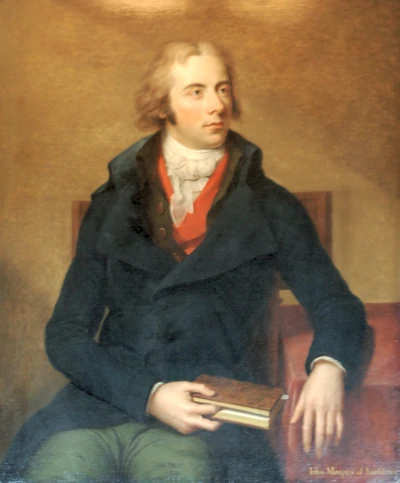
John Petty, 2nd Marquess Of Lansdowne
| Name | John Petty, 2nd Marquess Of Lansdowne |
| Title | British politician (1765-1809) |
| Gender | Male |
| Birthday | 1765-05-02 |
| nationality | Great Britain |
| Source | https://www.wikidata.org/wiki/Q923438 |
| pptrace | View Family Tree |
| LastUpdate | 2025-11-26T23:25:09.583Z |
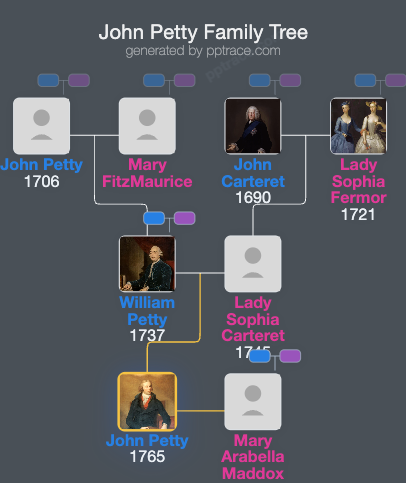
Family Tree
Tap  to expand more relatives
Introduction
John Henry Petty, 2nd Marquess of Lansdowne (born December 6, 1765; died November 15, 1809), was a British aristocrat and politician. He was initially known as Earl Wycombe from 1784 until 1805. He was born in London, the eldest son of William Petty, 2nd Earl of Shelburne, who later became the British Prime Minister, and Lady Sophia Carteret, daughter of John Carteret, 2nd Earl Granville. John Henry Petty was baptized at St George's, Hanover Square, Mayfair, on the day of his birth.
He was educated at Christ Church, Oxford, where he matriculated in 1783 at age 17 and graduated with an M.A. in 1785. His father was instrumental in his political career, securing him an English seat in the House of Commons in 1786, representing Chipping Wycombe, a seat previously held by his father. At that time, he held the courtesy title of Earl Wycombe.
Petty was associated with the Whig political faction and developed an independent stance, partly influenced by his travels and experiences. Between 1789 and 1790, he traveled on the European continent, including visits to Italy, Switzerland, and Paris, witnessing the early effects of the French Revolution. He also traveled to the United States in 1791. Upon returning to England late in 1792, he began to establish a reputation as a reform-minded critic of the government, which was then led by William Pitt. Petty was known for opposing the suppression of democratic agitation and supported parliamentary reform, although his position was often dependent on his relationship with his family and political allies.
In 1797, he went to Ireland and managed family estates there, becoming involved in Irish affairs amid the revolutionary unrest. During his time in Ireland, Petty maintained contacts with republican sympathizers, including the United Irishmen, and is believed to have been aware of the plans for insurrection led by Robert Emmet. He reported on military suppressions and violent repression during the Irish rebellion of 1798. Several accounts suggest that he was privy to discussions and activities related to the rising, and he was accused by some contemporaries of being involved in the conspiracy.
Despite suspicions, Petty remained in Ireland until 1803. He expressed concern over the conditions during the insurgency and attempted to help others escape following the failed rebellion. In December 1803, he inquired with the Irish Chief Secretary William Wickham about warrants for his arrest, which Wickham assured him had not been issued. Nevertheless, Petty's political associations and sympathies for revolutionary causes led to his distancing from Irish affairs for a time.
On May 7, 1805, Petty succeeded his father as the 2nd Marquess of Lansdowne. Subsequently, he married Maria Arabella Gifford, née Maddock, widow of Duke Gifford of Castle Jordan, County Meath. They had no children. His final years were spent in Southampton, where he expressed support for the British government amidst the Napoleonic wars.
Throughout his later life, Petty maintained a correspondence with Frances Stewart, Marchioness of Londonderry, discussing political and social issues, often expressing criticism of policies related to Ireland, the Act of Union, the Anglican church, navigation laws, and religion.
He died in 1809 at the age of 43. His half-brother Henry Petty-Fitzmaurice succeeded him as Marquess of Lansdowne.