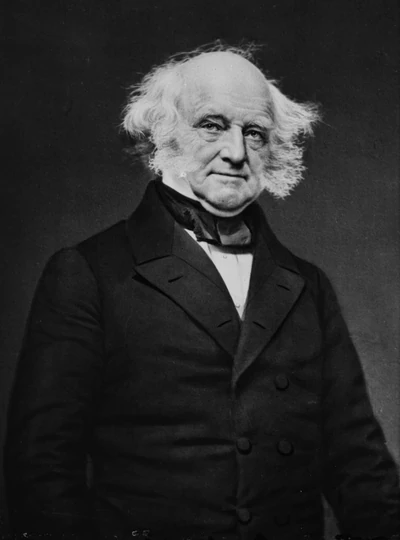
Martin Van Buren
| Name | Martin Van Buren |
| Title | president of the United States from 1837 to 1841 |
| Gender | Male |
| Birthday | 1782-12-05 |
| nationality | United States of America |
| Source | https://www.wikidata.org/wiki/Q11820 |
| pptrace | View Family Tree |
| LastUpdate | 2025-11-17T06:38:29.197Z |
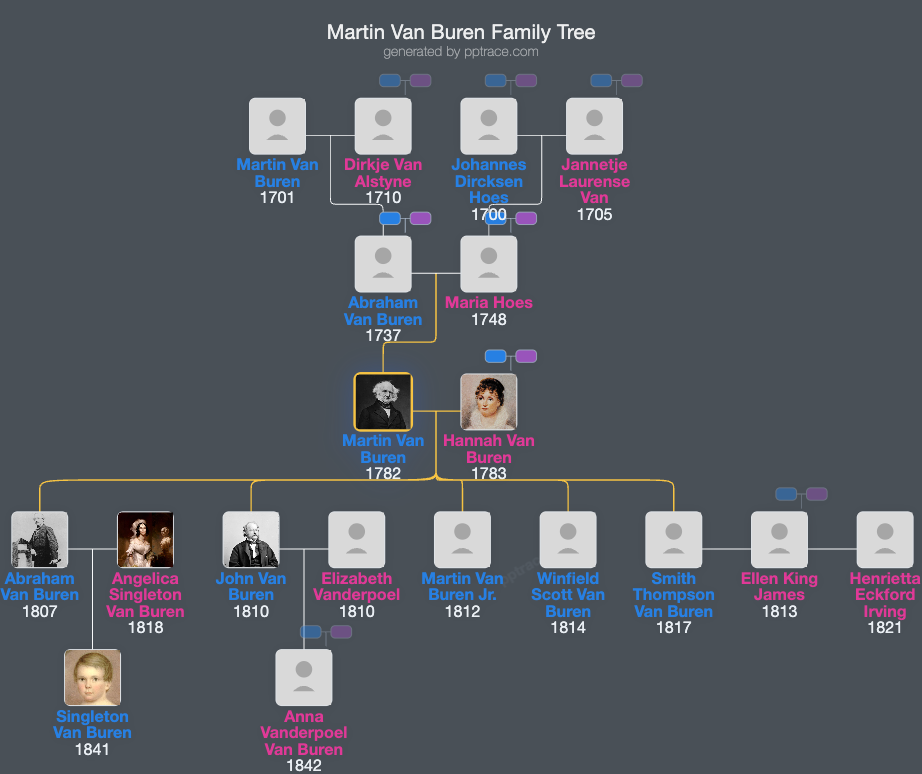
Family Tree
Tap  to expand more relatives
Introduction
Martin Van Buren (December 5, 1782 – July 24, 1862) was an American politician who served as the eighth president of the United States from 1837 to 1841. He was a founding member of the Democratic Party and held several prominent offices before his presidency, including New York's attorney general, a U.S. senator, a member of the New York State Senate, and the ninth governor of New York. Van Buren also served as the tenth United States secretary of state, minister to the United Kingdom, and the eighth vice president under President Andrew Jackson from 1833 to 1837.
Born in Kinderhook, New York, Van Buren arose from a background of Dutch descent, with most residents of Kinderhook speaking Dutch as their primary language. He is noted as the only U.S. president whose first language was not English, having learned English during his schooling. His father, Abraham Van Buren, was a Patriot in the American Revolution, owned an inn and tavern, and served as Kinderhook's town clerk. Martin Van Buren's early education was at the village schoolhouse, with brief studies in Latin at Kinderhook Academy and Washington Seminary. He read law under Peter Silvester and Francis Silvester after 1796, becoming a legal professional in 1803.
In 1807, Van Buren married Hannah Hoes, his childhood sweetheart, in Catskill, New York. They had six children, four of whom survived into adulthood: Abraham, John, Martin Jr., and Smith Thompson. Hannah Van Buren died of tuberculosis in 1819. Van Buren never remarried.
Van Buren's political career began early; he participated in Democratic-Republican Party conventions and was elected to the New York State Senate in 1812. He became a key figure in New York politics, prominent as leader of the Bucktails faction and establishing the Albany Regency, a political machine. He was appointed surrogate of Columbia County in 1807, and his practice as a lawyer flourished after moving to Hudson, New York, in 1808.
He briefly served as New York's governor in 1829, supporting Andrew Jackson's presidential campaign in 1828, before resigning to serve as Jackson's secretary of state. In this role, he collaborated in building the Democratic Party’s organizational structure. Van Buren was a key advisor to Jackson and played a significant role in the Petticoat affair, which led to his appointment as ambassador to the United Kingdom in 1831.
The Democratic ticket nominated Van Buren as vice president in 1832, and he assumed office after the election. In 1836, Van Buren was elected president with strong support from Jackson and the Democratic Party. His presidency was marked by the Panic of 1837, a financial crisis that led to a severe economic depression. His notable policy response was the implementation of the Independent Treasury system, which aimed to store federal funds separately from private banks. His administration also dealt with the costly Second Seminole War and refused to admit Texas as a slave state.
Van Buren ran for re-election in 1840 but was defeated by William Henry Harrison. He was considered an average or below-average president based on historical rankings, largely due to his response to the Panic of 1837. Initially a leading candidate for the 1844 Democratic nomination, he opposed the annexation of Texas, which contributed to his failure to secure the nomination in favor of James K. Polk.
Later, Van Buren became involved with the Free Soil Party, running as its presidential candidate in 1848 to oppose the expansion of slavery. His candidacy contributed to Zachary Taylor's victory over Democrat Lewis Cass. He subsequently returned to the Democratic Party but was disappointed with the pro-southern administrations of Franklin Pierce and James Buchanan.
During the American Civil War, Van Buren supported President Abraham Lincoln and was regarded as a War Democrat. He died at his home in Kinderhook in 1862, at the age of 79, from asthma.