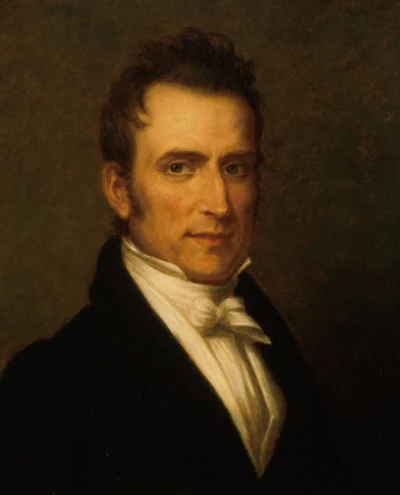
John McLean
| Name | John McLean |
| Title | American jurist and politician (1785-1861) |
| Gender | Male |
| Birthday | 1785-03-11 |
| nationality | United States of America |
| Source | https://www.wikidata.org/wiki/Q1371498 |
| pptrace | View Family Tree |
| LastUpdate | 2025-11-17T06:39:32.483Z |
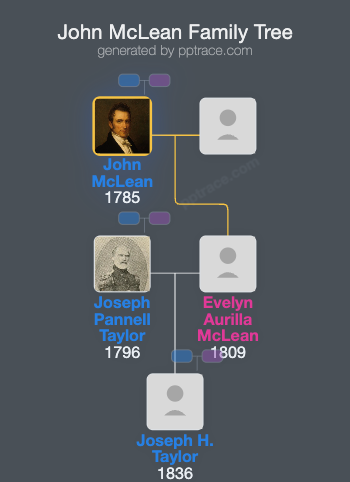
Family Tree
Tap  to expand more relatives
Introduction
John McLean was born on March 11, 1785, in Morris County, New Jersey. His parents were Fergus McLean and Sophia Blackford. During his childhood, he resided in several frontier towns, including Morgantown, Virginia; Nicholasville, Kentucky; and Maysville, Kentucky. In 1797, his family settled in Ridgeville, Warren County, Ohio. McLean received his formal education there and developed an interest in law. He graduated from Harvard University in 1806.
In 1807, McLean was admitted to the bar and began practicing law. That same year, he founded The Western Star, a weekly newspaper, in Lebanon, Ohio. In 1810, ownership of the newspaper was transferred to his brother Nathaniel, and McLean started practicing law independently.
McLean was elected to the U.S. House of Representatives, serving in the Thirteenth and Fourteenth Congresses from March 4, 1813, until 1816. On February 17, 1816, he was elected to the Ohio Supreme Court, succeeding William W. Irvin. He served on the Ohio Supreme Court until 1822 when he resigned to accept an appointment in the administration of President James Monroe.
From December 9, 1823, to March 7, 1829, McLean served as the United States Postmaster General. His tenure coincided with a period of expansion for the Postal Service, especially into western states and territories. During this time, he supported Vice President John C. Calhoun, despite factional tensions within the administration.
In 1829, President Andrew Jackson appointed McLean as an associate justice of the United States Supreme Court, filling the vacancy left by Robert Trimble. He was confirmed by the Senate on March 7, 1829, and sworn in on March 12, 1829. McLean served on the Supreme Court until his death in 1861.
Throughout his judicial career, McLean was known for his opposition to slavery. Notably, he was the sole dissenter in the 1850 case of Prigg v. Pennsylvania and one of only two justices dissenting in the landmark Dred Scott v. Sandford decision of 1857.
McLean's early legal and judicial philosophy was influenced by his evangelical Methodist upbringing, which emphasized egalitarian principles. During his tenure on the Ohio Supreme Court, he delivered a notable opinion in the case of State v. Carneal, involving a Kentucky slave named Richard Lunsford. The case, which occurred during McLean’s time on the Ohio Supreme Court, foreshadowed his later dissent in Dred Scott. In his opinion, McLean expressed opposition to slavery, stating, "Slavery, except for the punishment of crimes, is an infringement upon the sacred rights of man: Rights, which he derives from his Creator, and which are inalienable."
In his federal judicial service, McLean participated in cases such as Groves v. Slaughter (1841), where he upheld Mississippi’s right to restrict the importation of slaves and emphasized the importance of congressional regulation of commerce. Despite his economic nationalist inclinations, in this case, he also held that the power over slavery belonged to the states, reflecting his complex views on the issue.
McLean was considered a potential presidential candidate for various parties, including the Whigs, the Free Soilers, and later the Republicans. He was supported at the 1848 Whig National Convention, the 1856 Republican National Convention, and the 1860 Republican National Convention. Although he sought the presidency in 1860, he was not nominated; Abraham Lincoln received the Republican nomination.
He served on the Supreme Court until his death on April 4, 1861, in Washington, D.C.