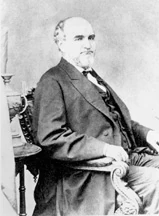
David T. Patterson
| Name | David T. Patterson |
| Title | American politician (1818-1891) |
| Gender | Male |
| Birthday | 1818-02-28 |
| nationality | United States of America |
| Source | https://www.wikidata.org/wiki/Q5240252 |
| pptrace | View Family Tree |
| LastUpdate | 2025-11-17T06:40:24.438Z |
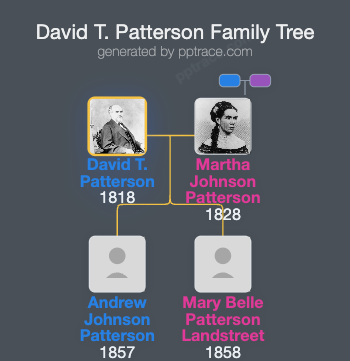
Family Tree
Tap  to expand more relatives
Introduction
David Trotter Patterson was born on February 28, 1818, at Cedar Creek, near Greeneville, Tennessee. He attended common schools and completed two years of study at Greeneville College. Subsequently, Patterson studied law under the instruction of a local attorney and was admitted to the bar in 1841, beginning his legal practice in Greeneville. In addition to practicing law, he engaged in manufacturing activities and acquired substantial landholdings in East Tennessee, cultivating commodity crops.
Patterson owned enslaved individuals prior to the Civil War era. He served as a judge of the first circuit court of Tennessee from 1854 to 1863. He married Martha Johnson on December 13, 1855. Martha was the daughter of Andrew Johnson and Eliza McCardle. The couple had two children: a son named Andrew (born 1857, died 1932) and a daughter named Mary (1859–1891).
As a political figure, Patterson was a Unionist representing East Tennessee, a region with significant Union support during the Civil War. Following Tennessee's readmission to the Union on July 24, 1866, Patterson was elected to the United States Senate by the Tennessee General Assembly. Tennessee was the first former Confederate state to regain representation in Congress after the Civil War. Patterson presented his credentials to the Senate on July 26, 1866; however, his credentials were challenged, and he was not permitted to take the oath of office until July 28, 1866.
During his tenure in the Senate, Patterson was closely associated with his father-in-law, Andrew Johnson, who had ascended to the presidency after Abraham Lincoln's assassination in 1865. In February 1868, Andrew Johnson was impeached by the House of Representatives. Patterson found himself involved in the impeachment proceedings as the Senate was responsible for conducting the trial. The Senate ultimately voted to acquit Johnson in May 1868, falling just short of the two-thirds majority required for conviction. Patterson believed that Johnson was not guilty and viewed the impeachment as politically motivated.
Patterson's term in the Senate concluded on March 3, 1869, and he retired from public office. Following his retirement, he returned to East Tennessee where he managed his agricultural interests. He died on November 3, 1891, in the community of Afton. He was interred alongside the Johnson family in the Andrew Johnson National Cemetery in Greeneville.
References for Patterson's biography include resources from the United States Congress, specifically the Biographical Directory of the United States Congress, as well as historical writings such as Kenneth McKellar's "Tennessee Senators as Seen by One of Their Successors" and W.S. Speer's 1888 sketches of prominent Tennesseans.