Kataoka Nizaemon XIII
| Name | Kataoka Nizaemon XIII |
| Title | Japanese kabuki actor (1903-1994) |
| Gender | Male |
| Birthday | 1903-12-15 |
| nationality | Japan |
| Source | https://www.wikidata.org/wiki/Q11569673 |
| pptrace | View Family Tree |
| LastUpdate | 2025-11-17T09:48:30.833Z |
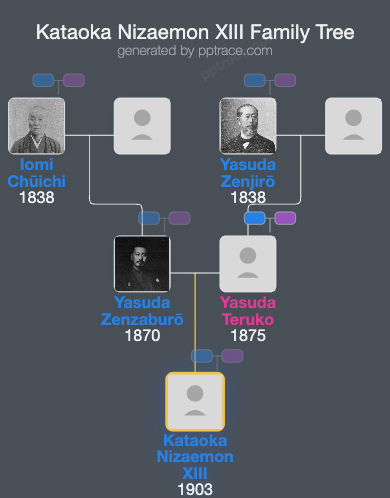
Family Tree
Tap  to expand more relatives
Introduction
The thirteenth generation Kataoka Nizaemon (born Katō Chiyonosuke; December 15, 1903 – March 26, 1994) was a Japanese kabuki actor. His real name was Katō Chiyonosuke. His shop name was Matsushima-ya, and his crest was a seven-pointed split circle with two pulls. He was recognized as a member of the Japan Arts Academy and as a holder of a Significant Intangible Cultural Asset (Living National Treasure).
He was born in Tokyo as the third son of Yasuda Zenzaburō and his daughter, Yasuda Yoshijirō's daughter, Teruko. Shortly after birth, he moved to Tokyo and became an adopted son of the 11th generation Kataoka Nizaemon. In 1905, he made his first stage appearance at the Minami-za Theatre in Kyoto. From childhood, he participated in activities such as the Kataoka Boys’ Theater, and from 1912 onwards, he appeared in boy kabuki performances.
In April 1929, he took on the name of the Fourth Kataoka Gato at the Kabuki-za Theatre. From that point, he mainly performed in Tokyo and deepened his studies under performers like the Seventh Ichikawa Chūza, who inherited the lineage of the Ninth Danjūrō. In January 1932, he formed a Youth Kabuki troupe at the Shinjuku New Kabuki Theatre operated by Shochiku, where he worked as a troupe leader. His activity in Youth Kabuki lasted about seven years.
In September 1939, he transferred to Kamigata (Osaka/Kansai) kabuki, and his activities centered around the Kansai region. In 1951, he succeeded his deceased father as Kataoka Nizaemon. However, from the 1960s onward, as Kansai kabuki declined, his activities became more limited. He formed the “Seven People’s Group” with actors such as the Second Nakamura Ganjirō and the Third Jikkainoen Wakayuki, but it did not attract much attention. Subsequently, from 1962, he launched his own performances under the name “Nizaemon Kabuki,” producing five independent shows with his own funding.
He was also dedicated to nurturing talent, hosting kabuki classes and managing the “Wakashio no Kai,” a group that trained young actors, aiming to develop the next generation.
In 1966, his performance as Izōemon in the play "Kurokura-Bunshō" at the Kabuki-za received high praise, showcasing a marked development in his acting. Especially from his late 70s to 80s, when retirement was near, his acting became notably deeper. In his final years, despite suffering from declining vision and eventual blindness, he continued to perform on stage.
In 1972, he was recognized as a holder of an Important Intangible Cultural Asset. In 1981, he delivered a superb performance in “Sugen Genjō Tehon Gaku,” at the National Theatre, which was so exquisite that he was likened to the deity Tenjin. From then on, even as his eyesight gradually worsened due to glaucoma, he kept performing. He was inducted as a member of the Japan Arts Academy in 1981 and was designated a Person of Cultural Merit in 1992.
His final stage appearance was at the 1993 Kagami-no-za performance at the Kyoto Minami-za, where he played Masa Kiyoshi in the segments “Hachi-Jin Moro no Go” and “The Guard of the Eight Banner Walls and the Crowned Ship.” He died of natural causes at his home in Kyoto on March 26, 1994, at the age of 90 (92 according to the Japanese age reckoning).
His family includes his children: the Fifth Kataoka Gato, the Japanese dance artist Hanryū Juju, the Second Kataoka Hidetarō, the Fourteenth Kataoka Nizaemon, and actress Kataoka Shizuka.