Yasuda Zenjirō II
| Name | Yasuda Zenjirō II |
| Title | (1879-1936) |
| Gender | Male |
| Birthday | 1879-03-07 |
| nationality | Q188712 |
| Source | https://www.wikidata.org/wiki/Q77808278 |
| pptrace | View Family Tree |
| LastUpdate | 2025-11-17T10:08:21.514Z |
Family Tree
Tap  to expand more relatives
Introduction
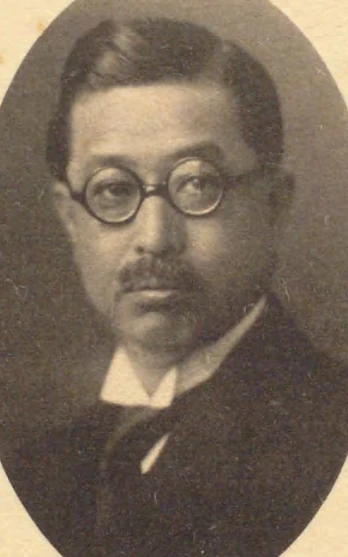
Yasuda Zenjiro (born March 7, 1879 – November 23, 1936) was a Japanese businessman. His original given name was Zennosuke. He used the pseudonym Matsuno-sha.
Birth and Family Background
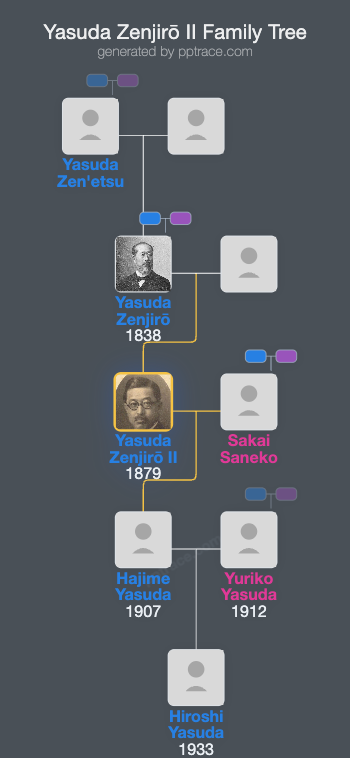
He was born as the eldest son of the first Yasuda Zenjiro. His father's name was also Yasuda Zenjiro. There are no records regarding his mother. His wife was Senko, the second daughter of Sutetsu Sakai. His children included his eldest son, Yasuda Hajime, and grandson, Yasuda Hiroshi. His brothers included Yasuda Gengorō and Yasuda Yō. There was also a granddaughter of his sister Teru (Kōko).
Education and Life History
Details of his educational background are not recorded. In 1896, he became the president of Yasuda Bank, concurrently serving as a director of Kyōsai Life Insurance. In 1920, he assumed the presidency of Ōgaki Kyōritsu Bank, and in 1921, he became the president of Teikoku Seima (Imperial Synthetic Hemp). The same year, he inherited the family headship and changed his name to Yasuda Zenjiro. In 1923, he was appointed president of the Third Bank and Yasuda Bank, as well as president of Kyōsai Trust. In 1936, he became president of Yasuda Life Insurance and Imperial Synthetic Hemp but died in that year.
Death
He passed away on November 23, 1936 (Showa 11), at the age of 58.
Hobbies and Collections
Alongside his business career, he was interested in bibliography and the collection of rare books, being known as a collector of valuable and hard-to-find books. His collection was destroyed in the Great Kanto Earthquake and the Tokyo Air Raids. His most famous collection was called the "Matsuno-sha Library," which mainly contained materials related to kabuki, including numerous classical texts, autographed manuscripts, and documents. It included materials related to renowned actors such as Ichikawa Danjūrō I and Onoe Kikugorō, as well as documentation on Noh and Kabuki traditions, actor evaluations, and old Jōruri (puppet theater) texts. Many of his books were lost due to fires, but some items can be known from exhibition materials at the National Library Conference in 1919.
Another collection, the "Yasuda Bunko," was reassembled after the Great Kanto Earthquake. It includes ancient sutras, calligraphy, editions of books, handwritten manuscripts from prominent Edo period families, Noh chants, and Edo-period ukiyo-e prints. He purchased many old possessions in bulk and acquired works from other collectors. His collection also included approximately 400 types of old movable type editions, as well as popular illustrated stories and chūraku sanninbon (woodblock-printed narrative books).
Donations and Remaining Materials
Materials related to theater were donated to Waseda University Theatre Museum. Many other materials were stored in a temporary library in Hirakawa-chō but were destroyed in the 1945 Tokyo Air Raids. Some items were lost during wartime evacuations, but others were circulating in the markets.
Overview of the Person
He was a leader in the business world, involved in managing banks and insurance companies, while also having a deep interest in ancient books and the history of kabuki.