Kijūrō Shidehara
| Name | Kijūrō Shidehara |
| Title | Japanese politician (1872-1951) |
| Gender | Male |
| Birthday | 1872-09-13 |
| nationality | Japan |
| Source | https://www.wikidata.org/wiki/Q335191 |
| pptrace | View Family Tree |
| LastUpdate | 2025-11-17T10:09:37.809Z |
Family Tree
Tap  to expand more relatives
Introduction
Kijūrō Shidehara (幣原 喜重郎, Shidehara Kijūrō) was born on September 13, 1872, in Kadoma, Osaka, Japan, into a wealthy farming family. His brother, Taira Shidehara, was the first president of Taihoku Imperial University. Shidehara pursued higher education at Tokyo Imperial University, where he graduated from the Faculty of Law in 1895, studying under Hozumi Nobushige.
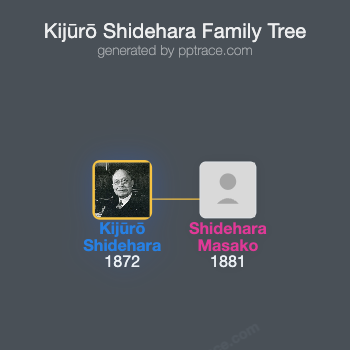
Following his graduation, Shidehara entered the Japanese Foreign Ministry, beginning his diplomatic career with an assignment as a consul in Chemulpo, Korea, in 1896. In 1903, he married Masako Iwasaki, who was affiliated with the Mitsubishi zaibatsu, making him the brother-in-law of Katō Takaaki, a future Prime Minister of Japan. Throughout his diplomatic service, he held postings in London, Antwerp, Washington D.C., and the Netherlands, where he served as ambassador. He returned to Japan in 1915 and was appointed Vice Minister of Foreign Affairs, a position he held across five consecutive administrations.
In 1919, Shidehara was appointed ambassador to the United States, serving until 1922. During this period, he was Japan's chief negotiator at the Washington Naval Conference. His diplomatic efforts included negotiations leading to the return of Jiaozhou Bay concession to China. His tenure was also marked by the enactment of discriminatory U.S. immigration laws against Japanese immigrants, which heightened tensions between the two nations. In recognition of his service, he was granted the peerage title of danshaku (baron) under the kazoku system in 1920, and in 1925, he was elected to a seat in the House of Peers.
Shidehara served as Japan’s Minister of Foreign Affairs initially in 1924 in Prime Minister Katō Takaaki’s cabinet, then again from 1929 to 1931. His foreign policy emphasized non-intervention in China and maintaining good relations with Western powers, including Britain and the United States. During his tenure, he promoted the principles of the League of Nations and maintained a liberal foreign policy known as "Shidehara diplomacy." Notably, he advocated for tariff autonomy for China and opposed military interventions, particularly during the Nanking Incident of 1927. His diplomatic approach was characterized by strong command of English and a preference for peaceful diplomacy.
In September 1931, the Kwantung Army, without central government approval, invaded Manchuria, marking the end of his non-interventionist policies and significantly impacting his diplomatic career. He was featured on the cover of Time magazine in October 1931, labeled as "Japan's Man of Peace and War."
During the lead-up and duration of World War II, Shidehara maintained a relatively low profile, remaining in government as a member of the House of Peers until 1945. After Japan's surrender, he was appointed as Prime Minister, serving from October 9, 1945, to May 22, 1946. His government was responsible for initiating reforms under the Allied occupation. It was during his premiership that the inclusion of Article 9 in the new Japanese constitution was proposed—an article limiting Japan’s capacity to wage war. Shidehara is credited with the idea of Article 9, which he reportedly conceived during a train ride to Tokyo, inspired by concepts of outlawing war he had encountered during his diplomatic work in Washington.
Following his tenure as prime minister, he continued active involvement in politics and diplomacy. He was elected to the National Diet in 1947, joined the Liberal Party after the Socialist government of Prime Minister Tetsu Katayama, and served as the speaker of the House of Representatives from 1949 until his death. Shidehara passed away on March 10, 1951, leaving a legacy as a diplomat advocating pacifism and cautious international engagement.
Throughout his career, he received numerous domestic and foreign honors, including the Grand Cordon of the Order of the Sacred Treasure, the Order of the Rising Sun, and international awards such as the Grand Cross of the Legion of Honour (France) and the Order of Saints Maurice and Lazarus (Italy).