Henry Hobart
| Name | Henry Hobart |
| Title | Anglican clergyman |
| Gender | Male |
| Birthday | 1774-01-01 |
| nationality | Great Britain |
| Source | https://www.wikidata.org/wiki/Q5723072 |
| pptrace | View Family Tree |
| LastUpdate | 2025-11-26T12:35:51.166Z |
Family Tree
Tap  to expand more relatives
Introduction
Hon. Henry Lewis Hobart (baptized 9 February 1774 – 8 May 1846) was an English Anglican priest who held the position of Dean of Windsor and, by virtue of that appointment, also served as Dean of Wolverhampton.
**Early Life and Education**
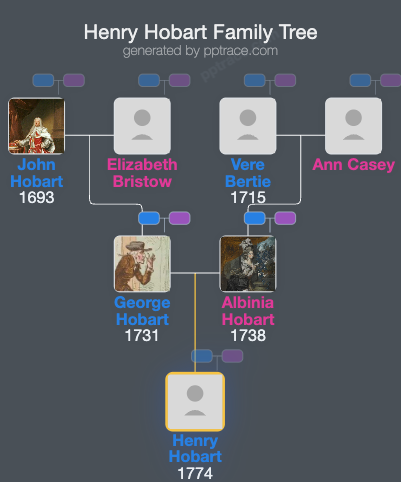
Henry Hobart was born in Nocton, Lincolnshire. He was the youngest of eight surviving children of George Hobart, the 3rd Earl of Buckinghamshire. His father was a Member of Parliament representing Grenville Whigs from 1754 to 1780 and served briefly as secretary to the British embassy in Saint Petersburg. In 1793, George Hobart succeeded his half-brother as Earl of Buckinghamshire.
Henry Hobart's mother was Albinia Bertie, the daughter of Lord Vere Bertie, who was the younger son of Robert Bertie, 1st Duke of Ancaster and Kesteven. Henry was baptized on 9 February 1774 in the parish church at Nocton.
He was educated at Westminster School and subsequently attended Christ's College, Cambridge, entering in 1793. He graduated with a Master of Arts degree in 1797 and later attained a Doctor of Divinity in 1816.
**Ecclesiastical Career**
Hobart was ordained as a deacon in Winchester in June 1797 and as a priest in February 1798. Due to his family background, he was able to secure multiple ecclesiastical positions early in his career, often in plurality, which was a common practice until restrictions were introduced by the Pluralities Act 1850.
His first appointed benefice was as rector of Chipping Warden in Northamptonshire, a position he held from 1797 to 1815. In 1801, he became rector of Edgcote, a nearby parish, maintaining both until 1815. He also held a prebendary position at Canterbury Cathedral from 1804 to 1816.
In 1815, Hobart obtained three lucrative church livings in a single year: he became Vicar of Nocton, Rector of St Dionis Backchurch in the City of London (a position he held until 1828), and Rector of Great Haseley in Oxfordshire.
In 1816, Hobart was appointed Dean of Windsor, a key ecclesiastical position that made him the spiritual head of St George's Chapel at Windsor Castle. This chapel served as a chapel royal and a royal peculiar, functioning as the private chapel of the monarch. He served as dean through the reigns of four monarchs: George III, George IV, William IV, and Queen Victoria. The role also included the responsibility of serving as the Register of the Order of the Garter.
As dean, Hobart had access to the monarch but is not known to have wielded significant influence. Notes suggest he may have lacked tact, exemplified by a remark congratulating Queen Victoria on her delivery of a male heir rather than a daughter in 1841.
Beyond Windsor, Hobart accumulated additional benefices. From 1823 to 1842, he was the vicar of Fulmer in Buckinghamshire, and from 1828, he served as Vicar of Wantage in Berkshire.
**Deanery of Wolverhampton**
The deanery of Wolverhampton was a royal peculiar associated with the Dean of Windsor due to historic tradition. St Peter's Collegiate Church, the center of the deanery, encompassed a large rural and urban parish extending into the Black Country and Staffordshire. The deanery and its prebends were considered largely vacant in practice, as absentee clergy delegated responsibilities to underpaid curates.
The revenues from the deanery, estimated at £600 annually, benefited from mineral rights beneath the land. During the 1830s, criticisms arose regarding clerical absenteeism, perceived corruption, and negligence, especially following conflicts involving Dr. Oliver, Hobart's Perpetual Curate in Wolverhampton.
The Ecclesiastical Commission was established in 1836 to reform Church of England revenues, leading to legislation such as the Cathedrals Act 1840 and the Ecclesiastical Commissioners Act 1840. These laws provided for the abolition of certain deaneries, including Wolverhampton. While deans were permitted to serve until death, the physical deanery was suppressed upon Hobart’s death, and the college was dissolved two years later.
**Family and Personal Life**
On 5 October 1824, Henry Hobart married Charlotte Selina Moore, daughter of Richard Moore, a Chelsea landowner who resided at Hampton Court Palace. The marriage produced at least seven children. Their eldest son, Robert Hobart (1836–1928), engaged in politics as a Liberal Member of Parliament from 1906 to 1910 and was created a baronet in 1914.
**Death**
Henry Lewis Hobart died on 8 May 1846.