Princess Louise Of Prussia
| Name | Princess Louise Of Prussia |
| Title | Prussian princess, 1770–1836 |
| Gender | Female |
| Birthday | 1770-05-24 |
| nationality | — |
| Source | https://www.wikidata.org/wiki/Q133752 |
| pptrace | View Family Tree |
| LastUpdate | 2025-11-12T01:15:51.134Z |
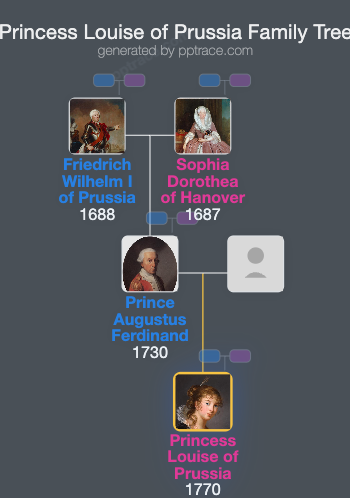
Family Tree
Tap  to expand more relatives
Introduction
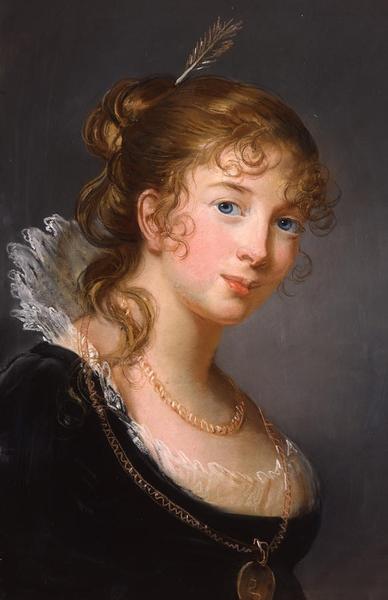
Princess Frederica Dorothea Louise Philippine of Prussia, commonly referred to as Princess Louise of Prussia, was born on 24 May 1770 in Berlin, at the Ordenspalais, the residence of the Order of Saint John. She was a member of the House of Hohenzollern, the second daughter and third child of Prince Augustus Ferdinand of Prussia and Margravine Elisabeth Louise of Brandenburg-Schwedt. While her biological father may have been Count Friedrich Wilhelm Carl von Schmettau, this detail remains uncertain. Her family was part of the Prussian royal family, with her paternal uncle being Frederick the Great.
During her early childhood, Princess Louise's family resided at the Friedrichsfelde estate in Berlin. Her education was overseen initially by a Lutheran governess, Frau von Bielfeld, who was responsible for her upbringing alongside her older sister, Lisette. Frau von Bielfeld provided a comprehensive education until her death in October 1782, after which she was replaced by a less formally educated governess, Fraulein von Keller, who fostered a love of study in Louise.
There had been considerations for her marriage early in life, notably with Count Palatine Maximilian Joseph of Zweibrücken-Birkenfeld, the heir-presumptive of the Elector of Bavaria. However, due to her age at the time and her father’s refusal to marry her before she was eighteen, this match did not materialize. Other potential suitors included Prince Frederick, Duke of York and Albany, the second son of King George III of the United Kingdom, but no marriage ensued from this interest.
In April 1795, Princess Louise married Prince Antoni Radziwiłł, a Polish nobleman from the influential Radziwiłł family. Their marriage was opposed by some members of her family, particularly her mother, due to the disparities in social rank, as the Radziwiłłs belonged to a Polish Catholic family while Louise was of the Prussian royal house. Despite opposition, the marriage was finalized in 1796, with both families eventually giving their consent.
The couple established their residence at Radziwill Palace in Berlin. They had seven children together. Louise and Antoni shared cultural interests, notably in music, and held social events in Berlin that were well-regarded in society. Antoni was an accomplished musician and patron of the arts, and Louise actively participated in social and charitable activities, including visiting hospitals during the Napoleonic Wars.
In 1815, Antoni Radziwiłł was appointed Duke-Governor of the Grand Duchy of Posen, and the family moved there. Due to political upheavals and military conflicts, his authority was weakened, and the duchy was eventually abolished, with its territory incorporated into Prussia. During this period, Louise's husband faced political challenges, and eventually, he returned to Berlin, where he died in 1833. Louise continued to live in Berlin until her death on 7 December 1836.
Her children were raised in the Protestant faith, with her daughters being raised Calvinist. Her eldest son was a contemporary and playmate of Prince Wilhelm of Prussia, the future German Emperor. Wilhelm developed a close attachment to Louise's daughter, Princess Elisabeth Radziwiłł, and aspired to marry her; however, this marriage was diplomatically prevented due to concerns over her royal rank and status.
Princess Louise of Prussia passed away on 7 December 1836, in Berlin.