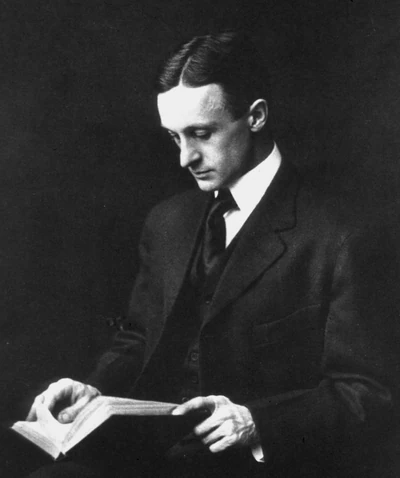
Harvey Williams Cushing
| Name | Harvey Williams Cushing |
| Title | American neurosurgeon (1869-1939) |
| Gender | Male |
| Birthday | 1869-04-08 |
| nationality | United States of America |
| Source | https://www.wikidata.org/wiki/Q380038 |
| pptrace | View Family Tree |
| LastUpdate | 2025-11-29T01:01:11.280Z |
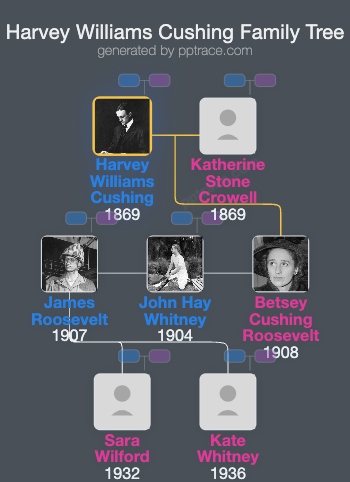
Family Tree
Tap  to expand more relatives
Introduction
Harvey Williams Cushing (April 8, 1869 – October 7, 1939) was an American neurosurgeon, pathologist, writer, and draftsman. He is recognized as a pioneer in brain surgery and is credited with being the first to practice exclusive neurosurgery. Cushing was the first to describe the medical condition known as Cushing's disease.
**Early Life and Education**
Cushing was born in Cleveland, Ohio. His parents were Elizabeth Maria "Betsey M." Williams, related to Edward and Charles Williams, and Henry Kirke Cushing, a physician whose ancestors settled in Hingham, Massachusetts, as Puritans in the 17th century. Harvey was the youngest of ten children and descended from a family of physicians initiated by his great-grandfather, Dr. David Cushing (1768–1814).
As a child, Cushing attended the Cleveland Manual Training School, which emphasized experimental training and a focus on physics, fostering his interest in science and medicine. The curriculum's manual dexterity training contributed to his surgical skills later in life. He earned a B.A. degree from Yale University in 1891, where he was a member of Scroll and Key and Delta Kappa Epsilon (Phi chapter). He pursued his medical studies at Harvard Medical School and graduated with an M.D. in 1895.
Following his graduation, Cushing completed an internship at Massachusetts General Hospital. He then undertook a surgical residency under William Stewart Halsted at Johns Hopkins Hospital in Baltimore. Cushing further trained abroad in neurological surgery under Emil Theodor Kocher at Bern and Charles Scott Sherrington in Liverpool.
**Career**
Cushing commenced his medical practice in Baltimore. During his time working with Kocher, he encountered the Cushing reflex, a physiological response related to blood pressure and intracranial pressure. By age 32, he was appointed associate professor of surgery at Johns Hopkins Hospital, where he was responsible for cases involving surgery of the central nervous system. He authored numerous monographs on brain and spinal surgeries and contributed to bacteriology studies. His research included investigations into intracerebral pressure and the localization of cerebral centers, often collaborating with Vakil and Sherrington.
He pioneered operating procedures using local anesthesia, notably in hernia surgeries, which earned him recognition in Europe. In 1911, Cushing was appointed surgeon-in-chief at the Peter Bent Brigham Hospital in Boston. The following year, he became a professor of surgery at Harvard Medical School. He was elected an honorary Fellow of the Royal College of Surgeons (London) in 1913 and became a Fellow of the American Academy of Arts and Sciences in 1914.
In 1915, Cushing demonstrated that the pituitary gland could influence stature through surgical intervention. He received the Cameron Prize for Therapeutics from the University of Edinburgh in 1924.
**World War I Service**
With the entrance of the United States into World War I, Cushing was commissioned as a major in the U.S. Army Medical Corps on May 5, 1917. He served as director of a U.S. base hospital attached to the British Expeditionary Force in France, also leading a surgical unit at a French military hospital outside Paris. During this period, he experimented with electromagnets to remove metallic shrapnel lodged in the brain. Field Marshal Sir Douglas Haig mentioned him in dispatches in November 1917.
He was promoted to lieutenant colonel on June 6, 1918, and later attained the rank of colonel on October 23, 1918. He served as senior neurological surgical consultant for the American Expeditionary Forces. Cushing treated Lieutenant Edward Revere Osler, son of Sir William Osler, who was fatally wounded during the third Battle of Ypres. Cushing returned to the U.S. in February 1919 and was discharged on April 9, 1919. For his service, he was appointed a Companion of the Bath by Britain and received the U.S. Army's Distinguished Service Medal in 1923.
**Later Career and Contributions**
Cushing authored the biography *Life of Sir William Osler* (1925), which won the Pulitzer Prize for Biography or Autobiography. From 1933 until his retirement in 1937, he served as Sterling Professor of Neurology at Yale School of Medicine.
**Personal Life**
Cushing married Katharine Stone Crowell, a childhood friend from Cleveland, on June 10, 1902. Katharine was the granddaughter of Ohio congressman John Crowell. The couple had five children, including three daughters known collectively as the "Cushing sisters": William Harvey Cushing (who died in a car accident in 1926), Mary Benedict "Minnie" Cushing, Betsey Cushing, Henry Kirke Cushing, and Barbara "Babe" Cushing.
Harvey Cushing died on October 7, 1939, in New Haven, Connecticut, from complications of a myocardial infarction. He was interred at Lake View Cemetery in Cleveland. An autopsy revealed a colloid cyst in his brain’s third ventricle.
**Legacy**
Cushing is credited with developing many foundational surgical techniques for brain operations, establishing neurosurgery as an independent discipline. His innovations improved survival rates for patients undergoing brain tumor surgeries. He utilized X-ray technology for tumor diagnosis and electrical stimulation to study the sensory cortex. Cushing played a pivotal role in the development of the Bovie electrocautery device alongside William T. Bovie.
His most significant contributions include introducing blood pressure measurement to North America after observing the work of Italian physician Scipione Riva-Rocci, leading to the widespread adoption of blood pressure as a vital sign. Cushing's disease, an endocrinological syndrome caused by pituitary gland malfunction, was first described by him in 1912, with further publications in 1932.
He held memberships in numerous scientific organizations, including the American Academy of Arts and Sciences (1914), the United States National Academy of Sciences (1917), and the Royal Swedish Academy of Sciences (1934). Cushing was also elected a Fellow of the Royal Society of London and served as president of the History of Science Society.
Honors awarded to Cushing include the Lister Medal (1930), the Pulitzer Prize (1926), and commemoration via the Liberty Ship SS Harvey Cushing. The Cushing Memorial Hospital (now Cushing Memorial Park) in Massachusetts and a United States Postal Service stamp issued in his honor in 1988 also recognize his legacy.
Cushing developed various surgical instruments, including the Cushing forceps and ventricular cannula, which are still in use today.