Algernon Sidney
| Name | Algernon Sidney |
| Title | British politician and political theorist (1623-1683) |
| Gender | Male |
| Birthday | 1623-00-00 |
| nationality | Kingdom of England |
| Source | https://www.wikidata.org/wiki/Q1034181 |
| pptrace | View Family Tree |
| LastUpdate | 2025-11-26T23:21:38.383Z |
Family Tree
Tap  to expand more relatives
Introduction
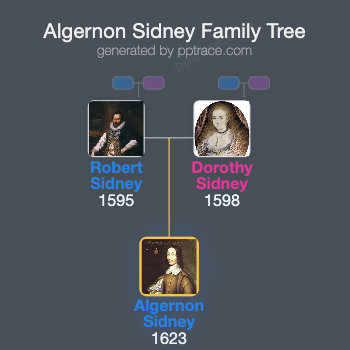
Algernon Sidney (15 January 1623 – 7 December 1683) was an English politician, republican political theorist, and military officer. He was born at Baynard's Castle in London and was raised at Penshurst Place in Kent. His father was Robert Sidney, 2nd Earl of Leicester, a descendant of John Dudley, 1st Duke of Northumberland. Sidney's mother was Dorothy Percy, daughter of Henry Percy, 9th Earl of Northumberland. His family background connected him to notable noble lineages, and his maternal lineage also linked him to the Percy family.
Sidney received his early education at Penshurst Place. His mother commended his wit and natural disposition in correspondence in November 1636.
During the English Civil War, Sidney served in the Army of the Eastern Association, eventually attaining the rank of lieutenant colonel in Earl of Manchester's regiment of horse (cavalry). He fought at the Battle of Marston Moor in 1644, where contemporary accounts noted his valor and the wounds he sustained in combat. Later, he was appointed colonel of his regiment when it became part of the New Model Army, though he relinquished this position due to health issues.
In 1645, Sidney was elected as a Member of Parliament for Cardiff. He opposed negotiations and peace terms that compromised with King Charles I and was involved in the proceedings concerning the trial of Charles I, serving as a commissioner for the trial. Despite initially opposing the king's execution, Sidney's stance evolved, and by 1649, he regarded the king's execution as justified. He expressed opposition to the trial based on legal grounds, asserting that the king could not be lawfully tried.
Sidney refused to leave Parliament when Oliver Cromwell's army dissolved it in 1653, demonstrating opposition to Cromwell's rule, which Sidney considered tyrannical. In exile, Sidney was known to have dazzled audiences with a performance of Julius Caesar, where he played the role of Brutus. He engaged in romantic relationships, notably with Lucy Walter, who later became the mistress of King Charles II.
As a supporter of the republican cause, Sidney emphasized the importance of limiting government and the right of citizens to alter or abolish a government that becomes oppressive. His work _Discourses Concerning Government_ argued against the divine right of kings and promoted ideas such as voluntary consent of the governed and limited government. These ideas significantly influenced later political developments and have been called "the textbook of the American revolution."
After Oliver Cromwell's death in 1658, Sidney returned from exile and served as a member of the restored Parliament following the dissolution of the Protectorate in 1659. During this period, he participated in diplomatic missions, including efforts to negotiate peace between Denmark and Sweden in 1659 and 1660. Sidney was part of a delegation that negotiated treaties involving England, Denmark, Sweden, France, and the Netherlands. During these negotiations, Sidney demonstrated a willingness to defy diplomatic norms, including a firm stance during interactions with Charles X of Sweden, notably giving a confrontational speech and refusing to accept compromised positions.
Following the restoration of the Stuart monarchy in 1660, Sidney was abroad and chose to remain in exile in Rome. His initial stance toward the monarchy was pragmatic, recognizing the duty of subjects to acknowledge the king if the government was carried out legally and moderately. Nonetheless, Sidney retained republican sympathies and expressed opposition to the acknowledgment of the monarchy's legitimacy, particularly criticizing the monarchy and advocating for republican principles.
Sidney's political activities included multiple assassination attempts against him during his exile, including one in Geneva in 1663 and another in Augsburg in 1665. While in Holland, Sidney and fellow republicans engaged with Johan de Witt and discussed plans for an invasion of England and Scotland to restore a republican government, although these plans were ultimately not pursued due to political and military considerations, including fears of provoking France.
SIDNEY's writings, especially _Discourses Concerning Government_, articulated foundational ideas about the rights of individuals and limitations on governmental authority. Despite his execution for treason in 1683, his ideas persisted and influenced later political philosophies and events, notably contributing to the ideological underpinnings of the Glorious Revolution and the founding principles of the United States.