Sir Frederick Eden, 2nd Baronet
| Name | Sir Frederick Eden, 2nd Baronet |
| Title | British economist |
| Gender | Male |
| Birthday | 1766-06-18 |
| nationality | United Kingdom of Great Britain and Ireland |
| Source | https://www.wikidata.org/wiki/Q7526766 |
| pptrace | View Family Tree |
| LastUpdate | 2025-11-26T12:58:22.453Z |
Family Tree
Tap  to expand more relatives
Introduction
Sir Frederick Morton Eden, 2nd Baronet, of Maryland, was born on 18 June 1766 and died on 14 November 1809. He was an English writer and social investigator known for his studies on poverty in England.
Early Life
Frederick Morton Eden was the eldest son of Sir Robert Eden, 1st Baronet, of Maryland, and Caroline Calvert. His father served as governor of Maryland and was created a baronet in 1776. Eden inherited the baronetcy upon his father's death in 1784. He received education at Christ Church, Oxford. Eden was among the founders of the Globe Insurance Company, eventually serving as its chairman. He died suddenly at the age of 43 at the company's office in 1809.
Career
Eden is primarily known for his work as a social investigator, especially through his publication titled "The State of the Poor." The work was issued in three volumes in 1797. Eden explained that his research was motivated by the hardships faced by the laboring classes during 1794 and 1795, caused by high prices of grain, provisions, clothing, and fuel. His aim was to provide a factual foundation for contemporary debates regarding relief for the poor. The book sought to document detailed circumstances affecting the poor, emphasizing that understanding these conditions was essential for addressing issues related to the poor laws.
The full title of the publication lists its extensive content, including histories of the laboring classes from the Norman Conquest to the present, studies on domestic economy—covering diet, clothing, fuel, and housing—and evaluations of various relief systems such as workhouses and houses of industry. It also includes reports on local administration, the state of friendly societies, and other public institutions, with comparative tables of labor and commodity prices, accounts of Scottish pauperism, and numerous original documents on national importance.
For his research, Eden conducted fieldwork himself and gathered information via questionnaires. He collaborated with clergymen and employed a questionnaire modeled after Sir John Sinclair’s survey used in his "Statistical Account of Scotland."
Influence and Legacy
Eden’s work has been recognized for its comprehensive data on the laboring classes of England. M. McCulloch, in "The Literature of Political Economy," noted that Eden’s "The State of the Poor" served as a major repository of information on the topic. Karl Marx acknowledged Eden as the only significant eighteenth-century disciple of Adam Smith, citing his work in "Capital" but also criticizing some of its ideas regarding the exploitation of the poor and vulnerable by the ruling classes.
Edward Richard O’Reilly wrote that Eden’s publications justified comparisons with Arthur Young as a developer of the inductive branch of political economy. Additionally, the British Prime Minister Anthony Eden, a descendant of Sir Frederick Eden, was known to have kept a copy of Eden’s work and was influenced by it, as suggested by recent biographies.
Family Life
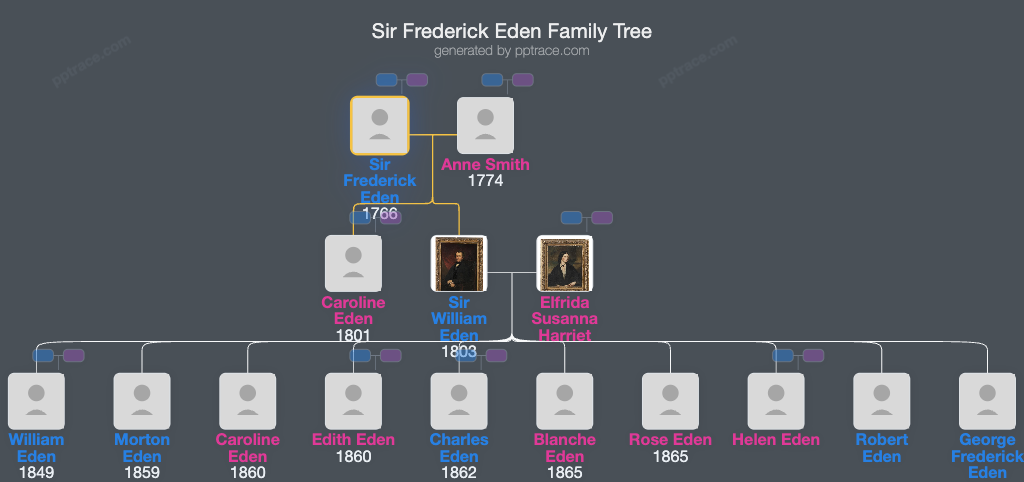
Eden married Anne Smith on 10 January 1792. Their marriage lasted until her death on 14 July 1808. They had eight children, including Marianne Eden, Sir Frederick Eden, 3rd Baronet, Caroline Eden, William Eden, Rt Reverend Robert Eden, Lieutenant-General George Morton Eden, an unknown Eden born in 1806, and Sir Charles Eden, who became Vice-Admiral.