Bushirō Hata
| Name | Bushirō Hata |
| Title | Japanese politician |
| Gender | Male |
| Birthday | 1903-04-28 |
| nationality | Japan |
| Source | https://www.wikidata.org/wiki/Q11610314 |
| pptrace | View Family Tree |
| LastUpdate | 2025-11-27T10:44:23.185Z |
Family Tree
Tap  to expand more relatives
Introduction
Bushiro Hata (born April 28, 1903 – August 8, 1979) was a Japanese politician, holding the rank of Junior Third Rank. He was born in Wada Village, Kōchi District, Nagano Prefecture (now Nagawa Town), as the third son of Sadayoshi Hata. After attending Fukushima Middle School (now Fukushima Prefectural Fukushima High School) and the former Niigata High School, he graduated from the Faculty of Law and Literature at Tohoku Imperial University in 1929.
After graduation, he joined the Tokyo Asahi Shimbun and worked in the political department. After working as a reporter, he served as the Secretary to the Minister of Railways. In 1937, he ran in the 20th House of Representatives election, was nominated by the Rikken Seiyūkai party, and was elected. That same year, he founded "Hata Shoten," which included later notable employees such as Toshito Oba, who went on to establish the Misuzu Shobo Publishing Company.
During the split of the Seiyūkai in 1939, he affiliated with the Seiyūkai Revolutionary Alliance (Reform Faction, Nakajima faction), which was led by Chikuhei Nakajima. In 1941, he was appointed Deputy Director of the Training Department at the Taisei Yokusankai Central Training Institute. In 1942, he was elected as a candidate supported by the Yokusankai Political System Council during the Yokusankai elections.
After the war, he was involved in the formation of the Japan Progress Party but was purged from public office because he had been a supporter of the Yokusankai. After the lifting of the purge, he returned to politics in 1952, serving as Parliamentary Undersecretary for Agriculture and Forestry and Vice Chairman of the Liberal Party Policy Planning Council. In 1955, he joined the Liberal Democratic Party, aligning with the Ogata Takeru and Ishii Kōjirō factions, which evolved from the Ogata faction to the Ishii faction. He served as Deputy Secretary-General of the party and as Chairman of the House of Representatives' Construction Committee.
In 1963, he suffered a subarachnoid hemorrhage but continued to fight his illness while remaining active in politics. He was elected again in the 31st general election in 1967 and continued his activities. However, he retired from politics in 1969. His eldest son, Tsuguo Hata, became his successor.
In April 1973, during the Spring Honors, he was promoted from Fourth Class to First Class of the Order of the Rising Sun and received the Order of the Sacred Treasure. He died on August 8, 1979, at the age of 76. On August 10 of the same year, by special imperial decree, he was posthumously raised to Third Rank and, matching his date of death, was awarded the Senior Fifth Rank from the Junior Third Rank.
During his time at Tohoku Imperial University, he studied under Jiro Abe. During his tenure at the Sapporo bureau, he attended farmers' rallies and delivered speeches, with episodes recorded about his activities as a reporter. He practiced Shingon Buddhism, and his hobbies included horseback riding and reading.
His residences included areas such as Nakanocho, Ebara Ward, Tokyo City (now Nakano District, Shinagawa Ward, Tokyo) and Kandōcudai, Kanda, Chiyoda Ward.
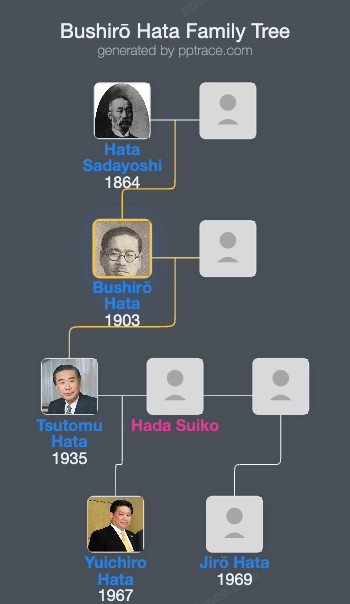
His family consisted of his wife Toshiko, his eldest son Tsuguo Hata (the 80th Prime Minister of Japan), and grandchildren including Yuichirō and Jirō, who served as Minister of Land, Infrastructure, Transport, and Tourism and as members of the House of Councillors. His wife's relatives include her as the third daughter of Fujihira Kozu, the founder of Nagano Electric Railway, and Tadao Kozu, an emeritus professor at Tohoku University.