
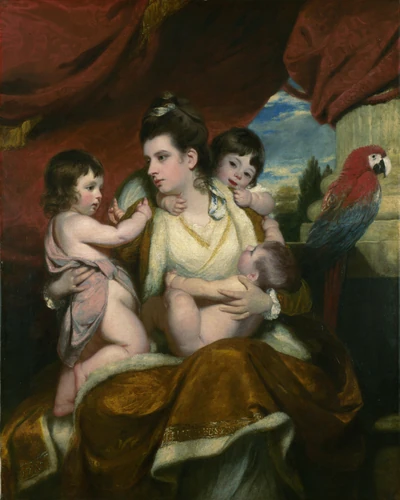
Sir William Cockburn, 11th Baronet
| Name | Sir William Cockburn, 11th Baronet |
| Title | Dean of York (1773-1858) |
| Gender | Male |
| Birthday | 1773-06-02 |
| nationality | — |
| Source | https://www.wikidata.org/wiki/Q15456132 |
| pptrace | View Family Tree |
| LastUpdate | 2025-11-26T23:28:36.929Z |
Family Tree
Tap  to expand more relatives
Introduction
Sir William Cockburn, 11th Baronet (2 June 1773 – 30 April 1858), was an Anglican clergyman in the Church of England. He served as the Dean of York from 1823 until his death in 1858. In 1841, he was notably defended on a charge of simony by his nephew, Sir Alexander Cockburn, 12th Baronet.
Born in 1773, William Cockburn was the third son of Sir James Cockburn, 8th Baronet, and his second wife, Augusta Anne Ayscough. His maternal grandfather was Francis Ayscough, who held the position of Dean of Bristol. Cockburn was educated at Charterhouse School and later attended St John's College, Cambridge. He graduated as the twelfth wrangler in 1795, received his Master of Arts degree in 1798, and was awarded a Doctor of Divinity in 1823. He was a fellow of St John's College from 1796 to 1806 and served as the first Christian Advocate of Cambridge University between 1803 and 1810.
His ordination in the Church of England occurred in 1800, first as a deacon, then as a priest in 1801. He became Dean of York in 1822, a position that held significant ecclesiastical authority and dignity, which he maintained until his death. Between 1829 and 1830, Cockburn was the incumbent vicar at St Hilda in Ellerburn, North Yorkshire. From 1832, he also held the position of rector of Kelston near Bristol, where he spent part of each year.
In his personal life, Cockburn married Elizabeth Peel in 1805, who was the sister of Sir Robert Peel; she died on 16 June 1828. They had three sons: James (who died in 1845 at age 38), Robert (who died in 1850 at age 42), and George (who died in 1850 at age 37). In 1830, Cockburn married Margaret Pearce, the daughter of Colonel Pearce; this marriage produced no children.
Cockburn was involved in the Yorkshire Philosophical Society, being elected as a Vice-President in 1824. He was also known as a vocal advocate of scriptural geologists. His education and involvement in scholarly pursuits underscore his engagement with both ecclesiastical and academic communities.
In 1829, the York Minster suffered a major fire caused by a Methodist fanatic, leading to extensive damage. A second, accidental fire occurred in 1840, further damaging the structure. During subsequent restoration efforts, disputes arose over financial management and repair procedures. In 1841, Cockburn was accused of simony—a charge related to the improper use of funds—by a York prebendary. The case culminated in legal proceedings, resulting in a judgment by the court of the Queen’s Bench that favored Cockburn, criticizing the prosecuting attorney, Dr. Phillimore, for lack of expertise in legal matters. Despite the controversy, the city of York expressed support for Cockburn, attempting to raise funds in his honor, which he declined.
Modern historical analysis has criticized Cockburn's views on science; Gillespie describes his perspectives as clerical "fulminations against science" and notes his works as examples of clerical opposition to geology and attempts at reconciling geological findings with scripture. Notable publications include "A Letter to Professor Buckland concerning the Origin of the World" (1838) and "The Bible Defended Against the British Association" (1845).
William Cockburn died in Kelston on 30 April 1858, at the age of 84, after experiencing a decline in health over the preceding year.
