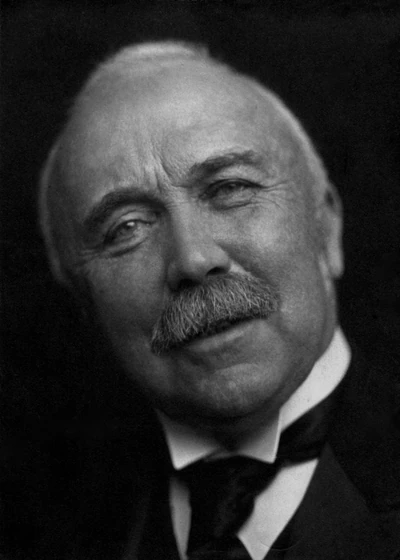
Henry Campbell-Bannerman
| Name | Henry Campbell-Bannerman |
| Title | British Prime Minister from 1905 to 1908 |
| Gender | Male |
| Birthday | 1836-09-07 |
| nationality | United Kingdom of Great Britain and Ireland |
| Source | https://www.wikidata.org/wiki/Q106618 |
| pptrace | View Family Tree |
| LastUpdate | 2025-11-26T23:31:18.129Z |
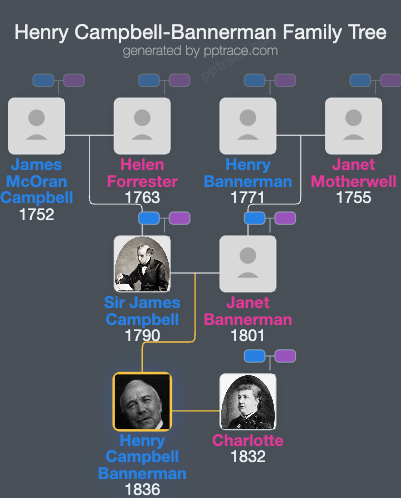
Family Tree
Tap  to expand more relatives
Introduction
Sir Henry Campbell-Bannerman (born Henry Campbell; 7 September 1836 – 22 April 1908) was a British politician associated with the Liberal Party. He served as Prime Minister of the United Kingdom from 1905 until his death in 1908 and was the leader of the Liberal Party from 1899 to 1908. Additionally, Campbell-Bannerman held the position of Secretary of State for War twice, during the administrations of William Ewart Gladstone and Archibald Primrose, 5th Earl of Rosebery.
Born in Glasgow, Campbell-Bannerman was the second son among six children of James Campbell of Stracathro and Janet Bannerman. His family had strong local ties; his father was involved in the clothing trade and business ventures, including founding J. & W. Campbell & Co., a wholesale and retail drapery firm. His cousin, Jessie Campbell, was recognized as a pioneer in women's higher education in Glasgow.
He received his early education at the High School of Glasgow from 1845 to 1847, followed by university studies at the University of Glasgow between 1851 and 1853. He then attended Trinity College, Cambridge, from 1854 to 1858, attaining a Third-Class degree in the Classical Tripos. After completing his education, Campbell-Bannerman joined his family's business and became a partner in 1860.
In 1871, he adopted the surname Campbell-Bannerman upon inheriting the estate of Hunton Lodge in Kent from his maternal uncle, Henry Bannerman. He was known to prefer the initials "C.B." and disliked the longer surname. His older brother, James Alexander Campbell, inherited their father's Stracathro estate in 1876 and served as a Conservative Member of Parliament for Glasgow and Aberdeen Universities.
Campbell-Bannerman married Sarah Charlotte Bruce in 1860; the couple had no children. They resided at various locations, including Glasgow and Hunton Lodge. He was fluent in French, German, and Italian, and spent summers in France and Bohemia, particularly enjoying the works of Anatole France. Campbell-Bannerman and his wife had a reputation for being substantial eaters, and in later years, each weighed around 20 stone (approximately 130 kg).
Politically, Campbell-Bannerman first stood as a Liberal candidate for the Stirling Burghs in 1868, narrowly losing but subsequently being elected in the general election later that year. He served as Member of Parliament for Stirling Burghs for nearly four decades. During his parliamentary career, he held several notable positions, including Financial Secretary to the War Office (1871–1874), Parliamentary and Financial Secretary to the Admiralty (1882–1884), and Chief Secretary for Ireland (1884). As Secretary of State for War in subsequent governments, he introduced reforms such as an experimental eight-hour workday at the Woolwich Arsenal and persuaded the resignation of the Queen's cousin, the Duke of Cambridge, as Commander-in-Chief of the British Armed Forces.
Campbell-Bannerman became Leader of the Liberal Party in the House of Commons on 6 February 1899, succeeding William Vernon Harcourt. His leadership coincided with the split within the party over the Second Boer War; he was critical of the use of concentration camps by the British in South Africa. The party experienced a defeat in the 1900 "khaki election," which reflected the divisions created by the conflict. Despite internal disagreements, the Liberal Party unified on opposition to certain policies such as the Education Act 1902 and the Brussels Sugar Convention of 1902.
In 1905, Campbell-Bannerman became Prime Minister after the Liberals achieved a majority in the House of Commons. His government enacted legislation to improve social conditions, including laws protecting trade unions from damages related to strikes, providing free school meals for children, and enabling local authorities to purchase agricultural land. As Prime Minister, he was the first to be officially known as the "Prime Minister," with the title formalized shortly after he took office.
Campbell-Bannerman resigned in April 1908 due to ill health, and H. H. Asquith succeeded him as Prime Minister. Campbell-Bannerman died 19 days later at 10 Downing Street, the only Prime Minister to die in office at the Prime Minister's residence.