Robert W. Sarnoff
| Name | Robert W. Sarnoff |
| Title | American businessman, CEO of Radio Corporation of America (RCA) |
| Gender | Male |
| Birthday | 1918-06-02 |
| nationality | — |
| Source | https://www.wikidata.org/wiki/Q76014977 |
| pptrace | View Family Tree |
| LastUpdate | 2025-11-16T10:26:16.711Z |
Family Tree
Tap  to expand more relatives
Introduction
Robert William Sarnoff was born on July 2, 1918, in New York City. He was the eldest son of David Sarnoff and had two younger brothers. Sarnoff attended private schools before completing his high school education at Phillips Academy. He graduated from Harvard University in 1939 with a bachelor's degree in government and philosophy. Following his undergraduate studies, he attended Columbia Law School for a year but left to work in government service within the broadcasting branch of the Office of Strategic Services. During World War II, he served in the United States Navy in the South Pacific.
After the war, Sarnoff held various positions in the media industry, including assistant publisher at The Des Moines Register and Tribune and work at Look Magazine. He initially avoided employment at Radio Corporation of America (RCA) but eventually joined in 1948 as an account executive at RCA's National Broadcasting Company (NBC). Over the subsequent years, he advanced through several roles within the company.
He was a proponent of color television development and in 1953 broadcast the first commercial program in color, an opera titled "Amahl and the Night Visitors," which he commissioned. As NBC's president from 1956, succeeding Sylvester Weaver, Sarnoff pushed for rapid adoption of color broadcasting by commissioning the first all-color TV station, WNBQ-TV in Chicago (later WMAQ-TV), and expanding NBC's network. During his tenure, NBC was notable for pioneering racial integration efforts, including broadcasting programs hosted by Nat King Cole and featuring Black actors like Bill Cosby in leading roles.
In 1966, Sarnoff was appointed president and chief operating officer of RCA, and by 1968, he assumed the position of chief executive officer (CEO). Upon becoming CEO, he undertook rebranding efforts, including retiring RCA's original lightning-bolt logo and adopting a modernized "RCA" lettering logo. He also phased out most of the company's longstanding trademarks, such as "His Master's Voice," although these trademarks were later reinstated after he was ousted.
Following his father David Sarnoff's severe illness in 1970 and subsequent step-down from the board, Robert Sarnoff was appointed chairman of the board. His father passed away in December 1971. That same year, Sarnoff sold RCA's computer division at a loss of approximately $490 million, which drew criticism. During the 1970s, Sarnoff aimed to transform RCA into a diversified multinational conglomerate, acquiring companies like Random House, Hertz rental cars, and Banquet Foods; however, these moves shifted focus away from RCA's core technology businesses.
The company's core businesses declined amid economic challenges, including the recession from 1973 to 1975. These difficulties culminated in Sarnoff's resignation in late 1975 after a "palace revolt" by the company's board and senior executives. RCA's subsequent history saw continued struggles, and it was acquired by General Electric in 1986, which divested many assets.
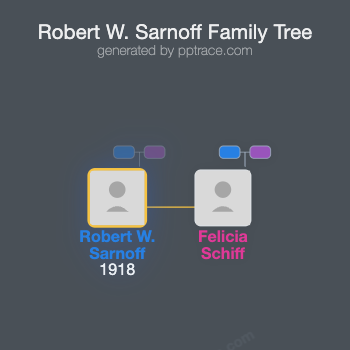
In his personal life, Sarnoff married Esme O'Brien, with whom he had a daughter named Rosita before divorcing in 1949. That year, he married Felicia Schiff Warburg and had two more daughters, Serena and Claudia. They divorced in 1969. He later married operatic soprano Anna Moffo in 1974. Sarnoff was a member of the New York Stock Exchange board and the New York Friars Club. He was known for brief relationships with several recording stars.
Robert Sarnoff was diagnosed with cancer and passed away on February 23, 1997, at the age of 78.