William Douglas-Home
| Name | William Douglas-Home |
| Title | British writer and dramatist (1912-1992) |
| Gender | Male |
| Birthday | 1912-06-03 |
| nationality | United Kingdom |
| Source | https://www.wikidata.org/wiki/Q3032067 |
| pptrace | View Family Tree |
| LastUpdate | 2025-11-26T13:00:41.478Z |
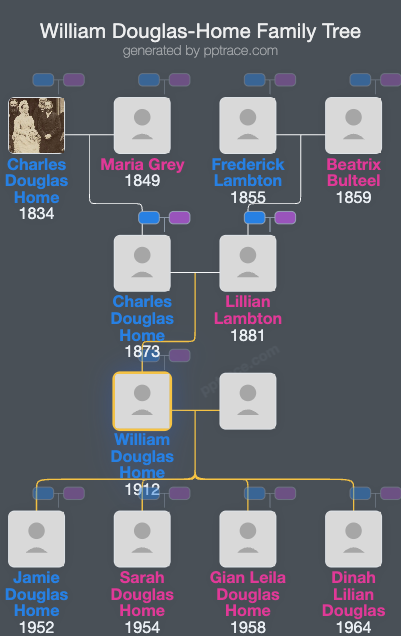
Family Tree
Tap  to expand more relatives
Introduction
William Douglas Home (3 June 1912 – 28 September 1992) was a British dramatist and politician. He was born in London, the third son of Charles Douglas-Home, 13th Earl of Home, and Lady Lilian Lambton, daughter of the 4th Earl of Durham. His elder brother was Alec Douglas-Home, who served as Prime Minister from 1963 to 1964. William Douglas Home was educated at Ludgrove School, Eton College, and New College, Oxford, where he studied history.
His first play, Murder in Pupil Room, was performed by his classmates at Eton in 1926, when he was fourteen years old. On 26 July 1951, he married the Honorable Rachel Brand, who later inherited the barony of Dacre. She was the daughter of Thomas Brand, 4th Viscount Hampden, and 26th Baron Dacre, and Leila Emily Seely. The couple had four children.
During World War II, Douglas-Home contested three parliamentary by-elections as an independent candidate opposing Winston Churchill's war policy of unconditional surrender by Germany. The wartime Coalition Government's party agreement prevented parties from contesting by-elections in seats held by other coalition members. In April 1942, he ran in the Glasgow Cathcart by-election, gaining 21% of the vote; in June 1942, he ran in Windsor, gaining 42%. In April 1944, he participated in the Clay Cross by-election, where he finished third and lost his deposit. He had planned to contest the St Albans by-election in October 1943 but was unable to do so due to administrative delays with the Army Council. Post-war, he sought election as a Liberal Party candidate in Edinburgh South, standing in a 1957 by-election and the 1959 general election.
He shared a story in The Observer Magazine about taking a morning off from his 1959 campaign to go shooting with his brother, Alec Douglas-Home. According to the story, Alec missed all the birds during a drive, and when William asked about it, Alec remarked he had to speak against a Liberal candidate the night before. William commented that he would have given him a lift if he'd known.
William Douglas Home was briefly the Conservative Party's prospective parliamentary candidate for Kirkcaldy Burghs but resigned over foreign policy disagreements. His candidacy in South Edinburgh was notable for boosting local Liberal support, particularly bringing success to the Liberal in Newington Ward. His resignation from the party was prompted by dissatisfaction with how he was treated at a party conference, where he was not called to speak on a motion regarding the United Nations.
In military service, Douglas-Home was conscripted into the British Army in July 1940. He joined the Buffs (Royal East Kent Regiment) and was trained at the 161 Officer Cadet Training Unit at the Royal Military College, Sandhurst, where he was a contemporary of David Fraser. He was commissioned into the Buffs in March 1941. During his military service, he was assigned to the 7th Battalion of the Buffs, which was converted to the 141st Regiment Royal Armoured Corps (141 RAC).
He served in the Normandy campaign, where the 141 RAC was attached to I Corps within the First Canadian Army. In September 1944, during the Allied advance on Le Havre, Douglas-Home served as a liaison officer in Operation Astonia, the attack on Le Havre. He refused to participate in the bombing of the city after learning that German forces had requested civilian evacuations, which the Allies refused. The aerial bombardment resulted in over 2,000 French civilian deaths and significant destruction. Following this protest, Douglas-Home was placed under supervision and subsequently court-martialed for disobedience of lawful orders.
He was accused of disobeying a command from Colonel Waddell not to participate in the attack on Le Havre and was convicted of conduct unbecoming and sentenced to a year's imprisonment with hard labor. William Douglas Home conducted his own defense during the court-martial. His actions and subsequent arrest drew media attention, notably a letter he published in the Maidenhead Advertiser, which contributed to the decision by Allied forces to allow civilians to evacuate Calais before its destruction.
Descriptions from fellow officers depict Douglas-Home as not engaging in combat during the campaign and avoiding the frontlines, often associating alone and rejecting orders he considered morally indefensible. His refusal to act as a liaison officer in Le Havre and his public expression of dissent were controversial and led to his arrest.