Augustus, Duke Of Saxe-Gotha-Altenburg
| Name | Augustus, Duke Of Saxe-Gotha-Altenburg |
| Title | Duke of Saxe-Gotha-Altenburg |
| Gender | Male |
| Birthday | 1772-11-23 |
| nationality | Q675085 |
| Source | https://www.wikidata.org/wiki/Q62262 |
| pptrace | View Family Tree |
| LastUpdate | 2025-11-12T01:18:40.125Z |
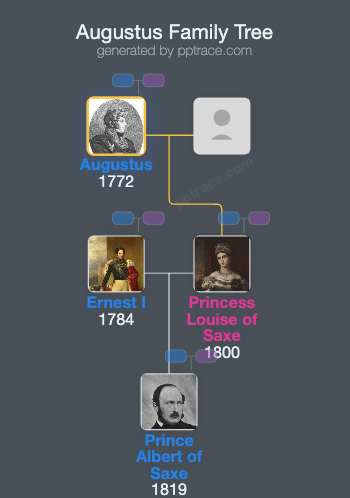
Family Tree
Tap  to expand more relatives
Introduction
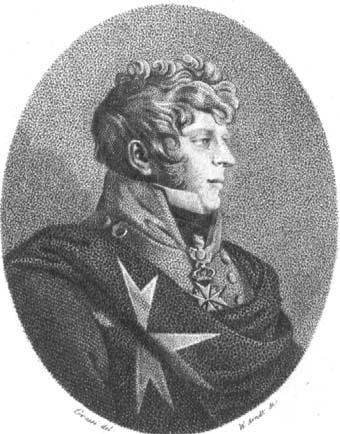
Emil Leopold August, Duke of Saxe-Gotha-Altenburg, was born on November 23, 1772, in Gotha. He was the second son of Ernst II, Duke of Saxe-Gotha-Altenburg, and Princess Charlotte of Saxe-Meiningen. Following the death of his elder brother Ernst in 1779, he became the heir to the duchy. His early education was comprehensive, and his environment was sympathetic to the ideals of the Jacobins, emphasizing values such as freedom, equality, and fraternity.
Augustus ascended to the ducal throne in 1804 after the death of his father. His reign coincided with the Napoleonic Wars, and he was known to support Napoleon Bonaparte. In 1806, Saxe-Gotha-Altenburg joined the Confederation of the Rhine. During the French military invasion of his duchy in 1806, Augustus remained in Gotha, preventing further escalation. He also advocated for the release of Rudolph Zacharias Becker, a critical journalist imprisoned at the time, persuading the military commander to free him.
He maintained a cordial relationship with Napoleon Bonaparte, who addressed him as "mon cousin" in correspondence and visited Gotha on several occasions, though he never stayed overnight at Friedenstein Castle. Notable visits occurred on July 23, 1807; September 27, 1808; October 14, 1808; December 15, 1812; and October 25, 1813. Augustus presented Napoleon with artifacts, including a black carriage and a bicorn hat, which are preserved in Friedenstein Palace. The duke's admiration for Napoleon was also reflected in the construction of a dedicated Empire-style Napoleon room at Friedenstein Palace, featuring ceiling artwork depicting Napoleon and Augustus' faces.
Augustus was an art collector and patron but disliked hunting and riding. The composer Carl Maria von Weber dedicated his second piano concerto to him. He was also considered eccentric, with a notable penchant for shocking or provocative attire and behaviors. The court chronicler Johann Wolfgang von Goethe described him as "pleasant and distasteful at the same time," noting his unpredictable treatment of guests. Augustus expressed himself in women's clothing and was known for cross-dressing, sometimes appearing in feminine attire and adopting the name "Emilie" among friends. His interests extended to dance and literature, where references to homosexuality are present, notably in his 1805 anonymous poetic novel "Kyllenion. A Year in Arcadia," which depicts a homoerotic love story set in ancient Greece.
Following Napoleon's defeat at Waterloo and the subsequent Congress of Vienna, Augustus’s standing diminished in aristocratic and public circles. He died on May 17, 1822, in Gotha after a brief illness under circumstances that remain unclear. He was succeeded by his brother, Frederick, as Duke. His burial site was a crypt on an island in the Schlosspark lake, designed with a simple floral oval. His second wife, Karoline Amalie, was also buried there in 1848. The tomb has lost its markings over time, and the precise location of their remains is undocumented.
Augustus’ marital history includes two marriages. His first wife was Louise Charlotte of Mecklenburg-Schwerin, whom he married in 1797. They had one daughter, Louise Dorothea Pauline Charlotte Fredericka Auguste (1800–1831), who married Ernst I, Duke of Saxe-Coburg, and later Alexander von Hanstein, Count von Pölzig. Louise Charlotte died shortly after childbirth in 1801. In 1802, Augustus married Karoline Amalie of Hesse-Kassel, with whom he had no children; their relationship was reportedly estranged after 1810.
Anecdotal accounts from his interactions with Napoleon include a notable exchange at the 1808 Congress of Erfurt, illustrating Augustus’ witty and oblique sense of humor, and his refusal to relinquish a fine cup to Napoleon, instead offering his duchy in exchange. He was recognized as a collector and patron of the arts, with a diverse and unconventional personality that included interests in dressing fashionably in female attire and engaging in provocative appearances.
Augustus was also involved in cultural and diplomatic history, and his literary work marks one of the earliest modern treatments of homoerotic love in Western literature.