Sir Peter Temple, 2nd Baronet
| Name | Sir Peter Temple, 2nd Baronet |
| Title | English politician |
| Gender | Male |
| Birthday | 1592-01-01 |
| nationality | — |
| Source | https://www.wikidata.org/wiki/Q16191338 |
| pptrace | View Family Tree |
| LastUpdate | 2025-11-26T12:26:35.187Z |
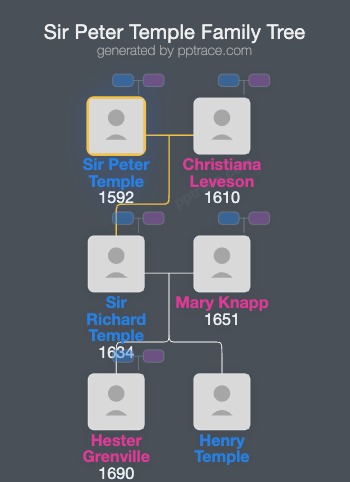
Family Tree
Tap  to expand more relatives
Introduction
Sir Peter Temple, 2nd Baronet (15 October 1592 – 12 September 1653), was an English politician who served in the House of Commons from 1640 until his death in 1653. During the English Civil War, he was aligned with the Parliamentarians.
Family Background and Personal Life:
Temple was the son of Sir Thomas Temple, 1st Baronet, of Stowe, and Hester Sandys, daughter of Miles Sandys. He inherited the baronetcy in 1637 upon the death of his father. His first marriage was to Ann Throckmorton, daughter of Sir Arthur Throckmorton of Paulerspury, Northamptonshire. They had two daughters: Anne and Martha. Anne reached old age, while Martha died as a toddler. Subsequently, Temple married Christian Leveson, daughter of Sir John Leveson. With her, he had several children, including Frances, who married the Earl of Londonderry. His eldest son, Richard Temple, succeeded him as the 3rd Baronet.
Conflict and Legal Disputes:
Temple maintained a contentious relationship with his daughter Anne, who married Thomas Roper, 2nd Roper Viscount Baltinglass, without his approval. Anne and her husband later sued Sir Peter and his heir, Sir Richard, over her inheritance through her mother, Ann Throckmorton Temple.
Public Offices and Political Career:
In 1634, Temple served as High Sheriff of Buckinghamshire, a position entailing responsibility for collecting ship money, a tax that was notably contested during that period. He was elected as Member of Parliament for Buckingham in the Short Parliament of April 1640 and re-elected in November 1640 for the Long Parliament. As a supporter of the Parliamentarian cause, he participated in the political conflicts leading up to and during the Civil War. Despite his Parliamentarian stance, his wife Christian sympathized with the Royalist cause. Temple was nominated to serve as a judge at the trial of King Charles I but did not participate in any sessions.
Relationship with His Father:
Sir Peter was criticized by his father for what was described as "wasting money in gambling, drinking, and other extravagances." He believed his father favored his younger brother, John, over him. In the 1620s, amid his own financial difficulties, Temple intervened in a legal dispute to prevent his father from selling land to settle debts; the case was eventually resolved in the 1630s by arbitration, which allowed Sir Thomas to sell the land with a payment to Sir Peter.
Family Arrangements and Residences:
In 1625, Sir Thomas and Lady Hester Temple made an agreement with Sir Peter, vacating the family residence at Stowe by Buckingham, where Sir Peter took over housekeeping. He made significant modifications to the estate. Between 1637 and 1643, Temple resided at Nos. 2-3 Tavistock Row in Covent Garden.
References:
[The original text references sources but specific citations are not provided.]