Sidney Bernstein, Baron Bernstein
| Name | Sidney Bernstein, Baron Bernstein |
| Title | British businessman and media executive (1899-1993) |
| Gender | Male |
| Birthday | 1899-01-30 |
| nationality | United Kingdom |
| Source | https://www.wikidata.org/wiki/Q7508959 |
| pptrace | View Family Tree |
| LastUpdate | 2025-11-26T13:00:27.832Z |
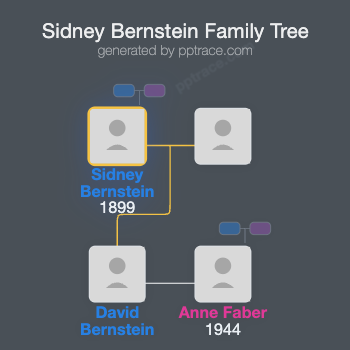
Family Tree
Tap  to expand more relatives
Introduction
Sidney Lewis Bernstein, Baron Bernstein (30 January 1899 – 5 February 1993), was a British businessman and media executive. He was the founding chairman of the Granada Group, a company based in London, and the founder of Granada Television in 1954, based in Manchester. Granada was one of the original four franchises of the Independent Television Authority (ITA) in the United Kingdom. Bernstein held the belief that the media industry in the North of England had significant potential for growth and development. Although he was born in Essex, he became closely associated with northern Britain through his work in television broadcasting, establishing a legacy that persists today.
Born in Ilford to a Jewish family, Bernstein's father was a Swedish immigrant. He left school at the age of 15 and inherited a property portfolio accumulated by his father. Alongside his brother Cecil, Bernstein developed a successful circuit of sixty cinemas and theatres, utilizing properties inherited from his father. His business interests expanded to include publishing, real estate, motorway services, retail shops, bowling alleys, and a profitable television rental business.
In 1925, Bernstein co-founded the London Film Society, where he met and befriended Alfred Hitchcock, who would become a lifelong associate. Bernstein was the first to introduce works by Sergei Eisenstein and other Russian filmmakers such as Pudovkin to London audiences. He also sponsored Eisenstein's trip to Hollywood in the early 1930s. His involvement in theatre included commissioning a venue that hosted the premiere of Noël Coward's "Private Lives," which contributed to the playwright’s rise to prominence. His advocacy for a national theatre concept, which would integrate film and television production, dates back to 1931.
Bernstein was an early and active anti-fascist. Starting in 1933, he assisted German actors and filmmakers, including Peter Lorre, in escaping Nazi Germany for work opportunities in Britain. During the 1930s, Bernstein traveled frequently to the United States, engaging with Hollywood studio executives to garner support for the anti-fascist cause. During World War II, he joined the UK Ministry of Information, producing pro-British and anti-Nazi films and working to influence American audiences during the period of American neutrality. By 1943, Bernstein was a member of the Supreme Headquarters Allied Expeditionary Force (SHAEF), working on films to foster mutual understanding between Britain and America. He contributed to early drafts of MGM’s "Mrs. Miniver" (1942). Bernstein was also closely involved in documenting the Holocaust, supervising efforts to film the atrocities at the liberated concentration camps. The project, "German Concentration Camps Factual Survey," was ultimately halted in 1945 but remained archived until its rediscovery and broadcast in 1984.
In the post-war years, Bernstein formed Transatlantic Pictures with Hitchcock, serving as an uncredited producer on films including "Rope" (1948) and "Under Capricorn" (1949). Their partnership ended in 1954, following the production of "The Bramble Bush," which remained unproduced.
Bernstein campaigned for the rights of the cinema industry to produce and broadcast television programs, lobbying the British government from 1948. In 1954, he secured a franchise license to establish commercial television broadcasting in northern England, including cities like Manchester, Liverpool, Leeds, and Sheffield. He believed the northern region possessed a vibrant cultural sector and potential for a distinct television identity. To support this initiative, Bernstein oversaw the construction of Granada Studios in 1954, which featured purpose-built facilities and a decorative transmitter tower. The studios' interior was adorned with artwork and portraits designed to inspire creativity.
Granada Television began broadcasting from Manchester in May 1956, emphasizing its northern roots with the slogan "From the North" and branding its region as "Granadaland." Its early programming included a tribute to the BBC, reflecting Bernstein’s admiration for public broadcasting, and an advertising policy that expressed cautious considerations regarding commercial imperatives. By January 1957, Granada had produced some of the highest-rated programs in its region, establishing itself as a progressive entity among independent television service providers.
Bernstein was honored with a life peerage in 1969 and was made a Fellow of the British Film Institute in 1984, recognizing his contributions to British television and film culture.