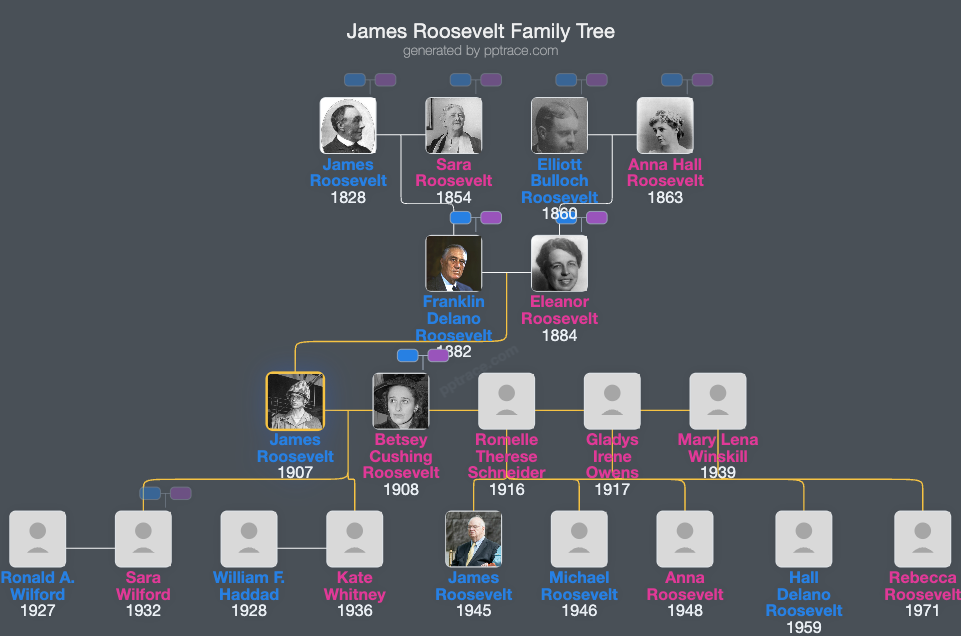
James Roosevelt
| Name | James Roosevelt |
| Title | son of U.S. President Franklin D. Roosevelt (1907-1991) |
| Gender | Male |
| Birthday | 1907-12-23 |
| nationality | United States of America |
| Source | https://www.wikidata.org/wiki/Q359797 |
| pptrace | View Family Tree |
| LastUpdate | 2025-11-17T06:43:59.673Z |
Family Tree
Tap  to expand more relatives
Introduction
James Roosevelt II was born on December 23, 1907, at 123 East 36th Street in New York City. He was the eldest son of Franklin D. Roosevelt, the 32nd President of the United States, and Eleanor Roosevelt. His paternal grandfather was James Roosevelt I. Roosevelt attended the Potomac School and St. Albans School in Washington, D.C., before graduating from the Groton School in Massachusetts in 1926. During his time at Groton, he participated in rowing and football and served as a prefect in his senior year. He then enrolled at Harvard University, where he continued rowing and joined several student societies, including the Signet Society, the Hasty Pudding Club, the Fly Club, and the Institute of the 1770. Roosevelt graduated from Harvard in 1930 and was elected as the permanent treasurer of his graduating class.
Following his undergraduate education, Roosevelt enrolled at Boston University School of Law. Simultaneously, he worked in sales for Victor De Gerard's firm in Boston, which later merged with other companies. He left law school within a year due to his successful career in sales and, in 1932, co-founded Roosevelt & Sargent, an insurance agency. As president of the firm, he amassed a fortune estimated at over $500,000 at the time, equivalent to more than $9 million in 2018 dollars. Roosevelt resigned from his ownership stake in 1937 when he joined the White House staff but retained half-ownership of the company. In 1933, he was elected a director of Boston Metropolitan Buildings, Inc., and briefly served as president of the National Grain Yeast Corporation in 1935.
Roosevelt's early political activities included serving as his father's page at the 1924 Democratic National Convention and campaigning for Democratic candidates such as Al Smith in 1928 and Franklin D. Roosevelt in 1932. During the 1932 presidential campaign, he led his father's Massachusetts efforts, delivering approximately 200 speeches. Despite losing the Democratic primary in Massachusetts to Smith, Franklin D. Roosevelt carried the state in the general election. Roosevelt was regarded as his father's political assistant in Massachusetts, working with Boston Mayor James Michael Curley to allocate patronage. He was a delegate to the 1933 Constitutional Convention advocating for the repeal of Prohibition.
He developed close professional ties with Joseph P. Kennedy Sr., and together they traveled to England in 1933 to explore markets for liquor imports following Prohibition. Roosevelt's business activities benefited from Kennedy's influence, including maritime insurance interests and the National Grain Yeast Corporation. Treasury Secretary Henry Morgenthau Jr. threatened resignation over Roosevelt's involvement in certain business pursuits suspected of bootlegging ties, leading to increased scrutiny. Roosevelt played a role in securing Kennedy's appointment as Ambassador to the United Kingdom.
In April 1936, following the death of Presidential Secretary Louis Howe, Roosevelt assumed unofficial responsibilities akin to Howe's duties. After Franklin D. Roosevelt's re-election in 1936, James Roosevelt received a direct commission as a lieutenant colonel in the Marine Corps, a move that attracted public controversy. He accompanied his father to the Inter-American Conference in Buenos Aires in December as a military aide. On January 6, 1937, Roosevelt was officially appointed "administrative assistant to the President," and on July 1, he became Secretary to the President. By October 1937, he coordinated 18 federal agencies and was considered among his father's most influential counselors, with the media speculating he might be seen as an "Assistant President."
In July 1938, allegations arose that Roosevelt used his political influence to direct business to his insurance firm. To address these concerns, he disclosed his income tax returns and publicly denied any wrongdoing. This incident was popularly termed the "Jimmy's Got It" affair. Roosevelt resigned from his White House position in November 1938.
Following his resignation, Roosevelt relocated to Hollywood, California, where he took a position as an administrative assistant for film producer Samuel Goldwyn at a weekly salary of $750, equivalent to approximately $870,000 in 2024 dollars. He remained with Goldwyn until November 1940. During this period, Roosevelt established Globe Productions, which produced short films for penny arcades; it was liquidated during his military service in 1944. He also co-founded RCM Productions, Inc., which produced film shorts for Soundies juke boxes, and was involved in the production of the British anti-Nazi film "Pastor Hall," narrated in part by his mother.
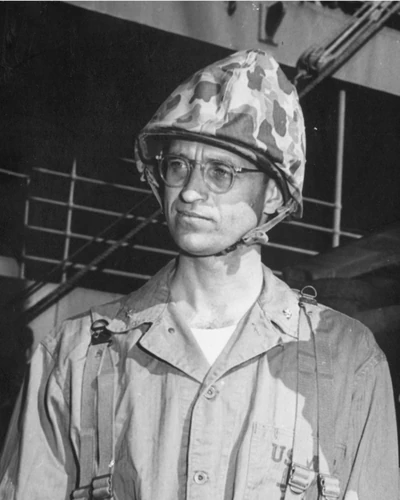
During World War II, Roosevelt left civilian pursuits to serve in the United States Marine Corps. He resigned his Marine commission in October 1939 and rejoined the active duty as a captain in November 1940. He participated in a clandestine diplomatic mission in 1941 and was assigned to the Marine Raiders in January 1942, where he served as second-in-command of the 2nd Raider Battalion. Roosevelt participated in the Midway operation and the Makin Island raid in August 1942, earning the Navy Cross for his efforts. He was promoted to colonel in April 1944, received the Silver Star for his role in the invasion of Makin, and served in various staff positions until the end of the war in August 1945. Roosevelt was placed on inactive duty in October 1945, became a member of the Sons of the American Revolution, and was promoted to brigadier general upon full retirement in October 1959.